
 Dr. Vaishali Suri (P.T.)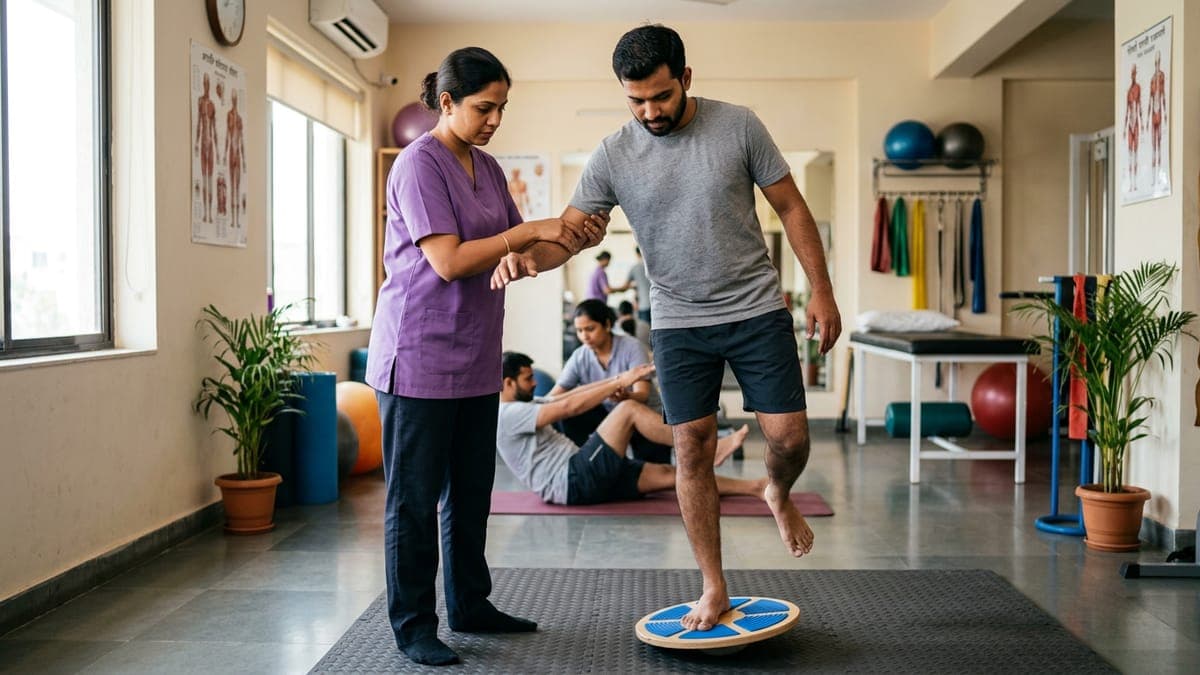
Chronic Ankle Instability: Physiotherapy Treatment in Faridabad
Without targeted physiotherapy, each subsequent sprain adds further damage, progressively increasing the risk of ankle osteoarthritis.
At Realign Rehab Clinic , NIT-5, Faridabad, our expert physiotherapists provide personalised, evidence-based care. We serve patients from NIT, Green Field Colony, Ballabhgarh, Sector 21–82, and across Faridabad.
Book: +91 9818185589 .
Causes and Risk Factors
- Incomplete rehabilitation after initial ankle sprain — returning to sport too soon
- Persistent laxity of the anterior talofibular ligament (ATFL) and calcaneofibular ligament (CFL)
- Neuromuscular deficits: reduced peroneal reaction time and proprioception
- Recurrent sprains creating a cycle of cumulative ligament damage
- Ankle hypermobility from generalised joint laxity
- Previous ankle fracture with incomplete rehabilitation
Signs and Symptoms
- Recurrent ankle sprains with increasingly minor mechanisms
- Sensation of ankle 'giving way' during activity or even daily walking
- Persistent ankle swelling and stiffness
- Reduced confidence and performance in sport
- Ankle pain at end-range inversion and during activity
- Tenderness over the ATFL and lateral ankle ligaments
Physiotherapy Treatment at Realign Rehab, Faridabad
- Proprioception and balance retraining: single-leg balance progressions, BOSU, wobble board
- Peroneal muscle strengthening: eversion resistance exercises with progressive loading
- Ankle joint mobilisation to address any talocrural stiffness
- Functional movement retraining: hop, land, and cut patterns
- Taping and bracing guidance for return to sport
- Gait and running mechanics assessment — identifying and correcting compensatory patterns
- Sport-specific return-to-play programme with criteria-based progression
- Patient education on recurrence prevention and footwear
Frequently Asked Questions
What is chronic ankle instability?
Chronic ankle instability is when the ankle repeatedly gives way or sprains, usually on the lateral (outer) side, due to persistent ligament laxity and neuromuscular deficits from inadequate rehabilitation after previous sprains.
Can physiotherapy fix a loose ankle?
While ligament laxity may persist structurally, neuromuscular rehabilitation overcomes this in most cases.
Do I need ankle surgery for chronic instability?
Surgery (Brostrom ligament repair) is only considered after 6 months of failed complete physiotherapy. The majority of patients achieve functional stability with appropriately structured physiotherapy.
How long does it take to fix chronic ankle instability?
A structured physiotherapy programme for CAI typically runs 8–12 weeks. Return to full sport is usually achieved at 8–10 weeks, with ongoing maintenance exercises to prevent recurrence.
What exercises help chronic ankle instability?
Single-leg balance progressions, peroneal eversion resistance exercises, proprioception retraining (wobble board), and sport-specific agility drills are the cornerstone exercises. These should be prescribed and progressed by a physiotherapist.
Book Your Consultation
Start your recovery today — contact Realign Rehab Clinic:
- 📍 NIT-5, Faridabad (near Green Field Colony, Ballabhgarh Road)
- 📞 +91 9818185589
- 🕑 Mon–Sat: 8 AM–8 PM