 Dr. Vaishali Suri (P.T.)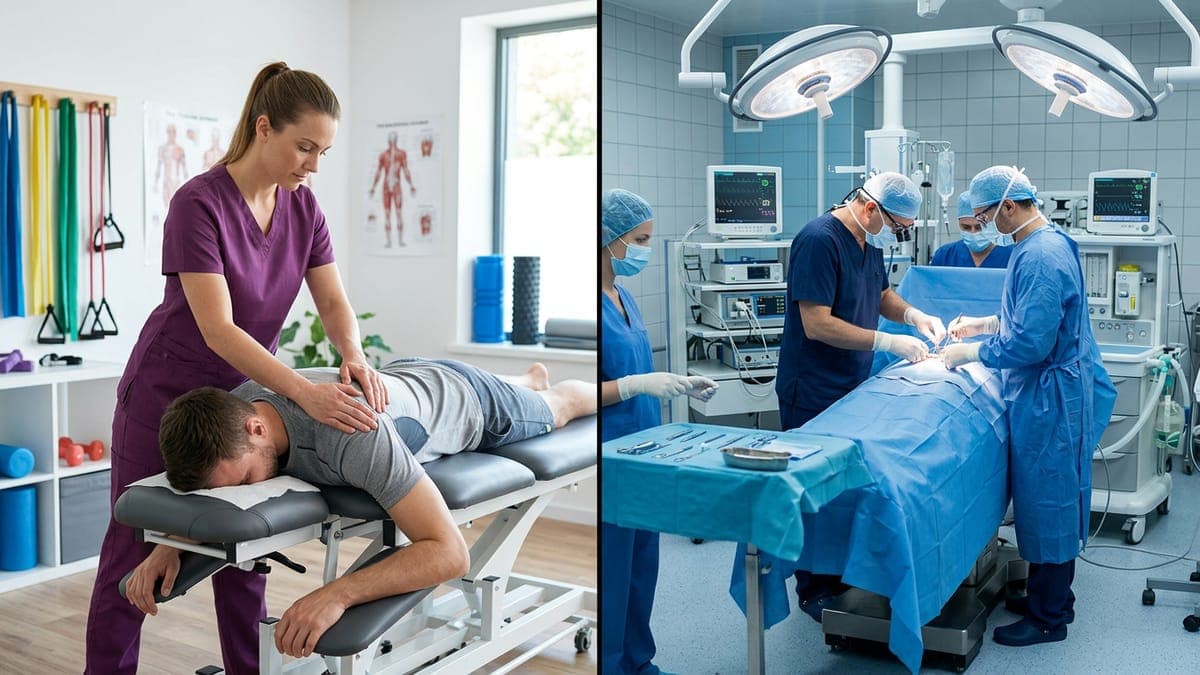
The Surgery Question
When a doctor recommends surgery, many patients wonder: is this truly necessary, or can physiotherapy achieve the same result? The answer is condition-specific and evidence-based.
Physiotherapy vs Surgery: Side-by-Side
| Factor | Physiotherapy | Surgery |
|---|---|---|
| Recovery time | 4–12 weeks | 3–12 months |
| Risk of complications | Minimal | Infection, DVT, anaesthesia |
| Cost | Lower | Noticeably higher |
| Long-term outcomes | Equivalent for most conditions | Good, with higher initial risk |
| Work disruption | Minimal | 2–6 weeks off work typical |
Conditions Where Physiotherapy Can Replace Surgery
- Meniscus tears: Research shows that physiotherapy achieves equivalent outcomes to arthroscopic surgery for degenerative meniscus tears in patients over 35.
- Rotator cuff tears: Partial tears and many full-thickness tears respond well to physiotherapy programmes.
- ACL tears: Certain patients, particularly non-pivoting sport athletes, achieve excellent function without reconstruction through targeted rehabilitation.
- carpal tunnel syndrome syndrome: Mild-to-moderate CTS frequently responds to physiotherapy, avoiding endoscopic release surgery.
When Surgery Is Necessary
Complete ligament ruptures, severe spinal cord compression, fractures requiring fixation, and advanced OA with bone-on-bone contact typically require surgery. Physiotherapy follows surgery in these cases.
Making an Informed Decision
Always get a physiotherapy assessment before committing to elective surgery. Our Faridabad clinic provides honest, evidence-based assessments to help you make the right decision for your specific situation.
Sources & References
- Katz JN et al. (2013). Surgery versus physical therapy for a meniscal tear and osteoarthritis. NEJM, 368(18):1675–1684.
- Weinstein JN et al. (2006). Surgical vs nonoperative treatment for lumbar disk herniation: SPORT trial. JAMA, 296(20):2441–2450.
- Kuhn JE et al. (2013). Exercise in the treatment of rotator cuff impingement. JBJS, 95(15):1381–1390.
Content author: Dr. Vaishali Suri (P.T.), MPT (Sports Medicine), BPT, MIAP, MIAP.
Why Evidence-Based Physiotherapy Makes the Difference
At Realign Rehab Clinic , NIT-5, Faridabad, every treatment plan is grounded in current clinical evidence and suited to the individual patient. We do not follow generic protocols — we identify the root cause of your specific presentation and design a programme that directly addresses it.
This approach consistently produces faster recovery, more durable results, and lower recurrence rates than passive or symptom-only management.
Frequently Asked Questions About This Condition
How soon will I see results from physiotherapy?
Most patients notice measurable improvement within 3–4 sessions. Real functional progress typically occurs within 4–8 weeks.
The speed of recovery depends on the severity and chronicity of your condition, your compliance with the home exercise programme, and the accuracy of the diagnosis.
Do I need a referral to see a physiotherapist in Faridabad?
No referral is needed to see a physiotherapist at Realign Rehab Clinic. You can self-refer directly by calling +91 9818185589 .
We will assess your condition and determine if any imaging or specialist referral is required.
What should I do between physiotherapy sessions?
Your physiotherapist will provide a specific home exercise programme to perform between sessions. Consistency with these exercises is the single most important factor in your recovery speed.
Activity modification advice (what to avoid) is equally important and will be explained at each session.
Can I return to work and sport while receiving physiotherapy?
In most cases, yes — with appropriate modifications. Our physiotherapist will provide clear, specific activity guidelines based on your condition and progress.
Returning to work and sport earlier (with modifications) usually produces better outcomes than prolonged rest.
Contact Realign Rehab Clinic, Faridabad
Ready to start your recovery? Realign Rehab Clinic offers complete physiotherapy at NIT-5, Faridabad, and home visits across all sectors of Faridabad including Green Field Colony, Ballabhgarh, and Sector 21–82.
- 📍 NIT-5, Faridabad (near Green Field Colony, Ballabhgarh Road)
- 📞 +91 9818185589
- 🕑 Mon–Sat: 8 AM–8 PM
Related Articles: Spinal Surgery Rehabilitation in Faridabad: Recovery After Back Surgery | Pre-Surgery Physiotherapy (Prehabilitation) in Faridabad: Better Outcomes | Prehabilitation: Why Physiotherapy Before Surgery Matters in Faridabad | Knee Pain Treatment Without Surgery: Proven Physiotherapy Solutions
Related Conditions: Post-Surgery Rehab | Wrist Pain Treatment | Women's Health Physio
Related Services: Wrist & Hand Therapy | Taping & Bracing