 Dr. Vaishali Suri (P.T.)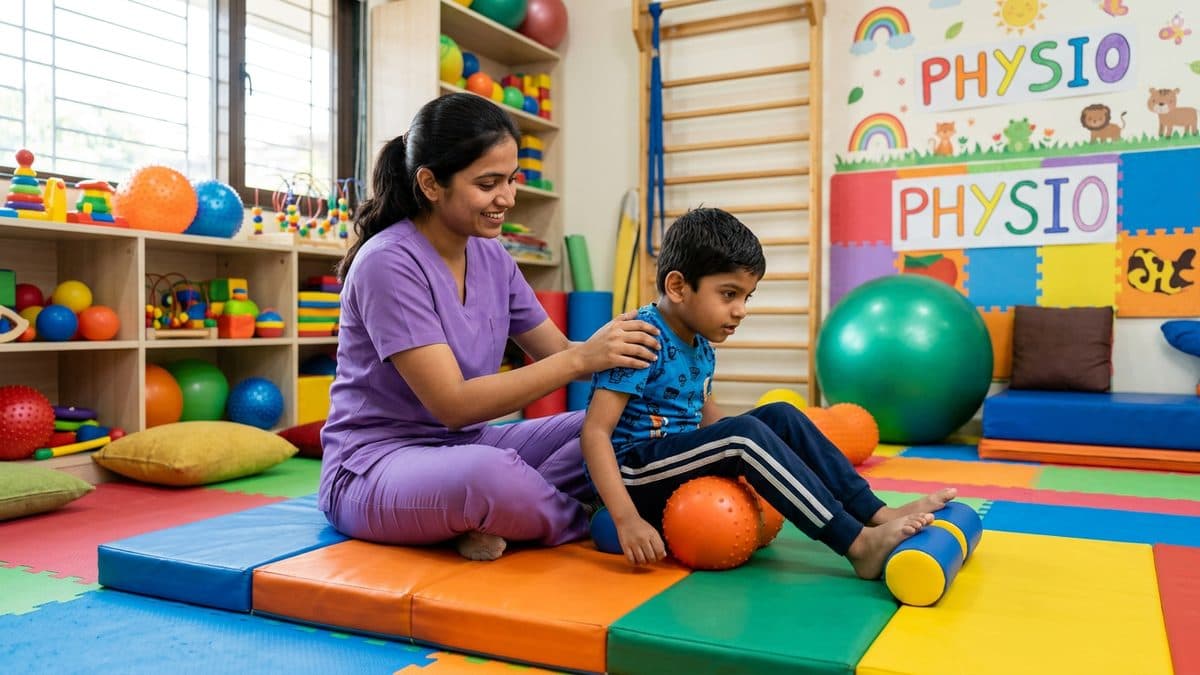
Cerebral Palsy: Early Intervention Changes Outcomes
Cerebral palsy (CP) is a group of permanent movement disorders caused by brain injury occurring before, during, or shortly after birth. It is the most common physical disability in children, affecting approximately 2–3 per 1,000 live births.
While CP is non-progressive (the brain injury does not worsen), the musculoskeletal consequences — contractures, bony deformities, scoliosis — progress without appropriate management.
Types of Cerebral Palsy
Dyskinetic CP: Involuntary, uncontrolled movements. Ataxic CP: Balance and coordination problems.
Mixed CP: Features of more than one type.
Physiotherapy Goals Across the Lifespan
Infants and Toddlers (0–3 years)
Early intervention exploits maximum neuroplasticity. Goals: aid normal movement patterns, prevent abnormal compensations, achieve motor milestones (rolling, sitting, standing, walking where possible), parent education and home programme.
School-Age Children (3–18 years)
Focus on: maintaining and improving walking ability (where present), preventing contractures (stretching, splinting, serial casting), strength training, participation in school and recreational activities.
Adults
Maintaining mobility and function as the body ages with CP (early fatigue, increasing spasticity, joint pain). Falls prevention. Maintaining independence in daily activities.
Evidence-Based Approaches
Constraint-induced movement therapy (CIMT) for hemiplegia. Treadmill training and robotic-assisted gait training for walking improvement.
Strength training — traditionally avoided, now strongly evidence-supported. Goal-directed training focusing on activities meaningful to the child.
CP Physiotherapy in Faridabad
At Realign Rehab Clinic, NIT-5, Faridabad, we provide specialised paediatric and adult CP physiotherapy. Book your consultation today.
Types of Cerebral Palsy and Their Physiotherapy Implications
- Dyskinetic CP: Involuntary, uncontrolled movements (athetosis). Physiotherapy addresses postural control, stability, and functional movement training.
- Ataxic CP: Poor coordination and balance. Balance training and fine motor coordination are primary goals.
- Mixed CP: Combination of types — most common is spastic-dyskinetic mixed.
GMFCS (Gross Motor Function Classification System) Levels I–V guide physiotherapy goal setting — children at GMFCS I–III have highest potential for functional independence with intensive physiotherapy.
CP Physiotherapy Programme at Realign Clinic Faridabad
Neurodevelopmental Treatment (NDT/Bobath)
Bobath therapy focuses on normalising abnormal movement patterns and facilitating typical movement through specific handling techniques. Widely used in India for CP rehabilitation — targeting postural control, movement transitions, and functional tasks.
Integrated into family participation through caregiver education.
Goal-Directed Therapy
Setting meaningful functional goals with the child and family (feeding, dressing, walking, communication) and directing therapy toward achieving these goals. Evidence shows goal-directed therapy produces better activity and participation outcomes than impairment-focused therapy alone.
Strength Training and Functional Exercise
Progressive resistance training is safe and effective for children with CP — particularly for GMFCS I–III. Functional exercise (step-ups, sit-to-stand practice, playground activities) builds strength in meaningful contexts.
Spasticity Management
Stretching programmes, serial casting, and positioning to manage spasticity and prevent contracture. Coordination with orthopaedic surgeons for botulinum toxin injections where indicated — physiotherapy is essential before and after BTX to maximise outcomes.
Frequently Asked Questions — Cerebral Palsy
Q: When should a child with CP start physiotherapy?
As early as possible — ideally from the time of diagnosis or high-risk identification. Early intervention (0–3 years) exploits peak neuroplasticity.
There is no minimum age for physiotherapy. In neonatal intensive care, physiotherapy begins in the first weeks of life for high-risk infants.
Q: Can a child with cerebral palsy learn to walk?
GMFCS Levels I and II children typically achieve independent walking. Level III children walk with assistive devices.
Levels IV and V children have limited walking potential but benefit from physiotherapy for transfers, positioning, and function. Early intensive physiotherapy maximises the likelihood of walking for borderline children (GMFCS II–III).
Q: Does Realign Clinic provide home physiotherapy for CP children in Faridabad?
Home physiotherapy visits for CP children across Faridabad provide the additional benefit of practising functional tasks in the child's own environment. And allow parents to participate in sessions and learn carryover techniques.
Call +91 9818185589 to arrange an assessment.
Book CP Physiotherapy in Faridabad
Call +91 9818185589. Realign Rehab Clinic, NIT-5, Faridabad. Also see: cerebral palsy conditions page, paediatric physiotherapy services.
References
- Novak I et al. (2020). State of the evidence traffic lights 2019: systematic review of interventions for preventing and treating children with cerebral palsy. Current Neurology and Neuroscience Reports, 20(2):3.
Content author: Dr. Vaishali Suri (P.T.), MPT (Sports Medicine), BPT, MIAP, MIAP.
Related Articles: Yoga Injury Treatment in Faridabad: Physiotherapy for Yoga-Related Pain | Wrist Tendinopathy: Physiotherapy Treatment in Faridabad | Wrist Fracture Rehabilitation in Faridabad: Recovery After Colles Fracture | Workplace Ergonomics and Physiotherapy in Faridabad for Office Workers
Related Conditions: Cerebral Palsy (CP) Child Therapy | Wrist Pain Treatment | Urinary Incontinence Treatment
Related Services: Wrist & Hand Therapy | Taping & Bracing