
 Dr. Vaishali Suri (P.T.)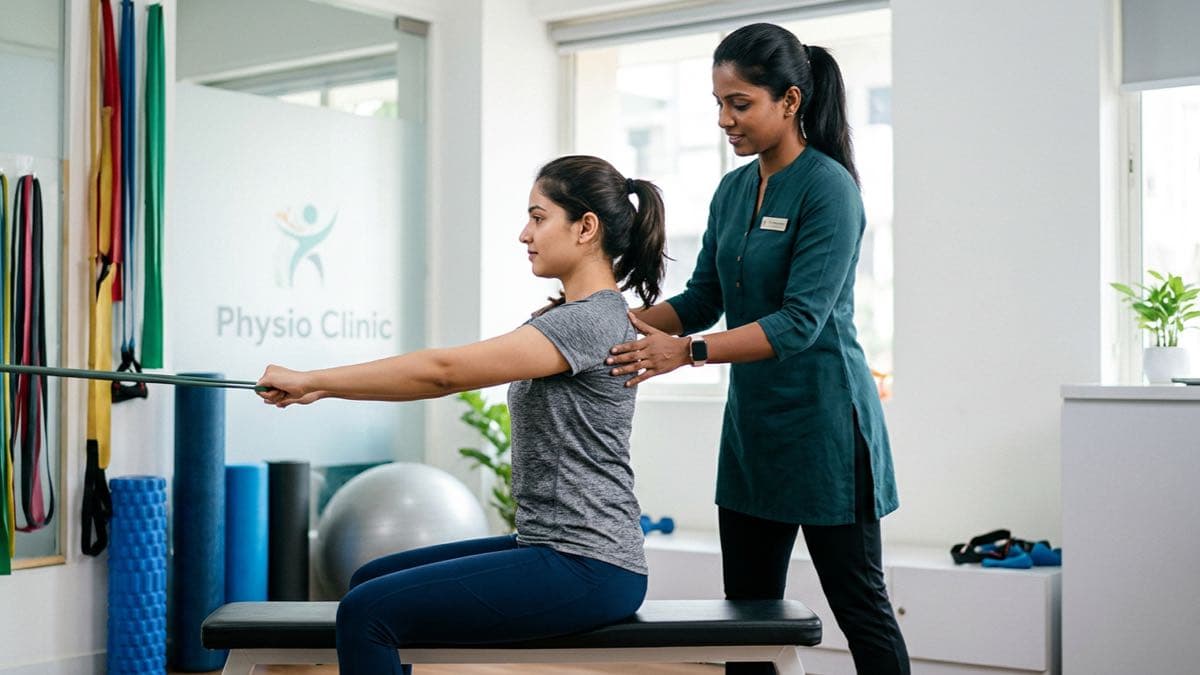
What Are Rounded Shoulders?
Rounded shoulders describe a resting shoulder position, not a diagnosis by itself. Shoulder-blade position can vary normally. Assessment matters when posture is accompanied by pain, weakness or restricted movement.
This is one of the most common postural abnormalities seen in modern populations, driven by prolonged sitting, desk work, and screen use.
A mirror can help you notice your posture, but it cannot diagnose the cause of pain or determine whether treatment is needed.
What Causes Rounded Shoulders?
Rounded shoulders develop from a predictable pattern of muscle imbalance known as upper crossed syndrome, first described by physiotherapist Vladimir Janda:
- Tight and overactive muscles: Pectoralis major, pectoralis minor, anterior deltoid, upper trapezius, levator scapulae, subscapularis
- Weak and inhibited muscles: Lower trapezius, middle trapezius, rhomboids, serratus anterior, deep cervical flexors
This imbalance develops gradually from sustained postures that hold the arms in front of the body: typing, driving, using a phone, cooking, and many sports including swimming, cycling, and cricket.
Health Consequences of Rounded Shoulders
Rounded shoulders are not merely a cosmetic concern. Left unaddressed, they cause:
- Neck and upper back pain treatment: The forward shoulder position increases strain on cervical and upper thoracic muscles.
- Shoulder impingement: The subacromial space narrows when the shoulder is in internal rotation, pinching the rotator cuff treatment and bursa — causing pain with arm elevation.
- Rotator cuff tendinopathy: Chronic impingement leads to rotator cuff degeneration and, eventually, rotator cuff tears.
- Headaches: Tension in the upper trapezius and suboccipital muscles causes tension-type headaches.
- Thoracic outlet syndrome: Compression of nerves and blood vessels causes arm tingling and weakness.
8 Physiotherapy Exercises to Fix Rounded Shoulders
These exercises target the specific muscles that are weak or tight in rounded shoulder posture. Perform them daily for lasting results.
Your physiotherapist at Realign Rehab Clinic will customize the program for your specific imbalance pattern.
1. Doorway Pectoral Stretch
Stand in a doorway, forearms on the frame at 90 degrees. Step through gently until you feel a stretch across the chest.
Hold 30-60 seconds, 3 sets. This releases the tight pectoral muscles that are the primary driver of shoulder rounding.
2. Prone Y-T-W (Prone Scapular Exercise)
Lie face down. Raise arms into Y shape (overhead), T shape (out to sides), and W shape (elbows bent, thumbs pointing up) — holding each for 5 seconds.
Perform 3 sets of 10 repetitions each. This directly strengthens the lower and middle trapezius which are inhibited in rounded shoulder posture.
3. Serratus Wall Push-Up Plus
Stand facing a wall, hands at chest height. Perform a wall push-up, and at the top, push further to fully protract the scapulae.
Push the back away from the wall, rounding between the shoulder blades. 3 sets of 15. Strengthens the serratus anterior, which holds the scapula flat against the rib cage.
4. Band Pull-Apart
Hold a resistance band at shoulder height in front of you, hands shoulder-width apart. Pull the band apart until arms are fully extended out to the sides.
Return slowly. 3 sets of 15. Excellent for middle trapezius and rhomboid strengthening.
5. Thoracic Extension Over Foam Roller
Place the foam roller under the upper-mid back. Allow the thoracic spine to extend over the roller with hands supporting the neck.
Hold 60 seconds at each thoracic level. Mobilizes the stiff thoracic segments that prevent upright posture.
6. Sleeper Stretch (Posterior Shoulder Capsule)
Lie on the affected side, arm bent at 90 degrees. Use the other hand to gently press the wrist down toward the bed.
Hold 30 seconds, 3 repetitions. Stretches the posterior shoulder capsule and subscapularis, which are often tight in rounded shoulder posture.
7. External Rotation with Resistance Band
Stand with elbow tucked at your side at 90 degrees, band attached to a fixed point. Rotate the arm outward (externally) against resistance. 3 sets of 15.
Strengthens the infraspinatus and teres minor — the key external rotators that counteract the internal rotation typical of rounded shoulders.
8. Wall Slide (Scapular Upward Rotation)
Stand with back against a wall, arms bent at 90 degrees with elbows at shoulder height. Slowly raise arms overhead along the wall while maintaining contact throughout.
Return slowly. 3 sets of 10. Promotes scapular upward rotation and lower trapezius activation simultaneously.
When Should I See a Physiotherapist?
While these exercises are effective for mild rounded shoulders, professional physiotherapy assessment is recommended if you experience:
- Associated shoulder, neck, or upper back pain
- Shoulder clicking or catching sensations during movement
- Arm tingling, numbness, or weakness
- No improvement after 6-8 weeks of diligent daily exercise
- History of shoulder injury or surgery
At Realign Rehab Clinic in Faridabad, our physiotherapists assess your specific muscle imbalances and design a targeted correction program alongside manual therapy and posture re-education suited to your posture pattern.
Rounded Shoulders FAQs
How long does it take to fix rounded shoulders?
With daily exercise, mild rounded shoulders typically improve within 6-12 weeks. More established patterns — years of poor posture — may take 3-6 months.
The key is consistency: doing the exercises daily, not just when shoulders are painful.
Can a posture corrector brace fix rounded shoulders?
Posture braces provide a temporary reminder to hold the shoulders back but do not strengthen the underlying muscles. Used long-term, they can actually weaken the muscles they passively support.
Active exercise-based correction is always the preferred approach for lasting improvement.
Can rounded shoulders be fully corrected in adults?
Significant correction is possible at any age. While long-standing structural bone adaptations cannot be reversed, the functional muscle imbalances that cause rounded shoulders can be corrected at any age through consistent physiotherapy and exercise.
Book Posture Correction in Faridabad
At Realign Rehab Clinic in Faridabad, our physiotherapists specialize in identifying and correcting the exact muscle imbalances driving your rounded shoulders. Get a personalized posture correction program today.
Call +91 9818185589 .
References
- Janda V. Muscles as a pathogenic factor in back pain. Proceedings of the International Federation of Orthopaedic Manipulative Therapists. 1980.
- Kibler WB, et al. Scapular dyskinesis and its relation to shoulder pain. Journal of the American Academy of Orthopaedic Surgeons. 2003;11(2):142-151.
- Ludewig PM, Cook TM. Alterations in shoulder kinematics in people with symptoms of shoulder impingement. Physical Therapy. 2000;80(3):276-291.
- Cools AM, et al. Rehabilitation of scapular muscle balance: which exercises to prescribe? American Journal of Sports Medicine. 2007;35(10):1744-1751.
Frequently Asked Questions
How long does posture correction take with physiotherapy?
Posture correction typically takes 6–12 weeks of consistent physiotherapy and home exercises. Mild postural issues may improve within 4–6 weeks.
Vaishali Suri at Realign Rehab Clinic designs a personalised programme based on your specific postural pattern.
Can I correct my posture at home without seeing a physiotherapist?
Home exercises can help maintain good posture, but a physiotherapist assessment is strongly recommended first. Performing the wrong exercises without knowing your specific postural imbalance can sometimes worsen symptoms.
Book an assessment at Realign Rehab Clinic, NIT-5 Faridabad.
Is posture correction physiotherapy available in Faridabad?
Yes. Realign Rehab Clinic in NIT-5 Faridabad offers specialist posture correction physiotherapy with Dr. Vaishali Suri (MPT (Sports Medicine), BPT, MIAP). Home visits are also available. Call +91 9818185589 to book.
Related Articles: Rounded Shoulders: Causes, Symptoms & Physiotherapy Treatment in Faridabad | How to Do Your Physiotherapy Home Exercises: A Patient Guide for Faridabad | Back Pain Relief: 10 Exercises at Home | Yoga Injury Treatment in Faridabad: Physiotherapy for Yoga-Related Pain
Related Conditions: Wrist Pain Treatment | Women's Health Physio | Urinary Incontinence Treatment
Related Services: Wrist & Hand Therapy | Taping & Bracing