
 Dr. Vaishali Suri (P.T.)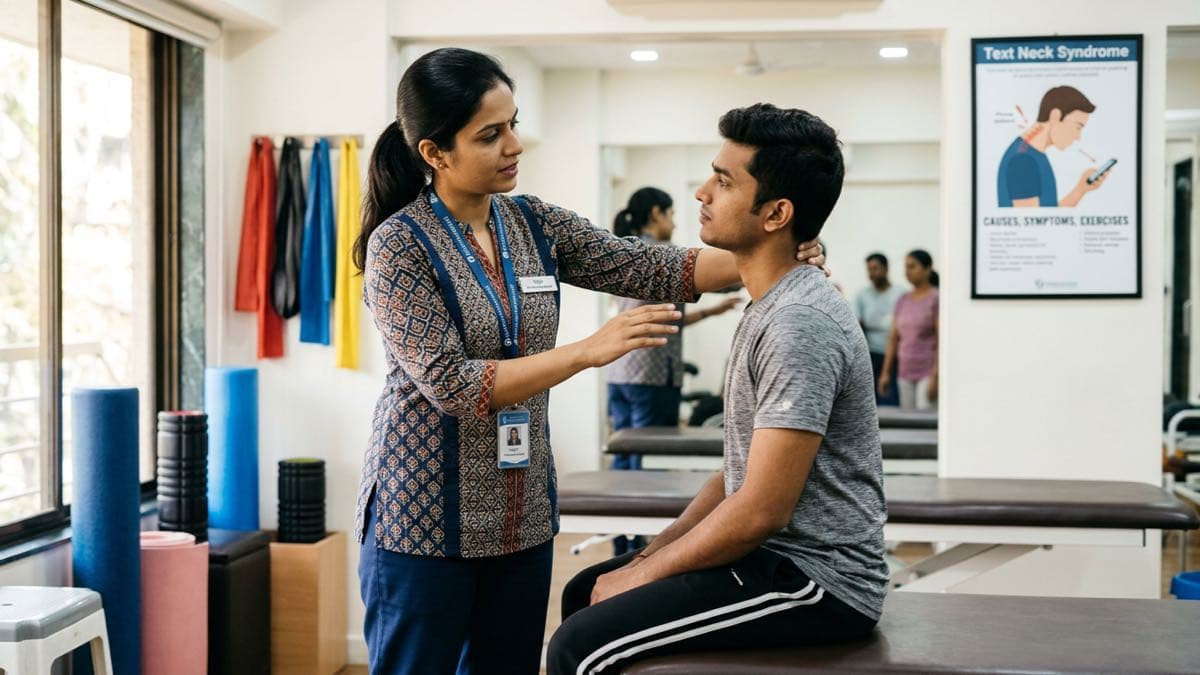
What Is Text Neck Syndrome?
Text neck syndrome — also called forward head posture or tech neck. Is a repetitive stress condition resulting from the prolonged forward and downward positioning of the head while using smartphones, tablets, and laptops.
It is one of the fastest-growing musculoskeletal disorders of the 21st century, affecting people of all ages across India.
In Faridabad, where IT professionals, students, and office workers spend 8-12 hours daily looking at screens, text neck has become one of the most common conditions we treat at Realign Rehab Clinic.
How Much Does Text Neck Strain Your Spine?
A neutral head weighs approximately 5-6 kg. As the head tilts forward, the effective force on the cervical spine increases dramatically:
- 15 degrees forward: approximately 12 kg of force
- 30 degrees forward: approximately 18 kg of force
- 45 degrees forward: approximately 22 kg of force
- 60 degrees forward (typical phone viewing angle): approximately 27 kg of force
Research by Dr. Kenneth Hansraj published in Surgical Technology International confirmed these measurements.
The average person spends 2-4 hours daily with their head at these angles. Accumulating hundreds of hours per year of excessive cervical spine loading that progressively damages discs, muscles, ligaments, and facet joints.
Symptoms of Text Neck Syndrome
- Neck pain and stiffness, often worst at the end of the workday
- Upper shoulder and upper back tightness (trapezius, levator scapulae)
- Headaches — particularly at the base of the skull and across the forehead
- Jaw pain and clicking (TMJ dysfunction) from forward head posture
- Eye strain and visual fatigue from prolonged screen use
- Pain or numbness radiating into the arms when nerve roots are affected
- Reduced range of motion — difficulty turning the neck fully
- Visible chin-forward, rounded upper back posture
Long-Term Consequences If Text Neck Is Left Untreated
Without treatment, text neck can progress to:
- Accelerated cervical disc degeneration (cervical spondylosis)
- Cervical disc herniation with radiculopathy — nerve root compression
- Chronic headaches and migraines
- Thoracic outlet syndrome — compression of nerves and blood vessels at the neck-shoulder junction
- Progressive muscle imbalances that worsen over time without intervention
Physiotherapy Treatment for Text Neck
Effective text neck treatment requires addressing both the symptoms and the underlying muscle imbalances. At Realign Rehab Clinic, our treatment protocol includes:
1. Deep Cervical Flexor Strengthening
The longus colli and longus capitis — the deep neck flexors — are typically weak and inhibited in text neck patients. These muscles provide dynamic stabilization of the cervical spine and are essential for maintaining a neutral head position.
We use progressive craniocervical flexion exercises to strengthen these muscles safely and effectively. A landmark study by Jull et al. confirmed this approach noticeably reduces neck pain and improves function.
2. Thoracic Spine Mobilization
The thoracic spine is often stiff in text neck patients, preventing proper upright posture. Manual therapy to mobilize thoracic segments measurably improves posture and reduces cervical strain.
Research by Cleland et al. confirms that thoracic manipulation provides substantial relief for cervical pain.
3. Pectoral and Scalene Stretching
The pectoralis minor and scalene muscles become chronically shortened in forward head posture. Targeted stretching of these muscles helps restore normal shoulder and head position, reducing the pull that perpetuates the forward posture.
4. Scapular Stabilization Exercises
Exercises targeting the lower trapezius, rhomboids, and serratus anterior strengthen the muscles that hold the shoulder blades back and down — directly counteracting the forward rounding posture pattern.
5. Ergonomic Education
- Raise your phone or tablet to eye level — never look down at a screen for extended periods
- Set your monitor so the top of the screen is at eye level
- Use a laptop stand and external keyboard when working at a desk
- Take a 2-minute posture break and stretch every 30 minutes
- Use a cervical roll in the curve of your neck when driving or sitting for long periods
Daily Exercises for Text Neck Relief
Chin Tuck (Cervical Retraction)
Sit or stand tall. Without moving your shoulders, gently pull your chin straight back — as if making a double chin.
Hold for 5-10 seconds. Repeat 10-15 times.
This directly strengthens the deep cervical flexors and counteracts forward head posture. It is the single most important exercise for text neck correction.
Chest Opening Stretch
Stand in a doorway with forearms on the frame. Step forward gently until you feel a stretch across the chest.
Hold 30-60 seconds, 3 repetitions. Stretches the tight pectoral muscles that pull shoulders forward into the rounded posture.
Thoracic Extension Over a Foam Roller
Lie on your back with a foam roller positioned at the upper-mid back. Allow the thoracic spine to extend over the roller for 30-60 seconds at each level.
This mobilizes the thoracic spine and counteracts the kyphosis associated with text neck.
Wall Angels
Stand against a wall with feet 10 cm away, lumbar spine flat against the wall. Press arms against the wall at 90 degrees, then slowly raise them overhead and back down (like making a snow angel on the wall).
Perform 10 repetitions. Strengthens scapular muscles and thoracic extensors simultaneously.
Text Neck FAQs
Is text neck permanent?
No. Text neck is a functional problem caused by muscle imbalances and habitual postures. With consistent physiotherapy and daily home exercises, real improvement is achievable regardless of how long the problem has been present.
How long does text neck treatment take?
Most patients see clear improvement within 6-8 weeks of consistent physiotherapy and home exercise. Mild cases may resolve in 4-6 weeks; severe, chronic cases may take 3-6 months for full correction of the underlying muscle imbalances.
Can children get text neck?
Yes — text neck is increasingly common in children and teenagers. Growing spines are more vulnerable to postural loading than adult spines.
Early physiotherapy intervention is especially important for young patients to prevent long-term complications including accelerated disc degeneration.
Book Text Neck Treatment in Faridabad
Is your phone damaging your spine? At Realign Rehab Clinic in Faridabad, we assess and treat text neck syndrome with targeted physiotherapy that addresses the root cause.
Call +91 9818185589 or book online.
References
- Hansraj KK. Assessment of stresses in the cervical spine caused by posture and position of the head. Surgical Technology International. 2014;25:277-279.
- Jull G, et al. A randomized controlled trial of exercise and manipulative therapy for cervicogenic headache. Spine. 2002;27(17):1835-1843.
- Cleland JA, et al. Immediate effects of thoracic manipulation in patients with neck pain. Manual Therapy. 2007;12(2):136-143.
- Gupta BD, et al. Effect of deep cervical flexor training vs conventional isometric training on forward head posture. J Phys Ther Sci. 2013;25(11):1419-1423.
Sources & References
- Hansraj KK (2014). Assessment of stresses in the cervical spine caused by posture and position of the head. Surgical Technology International, 25:277–279.
- Gallup (2015). Americans’ smartphone use increasing. Gallup Survey.
- Yoo WG (2013). Effect of the neck retraction taping (NRT) on forward head posture and the upper trapezius muscle. JOSPT.
Content author: Dr. Vaishali Suri (P.T.), MPT (Sports Medicine), BPT, MIAP, MIAP.
Frequently Asked Questions
How long does posture correction take with physiotherapy?
Posture correction typically takes 6–12 weeks of consistent physiotherapy and home exercises. Mild postural issues may improve within 4–6 weeks.
Vaishali Suri at Realign Rehab Clinic designs a personalised programme based on your specific postural pattern.
Can I correct my posture at home without seeing a physiotherapist?
Home exercises can help maintain good posture, but a physiotherapist assessment is strongly recommended first. Performing the wrong exercises without knowing your specific postural imbalance can sometimes worsen symptoms.
Book an assessment at Realign Rehab Clinic, NIT-5 Faridabad.
Is posture correction physiotherapy available in Faridabad?
Yes. Realign Rehab Clinic in NIT-5 Faridabad offers specialist posture correction physiotherapy with Dr. Vaishali Suri (MPT (Sports Medicine), BPT, MIAP). Home visits are also available. Call +91 9818185589 to book.
Related Articles: Neck Pain: Causes, Prevention & Treatment | Whiplash Injury Treatment in Faridabad: Physiotherapy for Road Accident Neck Pain | Tennis Elbow Treatment Guide: Physiotherapy in Faridabad | Slip Disc Treatment in Faridabad: Can Physiotherapy Avoid Surgery?
Related Conditions: Swelling Treatment | Posture Correction Treatment | Carpal Tunnel Syndrome
Related Services: Posture Correction | Neck Pain Therapy