 Dr. Vaishali Suri (P.T.)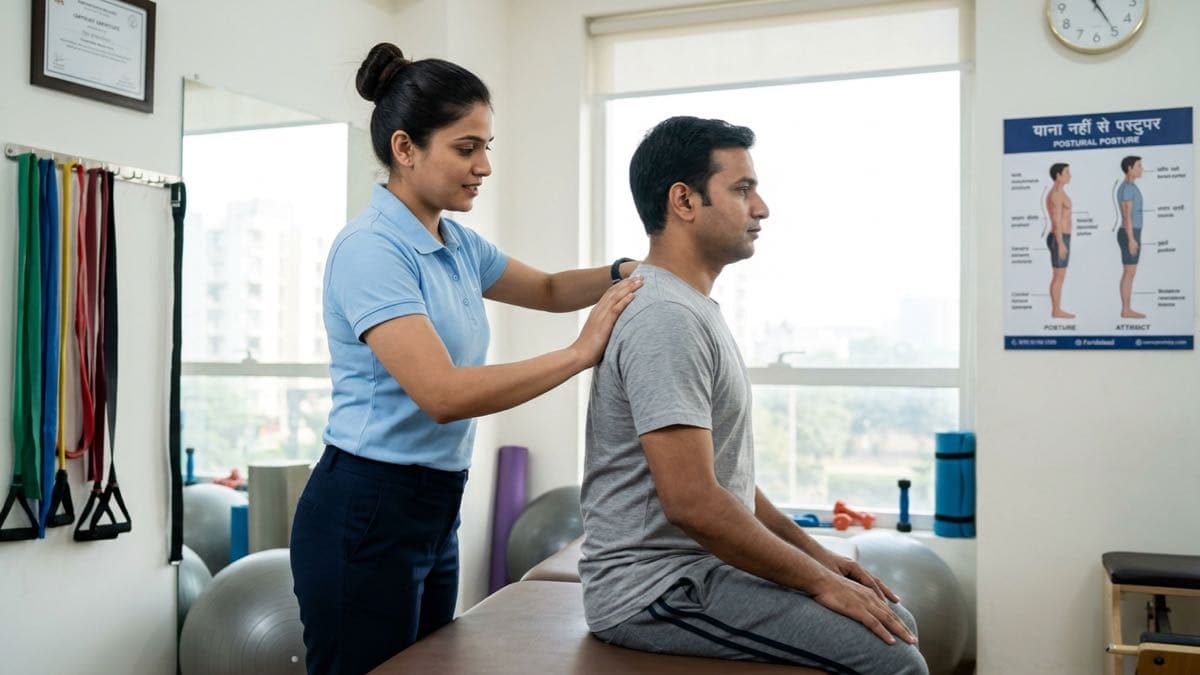
What Are Rounded Shoulders?
Rounded shoulders is a postural condition where the shoulders roll forward and inward from the ideal neutral position. From a side view, the shoulder points appear in front of the ear rather than aligned below it.
From the front, the backs of the hands are visible when the arms hang at rest — a sign that the shoulder girdle has internally rotated.
This is one of the most common postural deviations we see at Realign Rehab Clinic in Faridabad, affecting not just office workers but students, drivers, manual workers. Anyone who spends significant time in forward-reaching activities.
Typing, cooking, lifting, or looking at a phone.
The Anatomy Behind Rounded Shoulders
The shoulder girdle is designed for extraordinary mobility — it is the most mobile joint in the human body. This mobility comes at the cost of inherent stability: the shoulder relies almost entirely on muscles, tendons, and ligaments for its support.
When the muscles that control the shoulder blade (scapula) become imbalanced, the entire shoulder complex shifts out of alignment.
In rounded shoulders, two things happen simultaneously:
- Tight/overactive structures: Pectoralis major and minor (chest muscles), anterior deltoid, subscapularis, internal rotators, upper trapezius, and levator scapulae become shortened and overactive
- Weak/inhibited structures: Lower and mid trapezius, serratus anterior, rhomboids, external rotators (infraspinatus, teres minor), and deep cervical flexors become lengthened and inhibited
This imbalance — described by physiotherapy pioneers as Upper Crossed Syndrome — progressively worsens without intervention because the body adapts to the new position: soft tissue shortens, joint capsules tighten, and motor patterns reinforce the dysfunctional posture.
Common Causes of Rounded Shoulders
Prolonged Desk Work and Computer Use
Working at a computer for hours keeps the arms in front of the body continuously. This position chronically shortens the anterior shoulder structures while the posterior muscles fatigue from sustained isometric contraction trying to maintain scapular position.
Over months and years, the anterior structures win: the shoulders round forward permanently.
Smartphone and Tablet Use
Holding a phone at chest height requires the arms to be held in front of the body, internally rotated — the exact position that drives rounded shoulders. The typical person checks their phone 100+ times per day and uses it for hours in this position.
Occupational and Lifestyle Factors
Activities that keep the arms in front of the body — driving, cooking, carrying bags, manual work, painting — contribute to the same anterior tightening. Left-sided rounded shoulder is common in people who always carry a bag on the left, for example.
Weakness After Injury
Shoulder injuries — rotator cuff treatment tears, labral tears, AC joint sprains — are often followed by protective guarding that causes the shoulder to round forward. Without rehabilitation that specifically addresses scapular control, the rounded posture can persist long after the original injury has healed.
Gym Training Imbalances
Many gym-goers train their "mirror muscles" — chest and biceps — far more than their back. An overdeveloped chest combined with underdeveloped mid and lower trapezius is a direct recipe for rounded shoulders.
We see this frequently in young men aged 18–35.
Signs and Symptoms of Rounded Shoulders
Rounded shoulders is not just cosmetic — it generates a cascade of symptoms that become progressively more severe:
- Neck pain and stiffness: Forward shoulder position forces the neck into a compensatory forward head posture, loading the cervical joints
- Upper back pain treatment: The muscles between the shoulder blades (rhomboids, mid trapezius) are chronically stretched and fatigued
- Shoulder pain: The subacromial space — the gap between the rotator cuff tendons and the bone above — narrows when the shoulder is rounded, leading to impingement and eventual rotator cuff damage
- Headaches: Muscle tension from the upper trapezius and suboccipital muscles refers pain to the head
- Reduced shoulder mobility: Reaching overhead becomes restricted and eventually painful
- Chest tightness and shallow breathing: The rounded position compresses the chest, limiting diaphragmatic movement
- Thoracic outlet symptoms: In severe cases, vessels and nerves passing through the thoracic outlet can be compressed, causing tingling in the arms and hands
How Physiotherapy Treats Rounded Shoulders
At Realign Rehab Clinic, our treatment for rounded shoulders follows a structured protocol that addresses both the cause and the symptoms. There is no single exercise that fixes rounded shoulders — it requires a systematic approach targeting all the relevant structures.
Step 1: Postural and Movement Assessment
We begin with a full assessment to quantify the degree of shoulder rounding, identify which structures are tight and which are weak, assess compensatory patterns in the neck and thoracic spine, and rule out structural causes (AC joint issues, rotator cuff pathology, thoracic outlet syndrome).
Step 2: Manual Therapy to Restore Mobility
Before we can retrain muscles, we need to restore mobility in the structures that have shortened. Manual therapy techniques used include:
- Soft tissue release and myofascial techniques for the pectoralis major and minor
- Thoracic spine joint mobilisation — stiffness in the mid-back is almost always present alongside rounded shoulders
- Glenohumeral joint mobilisation to restore full external rotation
- Neural mobilisation if nerve tension is contributing to symptoms
Step 3: Targeted Strengthening
The key muscles that must be strengthened to correct rounded shoulders are:
- Lower trapezius: Critical for scapular depression and posterior tilting — exercises include prone Y, prone T, and cable pull-downs with scapular retraction emphasis
- Serratus anterior: Essential for scapular upward rotation and protraction on the ribcage — trained through push-up plus and wall slides
- External rotators (infraspinatus and teres minor): Side-lying external rotation and band pull-aparts
- Mid trapezius and rhomboids: Rows with scapular retraction emphasis, prone T exercise
- Deep cervical flexors: Chin tucks, craniocervical flexion training
Step 4: Stretching Tight Structures
Simultaneously, we work to lengthen the tight anterior structures:
- Doorway pectoral stretch — both pectoralis major (low arm position) and minor (high arm position)
- Anterior deltoid and subscapularis stretch
- Upper trapezius and levator scapulae side-neck stretches
Step 5: Postural Re-education and Motor Control
The final and most important phase: retraining the nervous system to hold the corrected position automatically. This involves postural awareness drills, proprioceptive training, and progressively loading the corrected posture under functional conditions — simulating sitting at a desk, reaching, and lifting.
Exercises You Can Start Today
Doorway Pectoral Stretch
Stand in a doorway and place both forearms on the door frame (elbows at 90°). Lean gently forward until you feel a stretch across the chest.
Hold 45 seconds. For the pectoralis minor, raise your arms slightly higher on the door frame.
Do this stretch 3 times daily.
Band Pull-Apart
Hold a resistance band at shoulder width in front of you with straight arms. Keeping arms straight, pull the band apart until your arms are fully to the sides.
Squeeze your shoulder blades together at the end. Slowly return. 3 sets of 15 reps.
Prone T Exercise
Lie face down on a firm surface. With arms out to the sides (T position) and thumbs pointing up, lift both arms off the ground — squeezing the shoulder blades down and together.
Hold 3 seconds. 3 sets of 12 reps. This is one of the best exercises for lower and mid trapezius activation.
Wall Slide
Stand with your back against the wall. Press the back of both arms against the wall (arms at 90°).
Slowly slide your arms up the wall above your head, maintaining contact throughout. If you cannot keep contact, you have found your current mobility limit. 3 sets of 10 reps.
How Long Does It Take to Correct Rounded Shoulders?
Rounded shoulders that have been present for less than 2 years typically show measurable improvement in 6–8 weeks of consistent physiotherapy and home exercises. For postural changes present for longer, meaningful improvement takes 3–6 months, and full correction may not be possible in patients with established structural changes in the spine or shoulder joint.
The most important variable is consistency: patients who perform home exercises daily and make ergonomic changes at work progress 2–3 times faster than those relying solely on in-clinic treatment.
Can You Fix Rounded Shoulders Without Physiotherapy?
Mild cases of rounded shoulders can improve with dedicated self-directed exercise — if you perform the right exercises consistently, have correct technique, and address ergonomic contributors. However, most people benefit measurably from professional assessment and treatment because:
- It is difficult to self-identify which specific muscles are underactive vs overactive in your particular presentation
- Manual therapy to release tight structures noticeably accelerates progress
- Incorrect technique in strengthening exercises can reinforce, rather than correct, postural imbalances
- A physiotherapist can identify associated issues (cervical, thoracic, rotator cuff) that self-treatment will miss
Posture Correction for Rounded Shoulders in Faridabad
At Realign Rehab Clinic in NIT-5, Faridabad, we provide complete posture correction treatment including specialist assessment and treatment for rounded shoulders. Led by Dr.
Vaishali Suri (P.T.), our team uses evidence-based manual therapy and corrective exercise protocols to help patients of all ages achieve lasting postural improvement.
Whether your rounded shoulders are causing active pain or you simply want to correct your posture before problems develop, we offer a structured programme designed for your work demands, fitness level, and goals. Book your posture assessment today.
Frequently Asked Questions
How long does posture correction take with physiotherapy?
Posture correction typically takes 6–12 weeks of consistent physiotherapy and home exercises. Mild postural issues may improve within 4–6 weeks.
Vaishali Suri at Realign Rehab Clinic designs a personalised programme based on your specific postural pattern.
Can I correct my posture at home without seeing a physiotherapist?
Home exercises can help maintain good posture, but a physiotherapist assessment is strongly recommended first. Performing the wrong exercises without knowing your specific postural imbalance can sometimes worsen symptoms.
Book an assessment at Realign Rehab Clinic, NIT-5 Faridabad.
Is posture correction physiotherapy available in Faridabad?
Yes. Realign Rehab Clinic in NIT-5 Faridabad offers specialist posture correction physiotherapy with Dr. Vaishali Suri (MPT (Sports Medicine), BPT, MIAP). Home visits are also available. Call +91 9818185589 to book.
Related Articles: Tennis Elbow Treatment Guide: Physiotherapy in Faridabad | Slip Disc Treatment in Faridabad: Can Physiotherapy Avoid Surgery? | Shin Splints Treatment in Faridabad: Get Back to Running Pain-Free | Scoliosis Treatment in Faridabad: Physiotherapy for Spinal Curves
Related Conditions: Wrist Pain Treatment | Urinary Incontinence Treatment | Tennis Elbow Treatment
Related Services: Wrist & Hand Therapy | Taping & Bracing