
 Dr. Vaishali Suri (P.T.)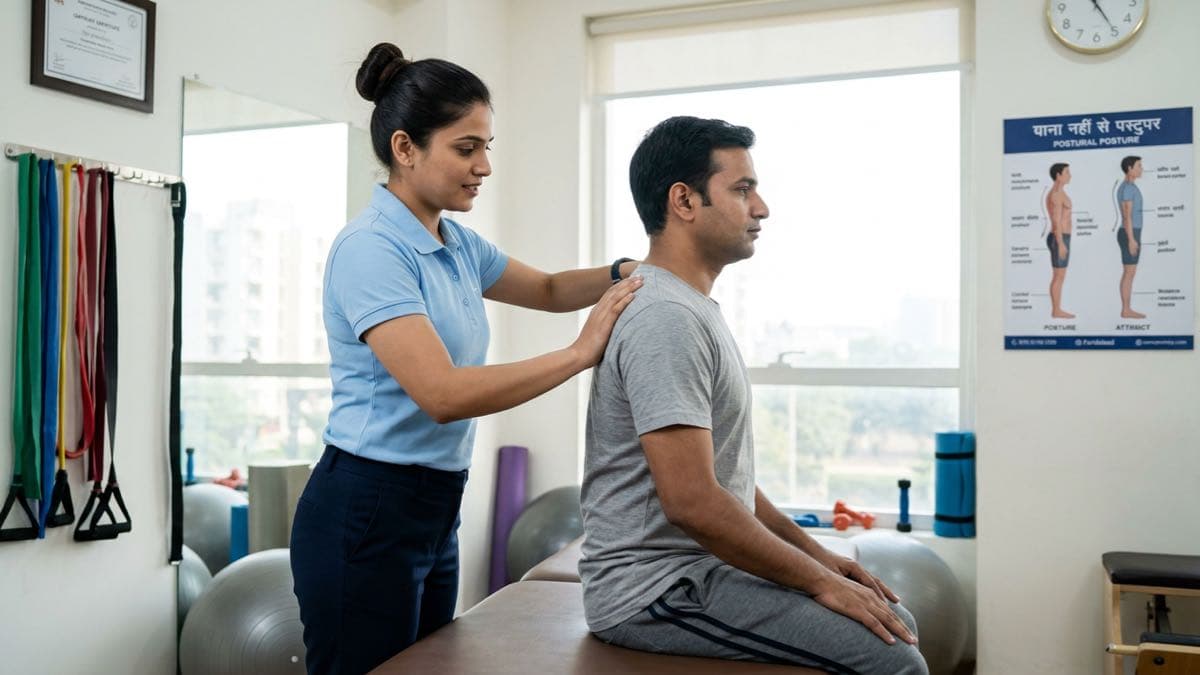
Why Choosing the Right Physiotherapist for Posture Correction Matters
Posture correction is not a single exercise or a one-size-fits-all protocol. It is a systematic process of assessment, manual treatment, corrective exercise, and postural re-education matched to your specific presentation.
The quality of your physiotherapist's assessment and treatment planning directly determines your outcome.
In Faridabad, where awareness of physiotherapy is growing rapidly, there are many options for posture correction treatment. Understanding what a high-quality posture correction programme looks like helps you make an informed choice.
And helps you recognise whether the treatment you are receiving is likely to produce lasting results.
What Is Posture Correction Physiotherapy?
Posture correction physiotherapy is a structured programme aimed at identifying and treating the root causes of poor posture. Unlike passive treatments (which provide temporary symptom relief) or simply being told to "sit up straight" (which addresses awareness but not the underlying muscle imbalance), physiotherapy-based posture correction works by:
- Identifying the specific muscles that are tight and the muscles that are weak in your posture pattern
- Using manual therapy to restore mobility in joints and soft tissues that have adaptively shortened
- Progressively strengthening inhibited muscles through graded therapeutic exercise
- Retraining your nervous system to maintain the corrected posture automatically
- Addressing the ergonomic and lifestyle factors driving the problem
Done properly, posture correction produces lasting structural and functional changes — not just temporary relief.
Common Posture Problems Treated in Faridabad
The posture problems we most commonly treat at Realign Rehab Clinic reflect the lifestyle patterns of Faridabad residents:
- Forward head posture / text neck: Extremely common in young adults, students, and anyone with significant smartphone use. The head shifts forward, increasing load on the cervical spine by 4–5 times.
- Rounded shoulders: A near-universal finding in office workers and anyone with a desk-centric lifestyle. The chest muscles tighten and the upper back muscles weaken, pulling the shoulders forward.
- Thoracic kyphosis (excessive upper back rounding): Often develops from chronic slumped sitting and is particularly common in students who spend hours studying at low desks.
- Anterior pelvic tilt / lower back arch: Tight hip flexors from prolonged sitting cause the pelvis to tip forward, creating an exaggerated lower back curve and predisposing to lower back pain treatment.
- Scoliosis-related posture: Structural or functional scoliosis creates lateral spinal curves that cause postural asymmetry, uneven shoulder or hip heights, and muscle imbalance.
- Post-pregnancy posture changes: Pregnancy shifts the centre of gravity forward, leading to exaggerated lumbar lordosis, abdominal weakness, and pelvic floor rehabilitation dysfunction that persist postpartum without targeted rehabilitation.
What a Proper Posture Assessment Includes
A thorough posture assessment should take 30–45 minutes and cover the following:
Postural Analysis
Your physiotherapist should evaluate your posture from front, side, and back — both standing and sitting. They are looking at head position, shoulder height symmetry, thoracic curve, lumbar curve, pelvic position, hip symmetry, knee alignment, and foot arch.
Photography or video may be used to document your starting point and track progress.
Movement Assessment
Static posture tells only part of the story. How you move — the quality of your cervical rotation, shoulder elevation, thoracic mobility, and hip movement — reveals the functional impact of your postural deviation.
Restricted movement in one area invariably causes compensatory strain in adjacent areas.
Muscle Length Testing
Your physiotherapist should manually test the length of key muscles known to be involved in common posture patterns: pectoralis minor length test, hip flexor (Thomas test), hamstring length, cervical flexor endurance test, and scapular stabiliser assessment. This identifies exactly which structures need to be stretched and which need to be strengthened.
Joint Mobility Testing
Stiff spinal joints — particularly in the thoracic spine — are a major driver of compensatory cervical and lumbar posture changes. Joint mobility should be assessed at the cervical, thoracic, and lumbar segments.
Neurological Screening
If you have arm or leg symptoms (tingling, numbness, weakness), basic neurological testing should be performed to rule out nerve root compression before a postural diagnosis is accepted.
Ergonomic History
Your physiotherapist should ask about your work setup, daily activities, exercise habits, sleep position, and hobbies. Posture is driven largely by what you do for the 8–10 hours a day when you are not at the clinic — understanding these inputs is essential for effective treatment.
Red Flags: When Posture Treatment Isn't Evidence-Based
Not all posture correction treatment delivers lasting results. Watch for these red flags:
- No assessment before treatment: If a practitioner begins treating you without a thorough initial assessment, they are treating a generic "posture problem" rather than your specific pattern
- Treatment is only passive: Passive therapy alone will not correct posture. You must do active exercise to retrain muscle patterns. If you are given no home exercise programme, long-term improvement is unlikely
- Generic exercise sheets: A list of 10 generic exercises given to every patient regardless of their findings will produce poor results. Your programme should be specific to your pattern
- No ergonomic guidance: Without addressing the daily habits and environment driving the problem, even excellent clinic treatment will be undone the moment you return to your desk
- Promises of very rapid results: Posture patterns built over years cannot be permanently reversed in 2 weeks. Honest timelines for meaningful improvement are typically 6–12 weeks
What Treatment Looks Like at Realign Rehab Clinic
At Realign Rehab Clinic in Faridabad, our posture correction programme is led by Dr. Vaishali Suri (P.T.), a highly experienced physiotherapist specialising in musculoskeletal rehabilitation. Every patient receives:
- A 45-minute initial assessment covering postural analysis, movement testing, muscle length testing, and ergonomic history
- A personalised treatment plan with clear goals and realistic timelines
- Hands-on manual therapy — soft tissue release, joint mobilisation, dry needling where indicated
- A progressive home exercise programme taught and monitored throughout treatment
- Ergonomic advice specific to your work setup and lifestyle
- Progress reassessment at regular intervals to make sure the programme remains appropriate as you improve
We treat patients from across Faridabad — NIT sectors, Sector 15–17, Ballabhgarh, Greater Faridabad, YMCA, Neelam Chowk — as well as from neighbouring areas including Palwal and Badarpur.
Results You Can Expect
Patients who follow their programme consistently report:
- Reduction in neck, shoulder, and back pain within 2–4 weeks
- Noticeable improvement in standing and sitting posture within 6–8 weeks
- Real improvement in energy levels, as poor posture creates constant muscular fatigue
- Better breathing — rounded posture compresses chest volume; correcting it improves respiratory function
- Improved confidence — multiple patients have noted that standing taller has a meaningful positive effect on their self-presentation
- Long-term prevention of progressive spinal degeneration
Frequently Asked Questions
How many sessions will I need for posture correction?
This depends on severity and how long the problem has been present. Most patients with mild-to-moderate postural deviation require 8–16 sessions over 6–10 weeks.
The home exercise programme is equally important — clinic sessions alone will not achieve lasting correction.
Is posture correction painful?
The treatment itself should not be painful. Manual therapy may create some mild temporary discomfort in areas that have been stiff for a long time — similar to the sensation after a deep soft tissue mobilisation.
Therapeutic exercises, when prescribed correctly, should be challenging but not painful. If you feel sharp pain during any exercise, stop and inform your physiotherapist.
Can posture be corrected at any age?
Yes — posture can be improved at any age, though the degree of correction achievable varies. Younger patients with shorter histories of postural deviation respond most rapidly.
Older patients with established changes may not achieve full correction but consistently achieve meaningful improvement in pain, mobility, and function.
Do I need a referral to see a physiotherapist for posture correction?
No. Physiotherapists in India are primary contact practitioners — you can book directly without a GP or orthopaedic referral.
Is posture correction covered by insurance?
Coverage depends on your health insurance policy. We recommend checking with your insurer whether physiotherapy treatment is included in your plan.
Book Your Posture Correction Assessment in Faridabad
If you are looking for the best physiotherapist for posture correction in Faridabad, Realign Rehab Clinic offers the full, evidence-based assessment and treatment that produces lasting results. Located in NIT-5, Faridabad, we are conveniently accessible from all major sectors of the city.
Don't settle for temporary symptom relief. Get to the root cause, correct the pattern, and build a spine that will serve you well for decades.
Book your consultation with Dr. Vaishali Suri today.
Related Articles: Posture Correction Therapy in Faridabad: Fix Bad Posture Permanently | Posture Correction for Office Workers in Faridabad: Complete Physiotherapy Guide | Dr.
Vaishali Suri — Top Physiotherapist in Faridabad
Related Conditions: Posture Correction Treatment | Hump Correction (Dowager's Hump) | Wrist Pain Treatment
Related Services: Posture Correction | Core Strengthening