
 Dr. Vaishali Suri (P.T.)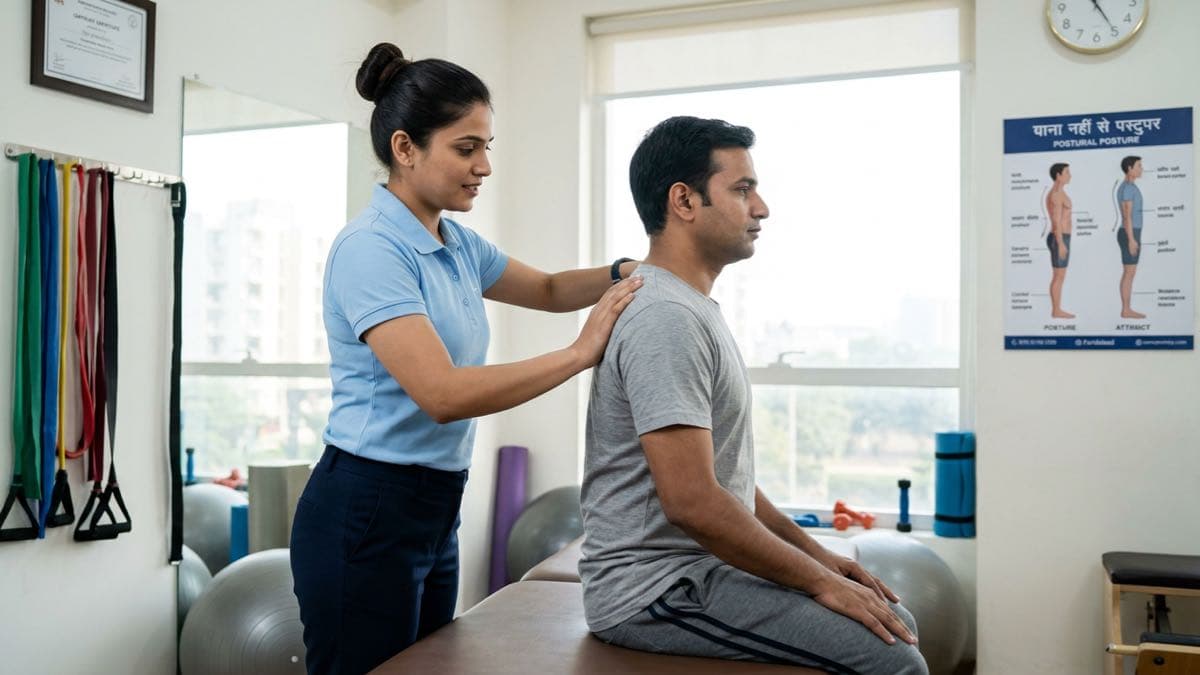
Why Desk Jobs Are Destroying Posture Across Faridabad
Faridabad has grown rapidly as a hub for manufacturing, IT, and service industries. Thousands of professionals spend 8 to 10 hours a day seated at workstations — and their spines are quietly paying the price.
In our clinic, we see a clear pattern: office workers aged 25–45 presenting with neck stiffness, upper back pain treatment , rounded shoulders, and chronic lower back ache. All rooted in sustained poor sitting posture.
The human body was never designed for prolonged sitting. Our muscles, joints, and discs perform best with regular movement and postural variation.
When we sit for hours in a fixed position. Especially one that is poorly set up — specific muscles become chronically tight while their opposing muscles weaken and switch off.
This muscle imbalance gradually reshapes your posture, and if left uncorrected, leads to pain, reduced mobility, and accelerating joint degeneration.
The good news: with structured physiotherapy, office worker posture problems are highly correctable. At Realign Rehab Clinic in Faridabad, we have helped hundreds of professionals reverse years of desk-related postural damage.
The Most Common Posture Problems in Office Workers
1. Forward Head Posture
For every inch your head shifts forward of your shoulders, the effective weight on your cervical spine increases by approximately 4.5 kg. Most desk workers — especially those on laptops or looking down at phones — carry their heads 3 to 5 cm forward.
This translates to 13–22 kg of constant load on the neck, leading to chronic neck pain, headaches, jaw tension, and even tingling in the arms from nerve compression.
2. Rounded Shoulders (Upper Crossed Syndrome)
Hours of typing and mousing with arms in front of the body tightens the pectoral (chest) muscles and weakens the scapular stabilisers. The muscles that hold your shoulder blades flat against your back.
The result: shoulders roll forward and the upper back rounds. This pattern is called Upper Crossed Syndrome and is one of the leading causes of shoulder pain, rotator cuff treatment problems, and thoracic stiffness in office workers.
3. Thoracic Kyphosis (Hunchback)
Sustained slouching causes the mid-back to develop an excessive outward curve. Over time this becomes structural — the vertebrae and discs adapt to the rounded position.
Thoracic kyphosis compresses the chest, reduces lung capacity, and puts the cervical spine in a mechanically compromised position.
4. Anterior Pelvic Tilt (Lower Crossed Syndrome)
When sitting in a soft chair with the hips flexed, the hip flexor muscles (especially the iliopsoas) become chronically shortened. The pelvis then tips forward — the lower back arches excessively, the glutes and deep abdominals switch off, and the lumbar discs come under uneven pressure.
Lower back pain is almost inevitable.
5. Lateral Imbalances
Reaching to one side for a mouse, holding a phone between ear and shoulder, or sitting with weight predominantly on one side creates lateral imbalances. Over time one side of the torso and hip tightens while the other lengthens, leading to asymmetric loading of the spine and eventual pain on the overloaded side.
How Poor Office Posture Progresses Into Injury
Many patients come to us saying their pain appeared suddenly. "I just turned my head and felt a sharp pain" or "I bent to pick something up and my back went." In reality, the injury was building for months or years.
Poor posture creates a slow accumulation of mechanical stress. The final incident — which feels sudden — is merely the moment a tissue that was already under chronic load finally reached its failure point.
Common progression:
- Stage 1 (0–2 years): Occasional stiffness and fatigue after long work days. Resolves with rest.
- Stage 2 (2–5 years): Morning stiffness, persistent tightness, occasional pain during work.
- Stage 3 (5+ years): Daily pain, restricted movement, possible nerve symptoms (numbness, tingling), structural changes visible on X-ray.
Intervention at Stage 1 or 2 dramatically shortens recovery time and prevents structural damage.
Physiotherapy Assessment for Office Workers
At Realign Rehab Clinic, we begin every posture correction programme with a in-depth postural assessment. This includes:
- Static postural analysis: Evaluating spinal curves, shoulder position, head alignment, and pelvic tilt from front, side, and back
- Dynamic movement assessment: How you move, not just how you stand — observing patterns in sitting, rising, walking, and reaching
- Muscle length testing: Identifying which muscles are shortened (tight) and which are lengthened (weak)
- Joint mobility assessment: Cervical, thoracic, and lumbar range of motion testing
- Workstation evaluation: Questions about screen height, chair setup, keyboard and mouse position — the ergonomic inputs driving your posture
This assessment allows us to build a personalised programme rather than a generic exercise sheet.
Our Posture Correction Programme for Office Workers
Phase 1: Pain Relief and Mobility Restoration (Weeks 1–2)
For patients presenting with active pain, the first priority is reducing discomfort and restoring basic joint mobility. Techniques include soft tissue release for the upper trapezius, levator scapulae, and pectorals; joint mobilisation for the cervical and thoracic spine; and dry needling for trigger points in hypertonic muscles.
Phase 2: Muscle Rebalancing (Weeks 3–6)
With pain managed, we begin the systematic retraining process. Tight structures are lengthened through targeted stretching and soft tissue work.
Weak muscles — typically the deep cervical flexors, lower trapezius, serratus anterior, glute medius, and deep abdominals — are progressively strengthened. This phase requires consistent home exercise practice in addition to clinic sessions.
Phase 3: Postural Re-education (Weeks 5–10)
Knowing what good posture looks like is not enough — you must retrain your nervous system to adopt it automatically. This involves proprioceptive training, movement re-education, and building postural endurance so you can maintain alignment during a full work day without conscious effort.
Phase 4: Ergonomic Optimisation and Long-Term Maintenance
We provide personalised ergonomic guidance: ideal screen height (eye level or slightly below), chair height (hips and knees at 90°, feet flat), keyboard position (elbows at 90°). Strategies for incorporating movement breaks into your work day.
We also design a maintenance programme to prevent regression.
Recommended Exercises for Office Workers
Chin Tuck (Cervical Retraction)
The single most important exercise for forward head posture. Sit or stand tall.
Without looking up or down, gently draw your chin straight back — creating a "double chin." Hold 5 seconds, release. Repeat 10–15 times, 3 times daily.
This activates the deep cervical flexors that have been inhibited by forward head posture.
Thoracic Extension Over a Foam Roller
Place a foam roller horizontally across your mid-back. Gently extend over it, arms folded across the chest.
Slowly move the roller from the lower to upper thoracic spine, pausing at tight spots. This mobilises the thoracic segments that become stiff from sustained flexion.
Wall Angels
Stand with your back against a wall, feet 15 cm from the wall. Flatten your lower back and press the back of your head against the wall.
Place arms in a "goalpost" position (elbows at 90°) on the wall. Slowly slide arms up to an overhead position, maintaining contact with wall throughout.
This simultaneously mobilises the shoulder and activates the lower trapezius.
Hip Flexor Stretch (Kneeling Lunge)
Kneel on one knee, the other foot in front at 90°. Gently push the hip forward until you feel a stretch in the front of the kneeling hip.
Hold 45 seconds each side. This directly addresses the shortened hip flexors that drive anterior pelvic tilt.
Dead Bug (Core Activation)
Lie on your back with knees bent to 90° and arms pointing to the ceiling. Slowly lower one arm overhead while extending the opposite leg — keeping the lower back pressed to the floor throughout.
Return and repeat opposite side. 3 sets of 8–10 reps. This activates the deep abdominals without loading the lumbar spine.
Ergonomic Tips You Can Apply Today
- Raise your screen so the top edge is at eye level — this alone reduces forward head posture
- Set your chair height so your feet are flat on the floor and knees at approximately 90°
- Use a lumbar support or roll a small towel for the lower back — this maintains the natural lumbar curve
- Keep your mouse close to the keyboard so your elbow stays at your side
- Set a timer for every 45 minutes — stand up, walk to the water cooler, do 5 shoulder rolls and a chin tuck before sitting back down
- If using a laptop, connect an external keyboard and raise the laptop on a stand to eye level
How Long Does Posture Correction Take for Office Workers?
Timelines depend on how long the poor posture patterns have been established and how consistently the home programme is followed:
- Mild postural deviation (less than 2 years): Noticeable improvement in 4–6 weeks. Full correction in 3 months.
- Moderate deviation (2–5 years): Pain reduction in 2–3 weeks, meaningful postural change in 6–10 weeks, full programme 4–6 months.
- Chronic/severe deviation (5+ years, possible structural changes): Meaningful functional improvement is still achievable, though structural changes to bone may be irreversible. Pain and mobility goals typically achieved in 3–6 months.
Consistency is the biggest factor. Patients who do their home exercises daily and make ergonomic adjustments at work recover significantly faster than those who only attend clinic sessions.
When to See a Physiotherapist
Don't wait for pain to become severe. See us if you experience:
- Neck or back pain that appears after work and takes more than 30 minutes to settle
- Morning stiffness in the neck or upper back that takes more than 15 minutes to ease
- Headaches that come on during or after computer work
- Tingling, numbness, or weakness in the arms or hands
- Feeling unable to straighten up easily after sitting for extended periods
- Colleagues or family commenting on your posture
Book Your Posture Assessment in Faridabad
Realign Rehab Clinic is located in NIT-5, Faridabad, and offers thorough posture correction programmes led by Dr. Vaishali Suri (P.T.), a specialist physiotherapist with extensive experience in musculoskeletal rehabilitation.
We see patients from across Faridabad including NIT, Sector 15, 16, 17, Neelam Chowk, YMCA, Ballabhgarh, and Greater Faridabad.
If your desk job is affecting your posture and causing pain, don't wait. Early intervention produces far better outcomes than treating the problem once it has become structural.
Book your consultation today and take the first step toward a pain-free work life.
Frequently Asked Questions
How long does posture correction take with physiotherapy?
Posture correction typically takes 6–12 weeks of consistent physiotherapy and home exercises. Mild postural issues may improve within 4–6 weeks.
Vaishali Suri at Realign Rehab Clinic designs a personalised programme based on your specific postural pattern.
Can I correct my posture at home without seeing a physiotherapist?
Home exercises can help maintain good posture, but a physiotherapist assessment is strongly recommended first. Performing the wrong exercises without knowing your specific postural imbalance can sometimes worsen symptoms.
Book an assessment at Realign Rehab Clinic, NIT-5 Faridabad.
Is posture correction physiotherapy available in Faridabad?
Yes. Realign Rehab Clinic in NIT-5 Faridabad offers specialist posture correction physiotherapy with Dr. Vaishali Suri (MPT (Sports Medicine), BPT, MIAP). Home visits are also available. Call +91 9818185589 to book.
Related Articles: Neck Stiffness and Pain in Office Workers Faridabad: Physiotherapy | Posture Correction Therapy in Faridabad: Fix Bad Posture Permanently | Repetitive Strain Injuries for Office Workers in Faridabad: Prevention and Treatment | Physiotherapy for Office Workers: Fix Desk Pain in Faridabad
Related Conditions: Posture Correction Treatment | Hump Correction (Dowager's Hump) | Wrist Pain Treatment
Related Services: Posture Correction | Core Strengthening