
 Dr. Vaishali Suri (P.T.)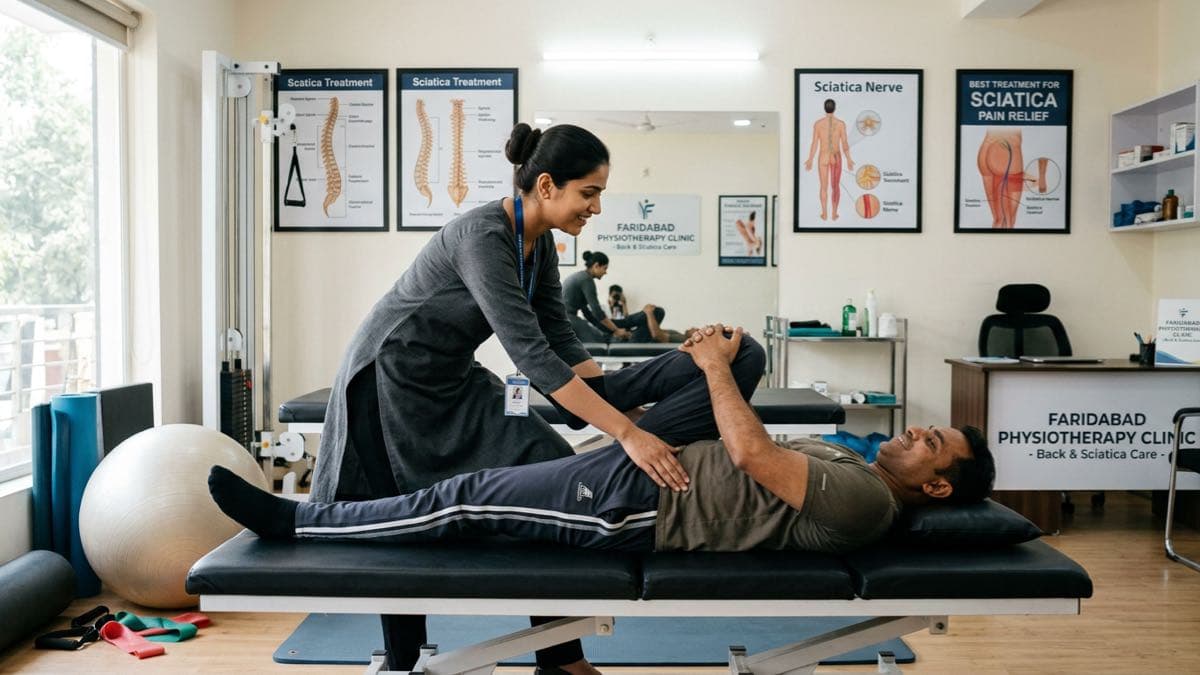
What Is sciatica treatment?
Sciatica refers to pain that radiates along the path of the sciatic nerve. The longest and widest nerve in the body — from the lower back through the buttock and down one leg.
The term describes a symptom (leg pain along the sciatic distribution) rather than a diagnosis in itself. Common causes include lumbar disc herniation, piriformis syndrome, lumbar spinal stenosis, and spondylolisthesis.
Sciatica is extremely common in Faridabad, particularly among office workers, drivers, and manual laborers. At Realign Rehab Clinic, we successfully treat sciatica using evidence-based physiotherapy — without surgery in the vast majority of cases.
Sciatica Symptoms: What Does It Feel Like?
- Sharp, shooting, or burning pain starting in the lower back or buttock and radiating down one leg
- Pain that follows a specific path: buttock — back of thigh — back or outer calf — foot
- Numbness, tingling, or a pins-and-needles sensation in the leg or foot
- Muscle weakness in the leg or foot
- Pain that worsens with sitting, coughing, or sneezing
- Pain that improves with walking or lying down in certain positions
Common Causes of Sciatica
1. Lumbar Disc Herniation (Most Common)
2. Piriformis Syndrome
The piriformis muscle, located deep in the buttock, can compress the sciatic nerve if it becomes tight or spasmed. This condition — sometimes called deep gluteal syndrome — produces sciatica-like symptoms without disc involvement and responds well to targeted physiotherapy.
3. Lumbar Spinal Stenosis
Narrowing of the spinal canal or foramen due to arthritis, disc degeneration, or bone spurs compresses the nerve roots. More common in adults over 50, it often causes bilateral leg symptoms that worsen with walking and improve with sitting or bending forward.
4. Spondylolisthesis
Forward slippage of one vertebra over another can compress nerve roots and cause sciatica — most commonly at the L4-L5 or L5-S1 level.
Physiotherapy Treatment for Sciatica
McKenzie Therapy (Directional Preference Exercises)
The McKenzie Method identifies whether your sciatica responds to extension (back-bending) or flexion (forward-bending) exercises. For disc-related sciatica, extension-based exercises often cause the leg pain to centralize — move from the foot toward the back — which is a reliable sign of improvement.
This method is highly effective and teaches patients to self-manage their condition long-term.
Neural Mobilization (Nerve Flossing)
Neural mobilization techniques help restore the sciatic nerve's ability to slide smoothly within its neural channel, reducing neural tension that contributes to pain and sensitivity. These gentle techniques are safe and highly effective when performed correctly by a physiotherapist.
Core Stabilization
Strengthening the deep core muscles — transversus abdominis and multifidus — provides better spinal support and reduces stress on the disc and nerve structures. Core training is essential for preventing sciatica recurrence.
Manual Therapy
Spinal mobilization and manipulation can reduce nerve root irritation and improve spinal mobility. Piriformis release techniques — including soft tissue therapy and trigger point treatment — are particularly effective for piriformis syndrome cases.
Sciatica Exercises You Can Do at Home
Knee to Chest Stretch
Lie on your back. Gently pull one knee toward your chest, holding for 30 seconds. Switch sides. Reduces lumbar disc pressure and stretches lumbar extensors. Safe for most sciatica presentations.
Piriformis Stretch (Figure-Four Stretch)
Lie on your back. Cross one ankle over the opposite knee.
Reach through and pull the bottom knee toward your chest. Hold 30-60 seconds.
Excellent for piriformis syndrome and deep buttock tightness.
Prone Press-Up (McKenzie Extension)
Lie on your stomach, hands under shoulders. Press up through your arms, leaving the hips on the floor.
Hold 10-15 seconds. Repeat 10 times. Particularly effective for disc-related sciatica with extension preference — perform this if it reduces or centralizes your leg pain.
Bird-Dog
On hands and knees, extend one arm and the opposite leg simultaneously, keeping the spine in neutral. Hold 10 seconds, alternate sides. 3 sets of 10.
Safe core stabilization exercise for sciatica patients at all stages.
When Is Surgery Needed for Sciatica?
Surgery is needed only in specific circumstances:
- Cauda equina syndrome — bowel or bladder dysfunction is a medical emergency requiring immediate surgery
- Progressive neurological deficit — rapidly worsening weakness or numbness
- Failure to improve after 6-12 weeks of in-depth conservative physiotherapy treatment
The vast majority of patients with sciatica — including severe cases with significant leg pain — do not need surgery.
Sciatica FAQs
How long does sciatica last?
Acute sciatica typically resolves within 4-12 weeks with appropriate treatment. Chronic sciatica (lasting more than 12 weeks) requires more intensive physiotherapy and may take 3-6 months to fully resolve.
Early physiotherapy intervention measurably accelerates recovery and reduces the risk of chronicity.
Is walking good for sciatica?
Yes — walking is one of the best activities for most sciatica presentations. It promotes circulation to the nerve, maintains spinal mobility, and strengthens supporting muscles.
Start with shorter, flat walks and gradually increase duration. Avoid prolonged sitting, which typically aggravates sciatica symptoms.
Can physiotherapy cure sciatica permanently?
Physiotherapy can eliminate sciatica pain and prevent recurrence in most cases. The key is addressing the underlying cause — disc issue, piriformis tightness, or spinal instability — and maintaining the corrective exercises and posture habits learned during treatment.
Book Sciatica Treatment in Faridabad
Do not live with sciatica pain. At Realign Rehab Clinic in Faridabad, we provide expert, evidence-based sciatica treatment with a high success rate.
Our physiotherapists identify the exact cause of your sciatica and deliver targeted treatment. Call +91 9818185589 or book online for a thorough assessment.
References
- Koes BW, et al. Diagnosis and treatment of sciatica. BMJ. 2007;334(7607):1313-1317.
- Deyo RA, Weinstein JN. Low back pain treatment. N Engl J Med. 2001;344(5):363-370.
- McKenzie R, May S. The Lumbar Spine: Mechanical Diagnosis and Therapy. Spinal Publications; 2003.
- Luijsterburg PA, et al. Effectiveness of conservative treatments for the lumbosacral radicular syndrome. Eur Spine J. 2007;16(7):881-899.
Sources & References
- Koes BW et al. (2007). Diagnosis and treatment of sciatica. BMJ, 334(7607):1313–1317.
- Cochrane Review (2010). Bed rest for acute low-back pain and sciatica.
- Neto T et al. (2019). Effects of neural mobilisation on pain and disability in low back pain. JOSPT.
- Zhong M et al. (2017). Incidence of spontaneous resorption of lumbar disc herniation. Pain Physician, 20:E45–E52.
Content author: Dr. Vaishali Suri (P.T.), MPT (Sports Medicine), BPT, MIAP, MIAP.
Frequently Asked Questions
Can physiotherapy help with my type of pain?
Physiotherapy is effective for most musculoskeletal pain conditions including back pain, neck pain, joint pain, and nerve pain. Dr. Vaishali Suri will assess the specific cause of your pain and create a personalised treatment plan at Realign Rehab Clinic, Faridabad.
How many physiotherapy sessions will I need?
Most patients with acute pain see meaningful improvement within 4–6 sessions. Chronic conditions may require 8–12 sessions.
A personalised plan is created after your first assessment at Realign Rehab Clinic, NIT-5 Faridabad.
Is physiotherapy available as a home visit in Faridabad?
Yes. Realign Rehab Clinic offers home physiotherapy visits across Faridabad including NIT-5, Sector 15, 16, 21 and surrounding areas. Call +91 9818185589 to book a home visit with Dr. Vaishali Suri.
Related Articles: Sciatica and Leg Pain Relief in Faridabad: Physiotherapy Treatment | Thoracic (Mid-Back) Pain Treatment in Faridabad: Physiotherapy Solutions | Sacroiliac Joint Pain Treatment in Faridabad: Physiotherapy for SI Joint | Wrist Pain from Keyboard and Mouse Use in Faridabad: Physiotherapy Solutions
Related Conditions: Wrist Pain Treatment | Shoulder Pain Relief | Postpartum Back Pain Relief
Related Services: Neck Pain Therapy | Manual Therapy