 Dr. Vaishali Suri (P.T.)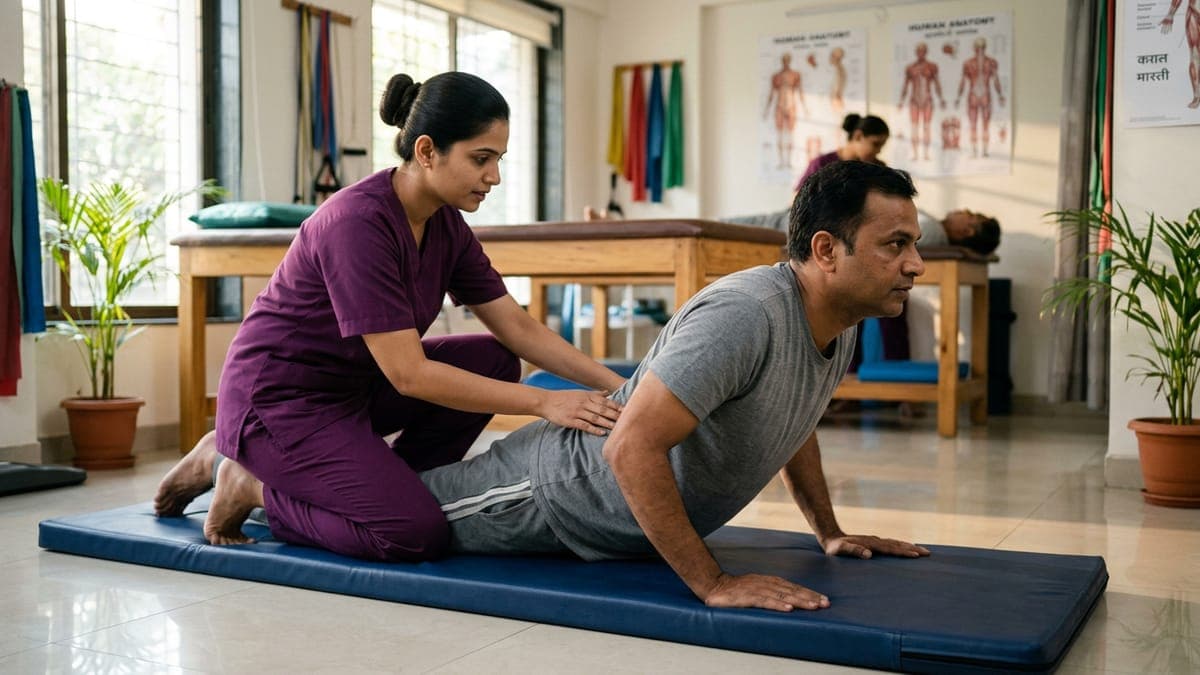
Disc Bulge: Not as Scary as It Sounds
Understanding Disc Injuries
Spinal discs act as shock absorbers between vertebrae. A disc bulge means the outer layer (annulus) has weakened and bulged outward.
A herniation means the inner nucleus has pushed through a tear in the annulus. Both can press on nearby nerves, causing local or referred pain.
Why Physiotherapy Works
The body has a natural ability to reabsorb herniated disc material. Physiotherapy accelerates this process while providing pain relief and preventing recurrence through core strengthening.
Treatment Approach
- McKenzie method: Direction-specific exercises that centralise and resolve disc-related pain
- Neural mobilisation: Sciatic nerve gliding exercises to restore nerve mobility
- Core stabilisation: Multifidus and transversus abdominis activation to protect the disc during daily activities
- Postural education: Correct sitting, lifting, and bending techniques to reduce disc load
- Traction therapy: Gentle spinal decompression to reduce disc pressure
When Is Surgery Needed?
Emergency surgery is needed only if you experience progressive leg weakness, bowel or bladder dysfunction (cauda equina syndrome). Otherwise, give physiotherapy at least 6-12 weeks before considering surgical consultation.
Book Your Disc Assessment
Contact Realign Clinic Faridabad for expert disc injury assessment and physiotherapy treatment.
Sources & References
- Boden SD et al. (1990). Abnormal MRI scans of the lumbar spine in asymptomatic subjects. JBJS, 72(3):403–408.
- Zhong M et al. (2017). Incidence of spontaneous resorption of lumbar disc herniation. Pain Physician, 20:E45–E52.
- Clare HA et al. (2004). A systematic review of efficacy of McKenzie therapy for spinal pain. Spine, 29(23):2699–2706.
Content author: Dr. Vaishali Suri (P.T.), MPT (Sports Medicine), BPT, MIAP, MIAP.
Why Evidence-Based Physiotherapy Makes the Difference
At Realign Rehab Clinic , NIT-5, Faridabad, every treatment plan is grounded in current clinical evidence and built around the individual patient. We do not follow generic protocols — we identify the root cause of your specific presentation and design a programme that directly addresses it.
This approach consistently produces faster recovery, more durable results, and lower recurrence rates than passive or symptom-only management.
Frequently Asked Questions About This Condition
How soon will I see results from physiotherapy?
Most patients notice measurable improvement within 3–4 sessions. Clear functional progress typically occurs within 4–8 weeks.
The speed of recovery depends on the severity and chronicity of your condition, your compliance with the home exercise programme, and the accuracy of the diagnosis.
Do I need a referral to see a physiotherapist in Faridabad?
No referral is needed to see a physiotherapist at Realign Rehab Clinic. You can self-refer directly by calling +91 9818185589 .
We will assess your condition and determine if any imaging or specialist referral is required.
What should I do between physiotherapy sessions?
Your physiotherapist will provide a specific home exercise programme to perform between sessions. Consistency with these exercises is the single most important factor in your recovery speed.
Activity modification advice (what to avoid) is equally important and will be explained at each session.
Can I return to work and sport while receiving physiotherapy?
In most cases, yes — with appropriate modifications. Our physiotherapist will provide clear, specific activity guidelines based on your condition and progress.
Returning to work and sport earlier (with modifications) usually produces better outcomes than prolonged rest.
Contact Realign Rehab Clinic, Faridabad
Ready to start your recovery? Realign Rehab Clinic offers thorough physiotherapy at NIT-5, Faridabad, and home visits across all sectors of Faridabad including Green Field Colony, Ballabhgarh, and Sector 21–82.
- 📍 NIT-5, Faridabad (near Green Field Colony, Ballabhgarh Road)
- 📞 +91 9818185589
- 🕑 Mon–Sat: 8 AM–8 PM
Take the Next Step Towards Recovery
Living with persistent pain affects every aspect of daily life — from work performance to sleep quality and emotional well-being. The good news is that evidence-based physiotherapy consistently delivers lasting relief without reliance on long-term medication or invasive procedures.
At Realign Rehab Clinic, NIT-5, Faridabad, our team brings physiotherapy expertise directly to your recovery journey. Whether you are managing an acute flare-up or a long-standing chronic issue, we design every programme around your anatomy, lifestyle, and goals — not a one-size-fits-all protocol.
Call +91 9818185589 or walk into our NIT-5 clinic to book your initial assessment. Same-week appointments are usually available, and home visit physiotherapy can be arranged across Faridabad for patients who find travel difficult.
Related Articles: Lumbar Disc Herniation Treatment in Faridabad: Physiotherapy for Slipped Disc | Slip Disc Treatment in Faridabad: Can Physiotherapy Avoid Surgery? | Wrist Pain from Keyboard and Mouse Use in Faridabad: Physiotherapy Solutions | Physiotherapy and Exercise for Weight Loss in Faridabad
Related Conditions: Wrist Pain Treatment | Urinary Incontinence Treatment | Tennis Elbow Treatment
Related Services: Advanced Sports Physiotherapy | Pediatric Physio