
 Dr. Vaishali Suri (P.T.)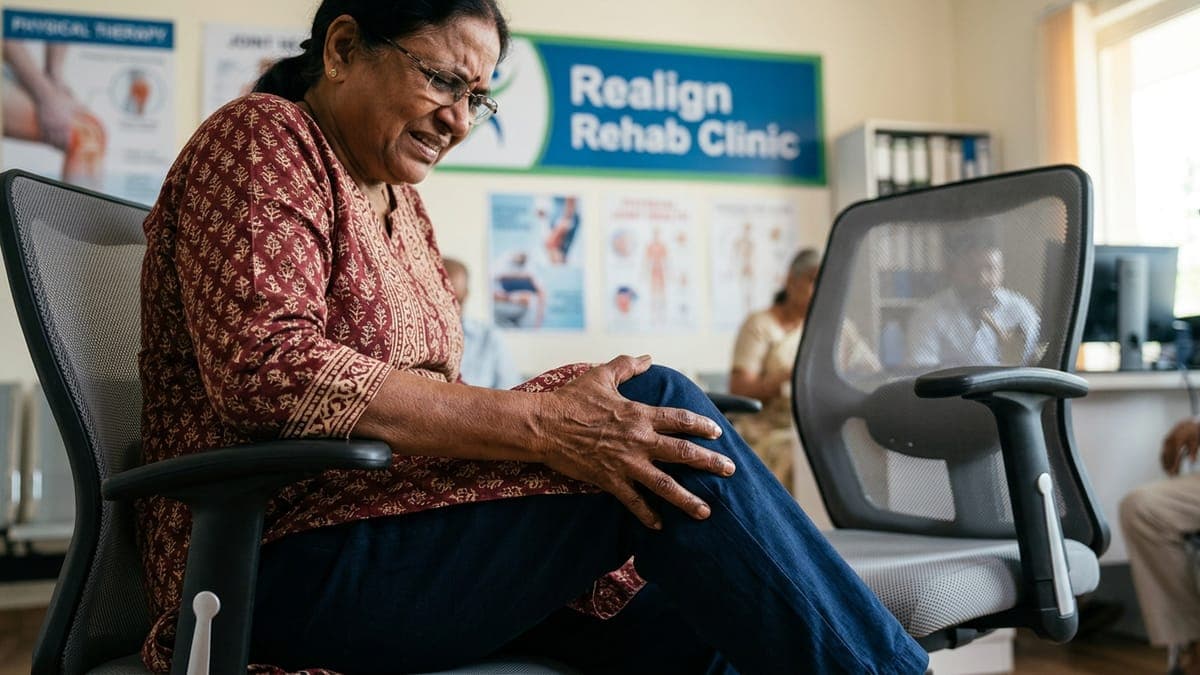
Knee Pain After Sitting: Patellofemoral Pain Physiotherapy in Faridabad
Knee pain that develops after prolonged sitting — particularly stiffness and aching when getting up from a chair, worsening on stairs, or pain when sitting with the knee bent for extended periods. Is the hallmark of patellofemoral pain syndrome (PFPS).
It is one of the most common knee complaints in young adults, adolescents, and desk workers, and responds very well to targeted physiotherapy.
At Realign Rehab Clinic , NIT-5, Faridabad, our expert physiotherapist Dr. Vaishali Suri provides evidence-based treatment designed for your specific needs.
We serve patients from NIT, Sector 14, Old Faridabad, Green Field Colony, Ballabhgarh, Surajkund, and surrounding areas.
Causes and Risk Factors
- Patellofemoral malalignment — the kneecap tracking laterally rather than centrally in the femoral groove
- Weak hip abductor and external rotator muscles causing excessive knee valgus
- Tight lateral structures — iliotibial band, lateral retinaculum pulling the patella laterally
- Rapid increase in running or exercise volume — classic in students starting new fitness regimes
- Prolonged sitting with the knee at 90° creating sustained patellofemoral joint compression
- Flat feet causing excessive tibial internal rotation and patella malalignment
Signs and Symptoms
- Anterior knee pain aggravated by prolonged sitting — the 'cinema sign'
- Pain when climbing stairs, particularly descending
- Aching and stiffness when standing up after sitting for more than 20–30 minutes
- Pain during or after running, squatting, or lunging
- Grinding or crepitus (grating sensation) under the kneecap
- Occasional swelling around the knee with activity
Physiotherapy Treatment at Realign Rehab, Faridabad
- Hip strengthening — gluteus medius, hip abductors, and external rotators (most evidence-backed intervention)
- Quadriceps strengthening — VMO emphasis with terminal knee extension
- Patellar mobilisation and taping to improve patellar tracking
- Iliotibial band and lateral retinaculum stretching
- Foot orthotic assessment — correcting pronation that contributes to valgus knee mechanics
- Running retraining — increasing cadence and reducing heel-strike to lower patellofemoral joint reaction force
Frequently Asked Questions
Why does my knee hurt more when I sit for a long time?
Sitting with the knee bent at 90° creates sustained pressure on the patellofemoral joint. After prolonged sitting, the joint is irritated, which is why the first few steps after sitting are painful until the joint warms up.
Should I avoid stairs and squats with PFPS?
Initially, yes — activities that load the patellofemoral joint at deep knee flexion should be reduced. But the goal is progressive reloading, not permanent avoidance.
Physiotherapy guides you through a graduated return to full knee loading.
How long does patellofemoral pain take to resolve?
Most patients see real improvement within 6–8 weeks of consistent physiotherapy, particularly when hip strengthening is the focus. Full resolution typically takes 3–4 months. A maintenance programme prevents recurrence.
Is knee pain after sitting related to my shoes?
Footwear and foot biomechanics are important contributing factors for many PFPS patients. Excessive pronation (flat feet) rotates the tibia internally, stressing the patellofemoral joint.
Orthotic assessment is often part of our PFPS management programme.
Book Your Consultation
Ready to get back to pain-free living? Contact Realign Rehab Clinic today.
📍 NIT-5, Faridabad (near Green Field Colony, Sector 15)
📞 +91 9818185589
🕑 Monday–Saturday: 9 AM–7 PM
Related Articles: Back Pain When Sitting in Faridabad: Physiotherapy for Desk Workers | Knee Pain in Elderly Adults in Faridabad: Physiotherapy Without Surgery | Knee Pain When Climbing Stairs in Faridabad: Physiotherapy Solutions | Wrist Pain from Keyboard and Mouse Use in Faridabad: Physiotherapy Solutions
Related Conditions: Wrist Pain Treatment | Postpartum Back Pain Relief | Knee Pain Treatment
Related Services: Advanced Sports Physiotherapy | Pediatric Physio