 Dr. Vaishali Suri (P.T.)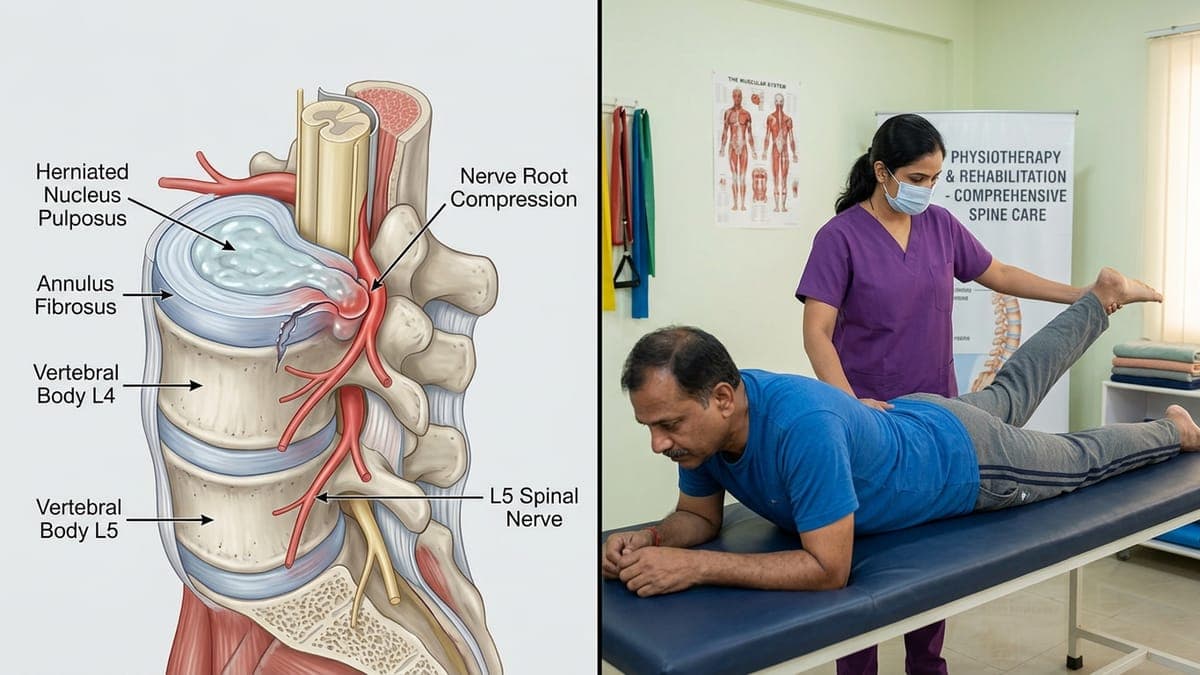
Lumbar Disc Herniation: Physiotherapy Treatment in Faridabad
At Realign Rehab Clinic, NIT-5, Faridabad, our expert physiotherapists provide personalised, evidence-based care. Serving NIT, Green Field Colony, Ballabhgarh, Sector 21–82, and across Faridabad. Contact us: +91 9818185589.
Causes and Risk Factors
- Degenerative disc disease: age-related loss of disc hydration and annular weakening
- Acute trauma: heavy lifting with poor mechanics causing sudden annular rupture
- Repetitive flexion-loading: sustained bent-forward postures in manual workers
- Genetic predisposition: family history is a significant risk factor for disc disease
- Sedentary lifestyle with weak core musculature failing to protect the disc
- Smoking: reduces disc nutrition by impairing blood supply
- Obesity: increased axial loading on the lumbar disc
Signs and Symptoms
- Acute lower back pain — often with a specific precipitating event (lifting, bending)
- Sciatica: shooting pain radiating from the buttock down the leg in a dermatomal pattern
- Numbness and tingling in the leg and foot (L4: inner calf; L5: top of foot; S1: outer ankle)
- Weakness: foot drop (L4–L5), or calf weakness (S1)
- Pain worsened by sitting, forward bending, and coughing/sneezing
- Pain improved by walking, lying down with hips and knees flexed
- Cauda equina syndrome (rare emergency): bilateral leg weakness, bladder/bowel dysfunction
Physiotherapy Treatment at Realign Rehab, Faridabad
- Directional preference exercises (McKenzie Method): most effective early intervention
- Neural mobilisation (nerve flossing): sciatic nerve gliding to reduce perineural inflammation
- Core stabilisation: transversus abdominis and multifidus recruitment
- Manual therapy: lumbar joint mobilisation and distraction techniques
- Postural education: neutral spine technique for sitting, standing, and lifting
- Neurological monitoring: tracking dermatomal sensory and motor function
- Ergonomic assessment: workstation and vehicle seating modification
- Progressive return to activity: avoiding bed rest beyond 2–3 days
Frequently Asked Questions
Will I need surgery for a disc herniation?
Surgery is considered for severe, progressive neurological deficit or failed 6+ weeks of physiotherapy.
How long does a disc herniation take to heal?
Most patients have measurable improvement in pain and function within 6–10 weeks. Complete reabsorption of the disc material takes 6–12 months. Physiotherapy during this period prevents recurrence and restores strength.
Can I exercise with a disc herniation?
Yes — specific exercises are beneficial and essential. Bed rest beyond 2–3 days is counterproductive.
Our physiotherapist will prescribe directional preference exercises and nerve flossing matched to your specific herniation pattern.
What is sciatica?
Sciatica is pain radiating from the lower back down the leg, caused by compression or irritation of the sciatic nerve, most commonly from a disc herniation at L4–L5 or L5–S1. It typically follows a specific dermatomal pattern (strip down the leg).
Can physiotherapy treat sciatica from a disc herniation?
Yes — physiotherapy is the most evidence-based treatment for sciatica from disc herniation. Surgery is rarely needed.
Book Your Consultation
Contact Realign Rehab Clinic today:
- 📍 NIT-5, Faridabad (near Green Field Colony, Ballabhgarh Road)
- 📞 +91 9818185589
- 🕑 Mon–Sat: 8 AM–8 PM