
 Dr. Vaishali Suri (P.T.)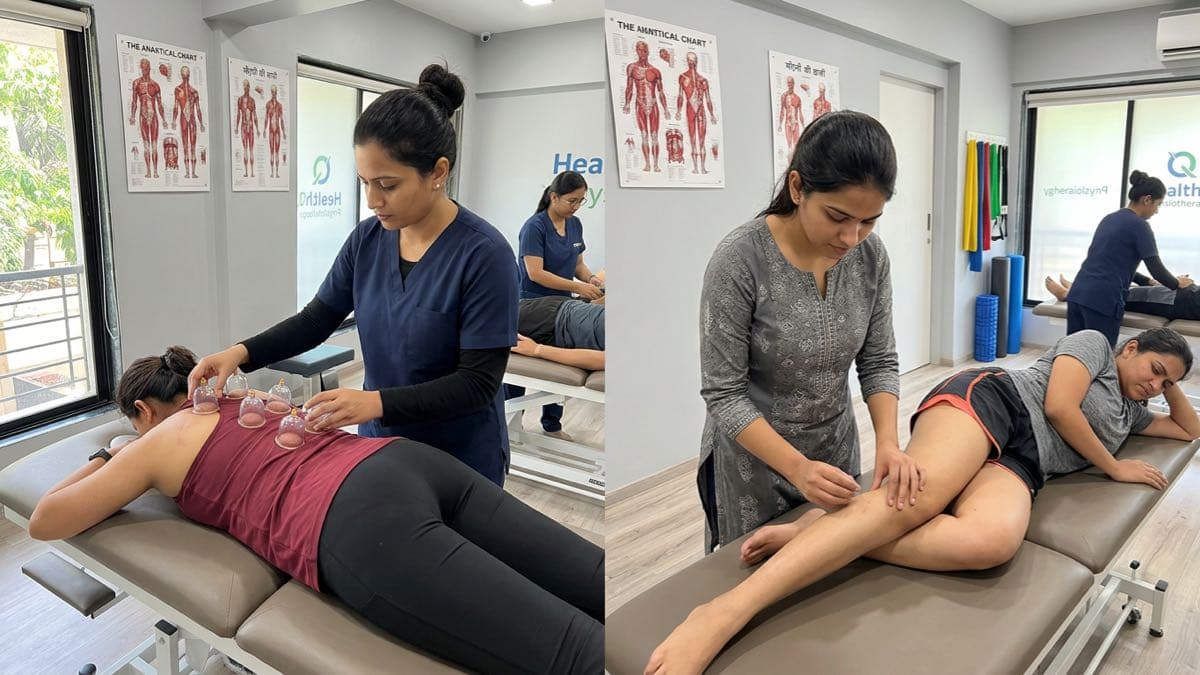
Cupping Therapy vs Dry Needling: Understanding Both Treatments
Both cupping therapy and dry needling are widely used in modern physiotherapy to treat pain and muscle dysfunction. While they target similar conditions — myofascial pain, trigger points, muscle tightness — they work through different mechanisms and are best suited for different patient profiles.
At Realign Rehab Clinic in Faridabad, our physiotherapists use both techniques and often combine them for real results.
Written and reviewed by Dr. Vaishali Suri (MPT (Sports Medicine), BPT, MIAP), Founder, Realign Rehab Clinic, NIT-5 Faridabad.
What Is Dry Needling?
Dry needling involves inserting thin acupuncture-style needles directly into trigger points — hyperirritable spots in taut bands of muscle. The term refers to the fact that no substance is injected — the therapeutic effect comes from the needle itself.
When the needle penetrates the trigger point, it often produces a brief involuntary contraction of the muscle fiber (twitch response), followed by relaxation and pain relief.
What Is Cupping Therapy?
Cupping therapy creates therapeutic negative pressure using suction cups placed on the skin. This decompression lifts the skin and superficial fascia upward, increasing blood flow, releasing fascial adhesions, and reducing trigger point activity.
Unlike dry needling, cupping is a completely non-invasive surface technique.
Key Differences: Cupping vs Dry Needling
- Mechanism: Dry needling uses compression and mechanical stimulation of trigger points. Cupping uses decompression to address broader fascial and circulatory issues simultaneously.
- Depth: Dry needling reaches directly into deep muscle tissue. Cupping primarily affects the skin, superficial fascia, and to a lesser extent the deeper muscle layers.
- Invasiveness: Dry needling is minimally invasive (punctures the skin). Cupping is completely non-invasive.
- Sensation: Dry needling can cause brief sharp pain, a muscle twitch, and post-treatment soreness for 24-48 hours. Cupping feels like a strong pulling sensation and leaves circular marks for 3-7 days.
- Best for: Dry needling excels for deep, focal trigger points. Cupping is ideal for large muscle groups, fascial restrictions, and patients who prefer non-invasive treatment.
Which Works Better for Pain?
Both treatments have strong evidence supporting their effectiveness for myofascial pain. A 2017 systematic review in the Journal of Orthopaedic and Sports Physical Therapy found that dry needling clearly reduces trigger point pain and improves function.
Reviews of cupping therapy in PLOS ONE and Evidence-Based Complementary and Alternative Medicine similarly found real pain reduction compared to controls.
The answer is not that one is always better — it depends on your specific condition:
- Choose dry needling if: You have identified deep trigger points in muscles like the psoas, piriformis, or subscapularis; you have cervicogenic headaches; you have nerve-related pain from trigger point referral.
- Choose cupping if: You have widespread muscle tension; you prefer non-invasive treatment; you want to complement exercise therapy; you need treatment over a large area like the full back or legs.
- Use both together if: You have chronic, complex pain conditions; you want complete tissue treatment; you are an athlete looking for maximum recovery benefit.
Can Cupping and Dry Needling Be Used Together?
Yes — and this is often the most effective approach. At Realign Rehab Clinic, we frequently combine dry needling to address specific deep trigger points with cupping to release the surrounding fascia and improve circulation.
This combination provides both focal trigger point treatment and broader tissue release, often producing faster results than either technique alone.
Safety: Cupping vs Dry Needling
- Cupping risks: Temporary skin marks (3-7 days), mild soreness, occasional lightheadedness. Avoid over broken skin, in pregnancy, or with bleeding disorders.
- Dry needling risks: Temporary post-treatment soreness (24-48 hours), rare bruising, very rare risk of infection (mitigated by sterile single-use needles). Not suitable for needle-phobic patients or those with bleeding disorders.
Frequently Asked Questions
Which treatment is better for back pain treatment?
For most back pain patients, cupping therapy is excellent for releasing the lumbar muscles and thoracolumbar fascia, while dry needling can target specific deep trigger points. A combination is often most effective.
Your physiotherapist will assess which is appropriate for your specific condition and response.
Does dry needling hurt more than cupping?
Most patients find cupping more comfortable during treatment. Dry needling involves momentary sharp pain and can produce a strong muscle twitch.
However, many patients report that dry needling produces more immediate relief for specific trigger points despite the brief discomfort during the procedure.
How many sessions of each do I need?
Typically 4-8 sessions of either modality are recommended for chronic pain, alongside exercise therapy. The number depends on your condition severity and duration.
Your physiotherapist will review your progress and adjust the plan accordingly.
Book Cupping Therapy or Dry Needling in Faridabad
Not sure which treatment is right for you? At Realign Rehab Clinic in Faridabad, our physiotherapists will assess your condition and recommend the most appropriate approach — whether that is cupping, dry needling, or a combination.
Call +91 9818185589 or book online.
References
- Gattie M, et al. The Effectiveness of Trigger Point Dry Needling for Musculoskeletal Conditions by Physical Therapists. JOSPT. 2017;47(3):133-149.
- Cao H, et al. An updated systematic review of the evidence for wet cupping therapy. PLOS ONE. 2018;13(8):e0200433.
- Kietrys DM, et al. Effectiveness of dry needling for upper-quarter myofascial pain. JOSPT. 2013;43(9):620-634.
- Lauche R, et al. A systematic review and meta-analysis of cupping therapy for musculoskeletal pain. Eur J Integr Med. 2012;4(3):e265-e276.
Related Articles: Acupuncture vs Dry Needling in Faridabad: What's the Difference? | Heat vs Cold Therapy: Which Is Right for Your Pain? | Physiotherapy Guide | Dry Needling in Faridabad: Trigger Point Therapy for Muscle Pain | Cupping Therapy Benefits & Types Explained — Faridabad
Related Services: Dry Needling Therapy | Cupping Therapy