
 Dr. Vaishali Suri (P.T.)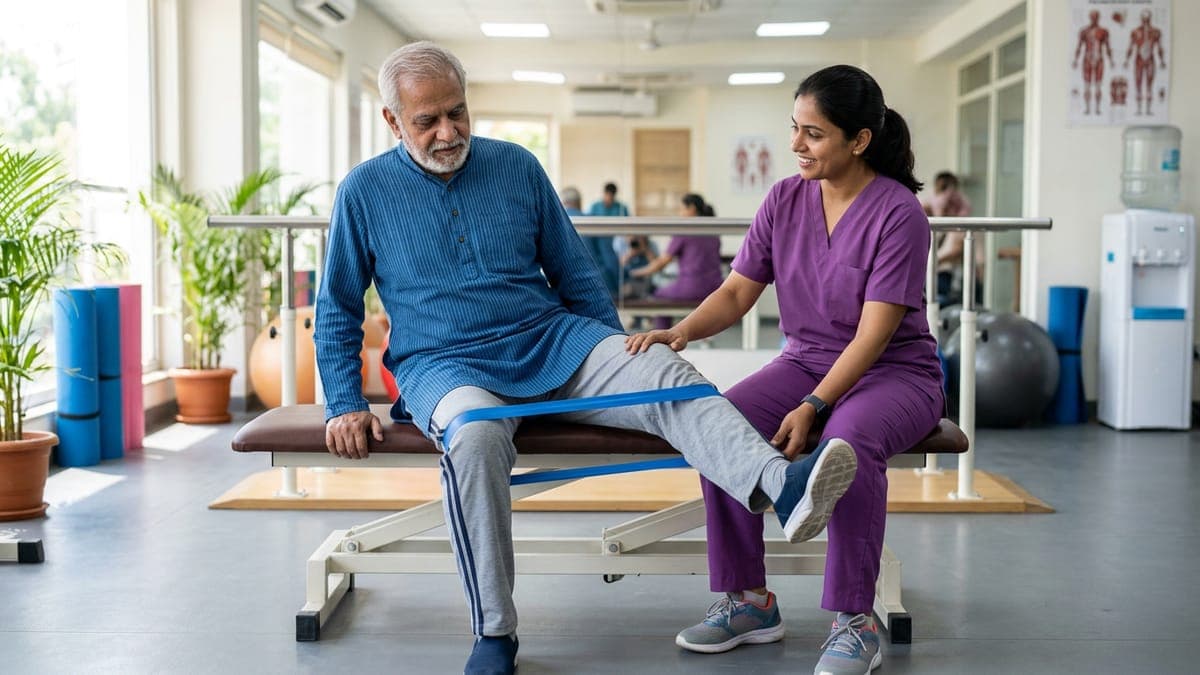
What Is Hip Osteoarthritis?
Hip osteoarthritis (hip OA) is the progressive loss of articular cartilage in the hip joint, accompanied by changes in the subchondral bone, formation of osteophytes (bone spurs), and inflammation of the joint capsule. It is one of the leading causes of disability in adults over 50 worldwide and is particularly prevalent in Faridabad's growing elderly population.
Hip OA causes groin pain, stiffness, and difficulty with walking, sitting-to-standing, and climbing stairs. But physiotherapy can clearly reduces pain, improve function, and in many cases delay or prevent the need for hip replacement surgery.
Causes and Risk Factors
- Age (most common over 50 — cartilage deterioration is age-related)
- Obesity (each kg of excess weight adds 3–6 kg of force through the hip)
- Previous hip injury: fracture, labral tear, hip impingement (FAI)
- Developmental hip dysplasia
- Occupational loading: farmers, construction workers, heavy manual labourers
- Genetics (family history of OA)
- Female sex (higher prevalence after menopause)
Symptoms of Hip Osteoarthritis
- Groin pain — the most reliable indicator of hip OA (not outer hip/buttock)
- Pain referring to the thigh, knee, or even lower leg
- Morning stiffness lasting 15–30 minutes (less than RA)
- Reduced range of motion — particularly hip internal rotation and flexion
- Difficulty with: sitting-to-standing, putting on shoes, climbing stairs
- Antalgic gait (limping) in advanced cases
- Crepitus (grinding) with hip movement
Hip OA Physiotherapy at Realign Clinic Faridabad
Exercise Therapy (OARSI Gold Standard)
Hip strengthening (gluteus medius, gluteus maximus, hip flexors), aerobic conditioning (cycling preferred over high-impact activities), balance training. Progressive exercise over 12–16 weeks noticeably reduces pain and improves walking distance, stair-climbing, and function.
Exercise is the single most evidence-based treatment for hip OA.
Manual Therapy
Hip joint mobilisation (longitudinal distraction, anterior-posterior glides) provides immediate pain relief and improves range of motion. Manual therapy combined with exercise outperforms either treatment alone.
We use joint mobilisation as an adjunct to the exercise programme, not as a standalone treatment.
Aquatic Physiotherapy
We can recommend hydrotherapy facilities in Faridabad where appropriate.
Education and Activity Modification
Advice on activity modification (preferred activities, activities to limit), footwear, walking aids, weight management strategies, and flare management. Self-management education improves long-term outcomes in OA.
Home Exercises for Hip Osteoarthritis
Supine Hip External Rotation Stretch
Lying on your back, feet flat. Let one knee fall outward to the side and gently press it further with light hand pressure.
Hold 30 seconds, 3 times. Stretches the hip capsule and external rotators — reduces the stiffness of hip internal rotation loss typical of hip OA.
Standing Hip Abduction
Stand holding a support. Lift the leg directly sideways 20–30°, slowly lower. 3 sets of 15.
Strengthens gluteus medius — the most important hip muscle for walking mechanics and hip OA management.
Frequently Asked Questions — Hip Osteoarthritis
Q: Can physiotherapy delay hip replacement surgery?
Studies show structured exercise physiotherapy can delay hip replacement by 1–2 years on average in moderate hip OA. For mild to moderate OA, many patients avoid replacement entirely with a consistent long-term exercise programme.
Surgery remains the appropriate choice for severe end-stage OA with unacceptable pain and function limitation despite thorough conservative management.
Q: What is the best exercise for hip osteoarthritis?
Cycling (stationary or road) is often the best-tolerated exercise for hip OA — it loads the hip through range of motion with low impact. Swimming is also excellent.
Walking at a comfortable pace is beneficial. High-impact activities (running, jumping, heavy lifting) should be modified based on symptom response.
Q: Should I avoid sitting cross-legged with hip OA?
Cross-legged sitting (on floor) places the hip in combined flexion, abduction, and external rotation — a position that can aggravate hip OA, particularly in more advanced stages. Chair sitting with hips at 90° is more comfortable.
Low chairs that force deep hip flexion should be avoided. Your physiotherapist will provide specific advice for your situation.
Book Hip OA Physiotherapy in Faridabad
Call +91 9818185589. Realign Rehab Clinic, NIT-5, Faridabad. Also see: osteoarthritis treatment, joint replacement rehabilitation.
References
- Bannuru RR et al. (2019). OARSI guidelines for the non-surgical management of hip and knee OA. Osteoarthritis Cartilage, 27(11):1578–1589.
- French HP et al. (2011). Manual therapy for osteoarthritis of the hip or knee — a systematic review. Man Ther, 16(2):109–117.
Content author: Dr. Vaishali Suri (P.T.), MPT (Sports Medicine), BPT, MIAP, MIAP.
Related Articles: Hip Replacement Rehabilitation in Faridabad: Complete Recovery Guide | Snapping Hip Syndrome (Coxa Saltans) Treatment in Faridabad: Physiotherapy | Hip Replacement Home Physiotherapy in Faridabad: Recovery at Home | Hip Pain in Elderly Adults in Faridabad: Physiotherapy Treatment
Related Conditions: Osteoarthritis Management | Wrist Pain Treatment | Urinary Incontinence Treatment
Related Services: Wrist & Hand Therapy | Taping & Bracing