
 Dr. Vaishali Suri (P.T.)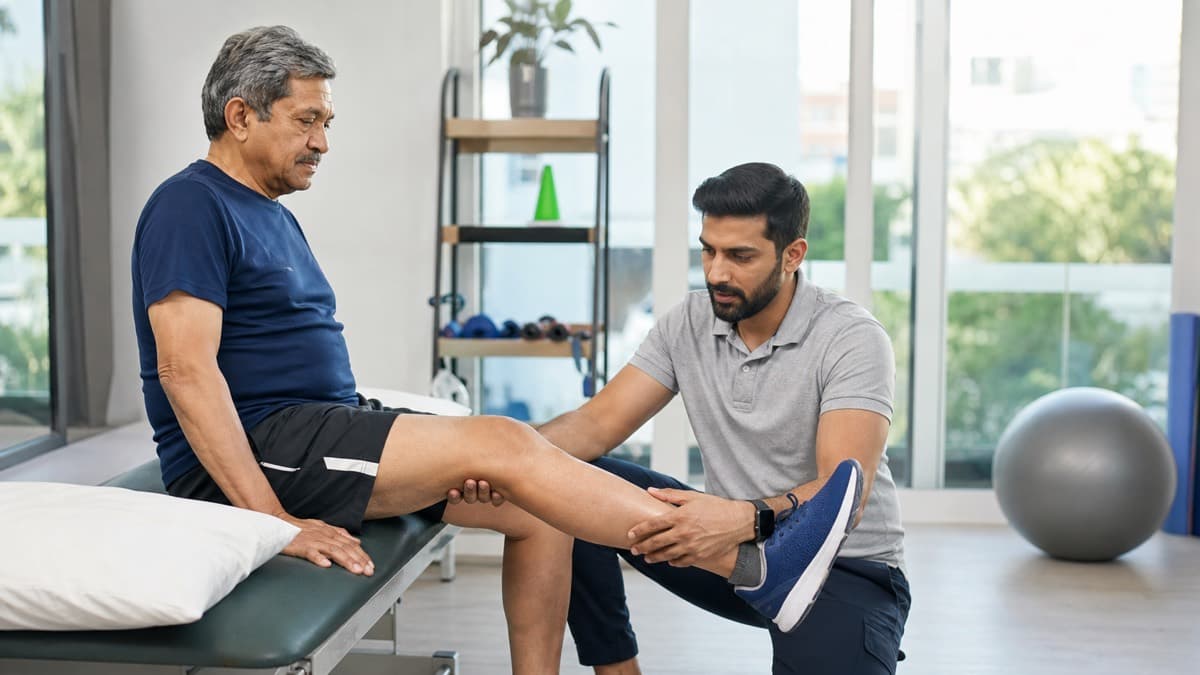
Quick answer: How early outpatient or home rehabilitation may progress movement, gait and functional strength. The right plan depends on the surgeon’s instructions, wound status, medical history and an individual physiotherapy assessment; this guide does not prescribe a universal exercise dose.
Knee Replacement Physiotherapy During Weeks 2–6
This stage is not a deadline. Surgical approach, medical history, wound status, pain control, strength and the hospital pathway all influence what is appropriate.
A physiotherapist checks transfers, walking quality, knee movement, muscle control and the response to the previous exercise dose before progressing the plan.
What an assessment should establish
Reassessment compares current function with the patient’s own recent baseline. It considers pain behaviour, swelling, wound status, walking, transfers, confidence and the home setup before load is changed.
The NICE joint-replacement guideline recommends rehabilitation on the day of surgery when possible and no more than 24 hours after primary elective replacement, including daily-activity advice, a home exercise programme and mobilisation. The exact pathway remains subject to medical stability and local surgical instructions.
How this phase fits into the wider recovery
A phase label is useful for orientation, but it does not clear a patient for a task. The physiotherapist compares current function with the previous review, checks whether symptoms settle after activity and confirms that the next progression remains consistent with the surgeon’s instructions. A slower week does not automatically mean failure, and a good day does not justify skipping stages of support.
- What changed since discharge or the last review?
- Which daily task is still limited?
- Does the exercise response settle by the next day?
- Has the surgeon changed any precautions?
Four practical priorities for this topic
Progress is based on function, not a generic calendar
The relevance of “Progress is based on function, not a generic calendar” depends on the recent baseline. A small change can be important when it affects walking, transfers or safety, while a larger numerical change may not matter if movement quality worsens. Reassessment keeps the decision linked to function.
Extension and comfortable flexion are monitored
Extension and comfortable flexion are monitored should be checked alongside the hospital discharge advice and current medical status. It is not a universal milestone. The safest progression is the one the patient can perform with control and recover from without a concerning symptom increase.
Walking quality matters more than abandoning an aid
In how early outpatient or home rehabilitation may progress movement, gait and functional strength, walking quality matters more than abandoning an aid can influence both confidence and independence. Practice should begin in a predictable setup, add challenge gradually and retain enough support for good technique. New instability, sharp pain or marked swelling changes the plan.
Exercise load should settle between sessions
Exercise load should settle between sessions is a practical checkpoint within how early outpatient or home rehabilitation may progress movement, gait and functional strength. The physiotherapist observes whether it improves safety or function, records the response and changes only one part of the task at a time. If performance deteriorates, the previous level of support may remain appropriate.
These priorities are prompts for discussion, not a substitute for the programme issued by the hospital or treating physiotherapist. Exercise should be scaled to the person’s current ability and recovery response.
How physiotherapy may progress the plan
Link each exercise to a functional goal, practise the goal itself and record whether assistance or control changes. Progress can mean better quality or less help; it does not always mean more repetitions.
The APTA-sponsored clinical practice guideline for physical therapist management after total knee arthroplasty supports structured rehabilitation while emphasising assessment-led decisions. It does not justify identical exercises or guaranteed timelines for every patient.
Home and clinic physiotherapy in Faridabad
Patients may attend Realign Rehab Clinic in NIT-5 or ask whether a selected Faridabad home visit is suitable. Home care is not automatically safer; the decision considers medical status, travel, mobility and the environment.
Use the main knee replacement rehabilitation guide, the home-visit guide and the complete topic library to navigate related questions.
When to contact the surgical team
Patients and caregivers need a clear escalation plan. Wound drainage, fever, spreading heat or redness, severe new pain, calf symptoms or unexpected decline should be discussed with the surgical team; chest symptoms are an emergency.
See the NHS knee-replacement complications guidance and follow the treating hospital’s local instructions.
Frequently asked questions
Does slower progress mean failure?
No. A plateau or setback should prompt reassessment, not blame.
Who clears restricted activities?
The surgeon provides medical and implant-related clearance; the physiotherapist contributes functional preparation.
Sources and clinical review
- NICE NG157: Joint replacement recommendations
- Physical Therapist Management of Total Knee Arthroplasty clinical practice guideline
- NHS: Recovering from a knee replacement
- NHS: Complications of a knee replacement
Clinical note: This article is general education and requires clinical review before it is treated as an individual plan. The hospital discharge instructions and treating surgeon’s precautions take priority.