 Dr. Vaishali Suri (P.T.)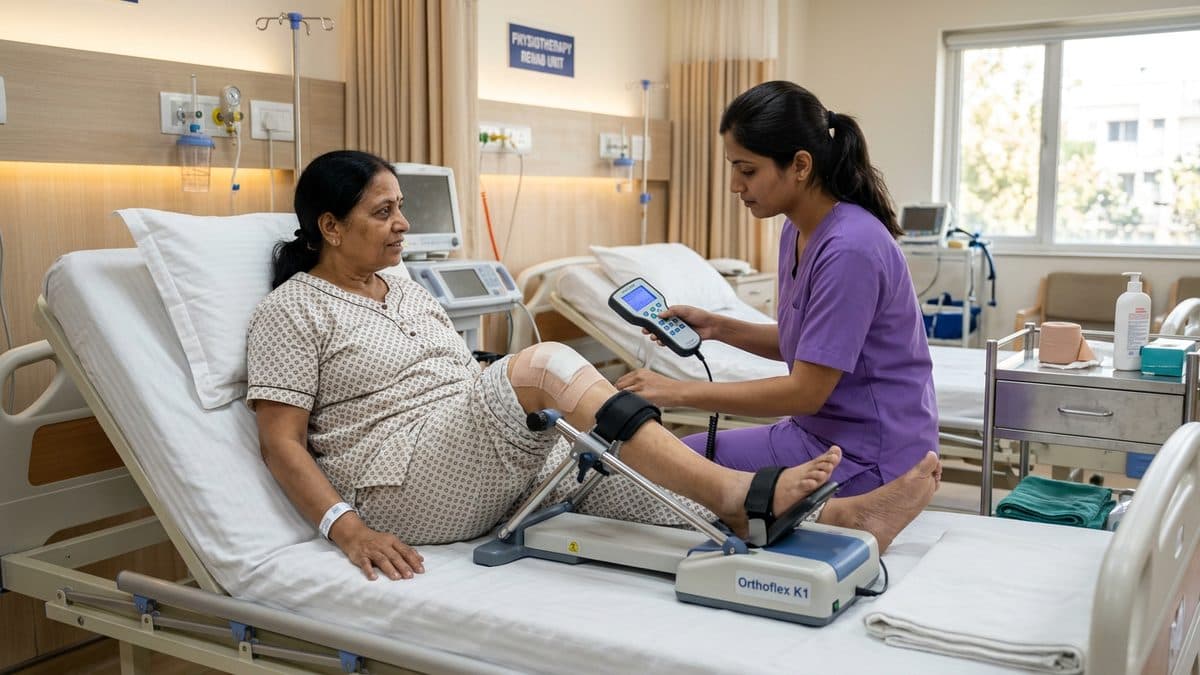
Knee Replacement Rehabilitation: The Key to a Successful Outcome
Total knee replacement (TKR) is a transformative surgery for end-stage knee osteoarthritis treatment — but the surgery itself only restores the joint surface. Physiotherapy rehabilitation is what translates the new joint into pain-free walking, stair climbing, and return to daily activities.
Research consistently shows that patients who receive structured rehabilitation achieve clearly better outcomes than those who do not: better range of motion, stronger quadriceps, greater walking distance. Superior quality of life at 12 months.
Pre-Operative Prehabilitation: Starting Before Surgery
The best knee replacement rehabilitation starts 4–6 weeks before the operation. Prehabilitation — pre-operative physiotherapy — strengthens quadriceps and hip muscles, improves range of motion, and trains the movements you will need post-operatively.
Post-TKR Rehabilitation Programme
Phase 1: Acute Inpatient Phase (Days 0–5)
Physiotherapy begins Day 1 after surgery — standing with support, first walk. Immediate post-operative knee extension: the most critical early goal.
Foot and ankle pumps (DVT prevention). Quadriceps activation (quad sets — pressing knee down).
Target: 90° knee flexion before hospital discharge, full extension (straight knee).
Phase 2: Early Home Rehabilitation (Weeks 1–6)
Daily exercises: quad sets, heel slides, straight leg raises, seated knee flexion over a step, standing heel raises. Walking programme with crutches/walking frame — increasing distance daily.
Swelling management: elevation, ice 3–4 times daily. Scar mobilisation once wound healed (Week 3).
Target: 110–120° flexion by 6 weeks.
Phase 3: Progressive Strengthening (Weeks 6–12)
Step-ups, mini squats, leg press. Stationary cycling (gentle on the joint, excellent for flexion).
Gait normalisation — reducing limp, improving walking speed. Balance training: single-leg standing progress.
Return to driving (6–8 weeks for left leg, 8–12 weeks for right/operative leg with automatic car).
Phase 4: Return to Full Function (Months 3–12)
Long-distance walking, stairs without rails, community activities. Swimming, gardening, low-impact activities. Progressive return to recreational activities with surgeon clearance.
Range of Motion Milestones After Knee Replacement
- Day 1–3: Full extension (0°), 70–90° flexion target for hospital discharge
- Week 6: 110–120° for comfortable sitting and stair climbing
- Week 12: 120–130° for squatting tasks and floor activities
- Final maximum: Most TKR patients achieve 110–130° — floor sitting requires more
home physiotherapy After Knee Replacement in Faridabad
Realign Rehab Clinic provides home physiotherapy visits across Faridabad for TKR patients who cannot easily travel. Home sessions are especially important in the first 4 weeks when mobility is most limited.
Call +91 9818185589 .
Frequently Asked Questions — Knee Replacement Rehab
Q: How long until I can walk normally after knee replacement?
Walking with aids (frame/crutches): Day 1–3. Walking without aids: 4–8 weeks for most patients.
Normal-looking gait: 3–6 months as quadriceps strength fully returns. Most patients walk noticeably better by 3 months — though full recovery and normal gait takes up to 12 months in some cases.
Q: Will I be able to sit cross-legged (Indian floor sitting) after knee replacement?
Indian floor sitting and squatting require 130°+ knee flexion, which many TKR designs can achieve. Intensive early physiotherapy maximises flexion outcomes.
Discuss this functional goal explicitly with your surgeon at pre-operative planning — specific implant choices and precise surgical alignment affect maximum achievable flexion. At Realign Clinic, we include floor-sitting as a specific goal for Indian lifestyle patients.
Q: Do I need physiotherapy if the surgery went well?
Yes — absolutely. The surgery creates the new joint surface, but the muscles, proprioception, and movement patterns need rehabilitation to function at its best.
Without physiotherapy, even technically perfect surgery produces clearly worse functional outcomes. Quadriceps strength, gait pattern, balance, and confidence all require systematic rehabilitation to reach their potential.
Book Knee Replacement Physiotherapy in Faridabad
Call +91 9818185589. Realign Rehab Clinic, NIT-5, Faridabad. Expert post-surgical rehabilitation. Also see: joint replacement rehab, knee pain treatment without surgery.
References
- Mistry DA et al. (2016). A systematic review of randomised controlled trials of pre-operative rehabilitation for total knee replacement. BMJ Open, 6(1):e009405.
Content author: Dr. Vaishali Suri (P.T.), MPT (Sports Medicine), BPT, MIAP, MIAP.
Related Articles: Hip Replacement Rehabilitation in Faridabad: Complete Recovery Guide | Knee Replacement Home Physiotherapy in Faridabad: Recovery at Home | Runner's Knee (Patellofemoral Pain) Treatment in Faridabad | Post-Surgical Rehab: Recovery Guide
Related Conditions: Post-Surgery Rehab | Joint Replacement | Wrist Pain Treatment
Related Services: Orthopedic Physio