
 Dr. Vaishali Suri (P.T.)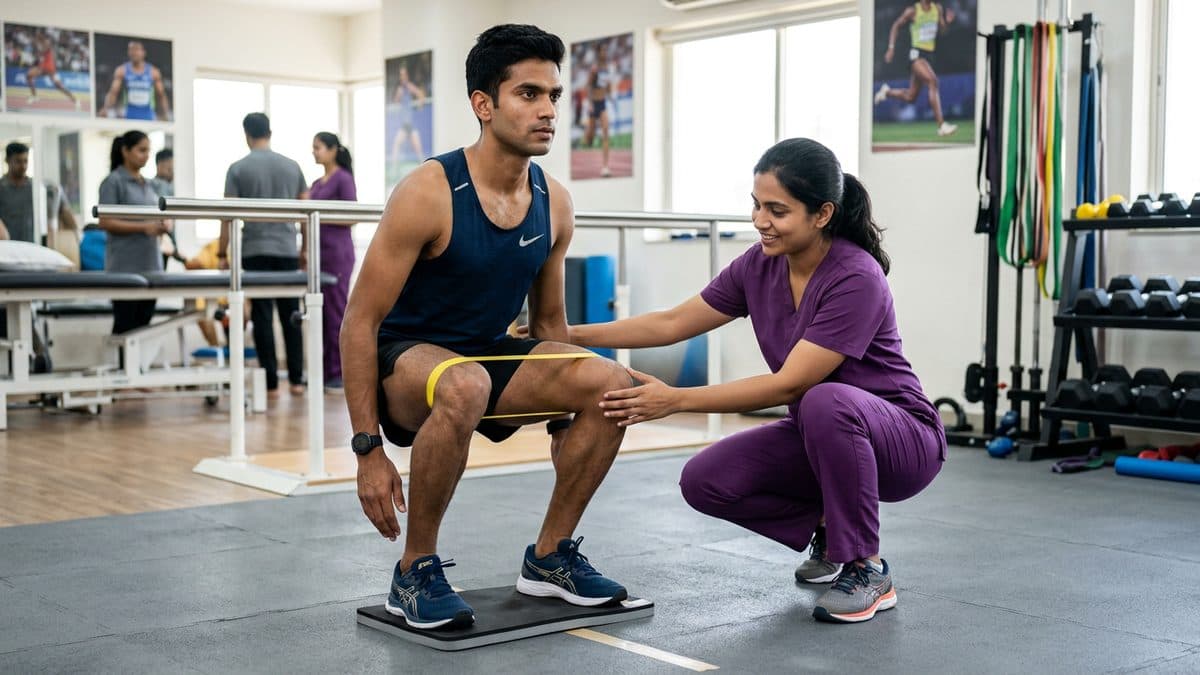
What Is Runner's Knee (Patellofemoral Pain Syndrome)?
Runner's knee — medically known as patellofemoral pain syndrome (PFPS) — is pain around or behind the kneecap (patella). It is the most common knee complaint among runners, cyclists, and active young adults.
In Faridabad, PFPS is extremely common among office workers who begin running programmes, students in sports, and athletes returning after periods of inactivity. The good news: physiotherapy resolves the majority of patellofemoral pain cases without surgery or injections.
Why Does Patellofemoral Pain Happen?
The patella tracks in a groove on the femur (the trochlear groove). When the surrounding muscles are imbalanced or the hip is weak, the patella tracks slightly laterally, creating uneven pressure on the cartilage underneath.
- Weak VMO (vastus medialis oblique): The inner quad muscle that pulls the patella medially — weakness allows lateral tracking
- Weak hip abductors and external rotators: Causes femoral internal rotation and valgus (knock-knee) loading
- Tight IT band and lateral retinaculum: Pulls the patella laterally
- Poor foot pronation control: Overpronation increases tibial internal rotation and patellar stress
- Training load errors: Too much too soon — particularly in new runners
Symptoms of Patellofemoral Pain
- Aching or sharp pain around or behind the kneecap
- Pain worse with prolonged sitting (cinema sign), stairs, squatting, kneeling
- Pain during or after running — especially downhill
- Crepitus (grinding sensation) under the kneecap with movement
- No locking, giving way, or noticeable swelling (distinguishes from meniscal injury)
- Positive Clarke's test on physiotherapy assessment
Patellofemoral Pain Treatment at Realign Clinic Faridabad
VMO and Quadriceps Strengthening
Short arc quads, terminal knee extensions, wall squats, and leg press (0–60° range to avoid peak patellofemoral stress) target the VMO and quadriceps while minimising painful loading. Progressive resistance with objective monitoring of pain response.
Hip Strengthening Programme
Gluteus medius exercises (clamshells, side-lying abduction, lateral band walks), hip external rotation exercises, and single-leg squat training with knee alignment feedback. This addresses the proximal driver of patellar maltracking in most patients.
McConnell Patellar Taping
A specific taping technique that draws the patella medially, immediately reducing patellofemoral joint stress and pain. Used in early rehabilitation to allow progressive loading with reduced pain.
We teach patients to self-apply the tape at home.
Running Gait Retraining
Exercises for Runner's Knee
Terminal Knee Extension
Resistance band behind the knee. Straighten the knee fully. 3 sets of 20. Activates VMO without full squat loading. Safe in acute and early rehabilitation phases. Daily from Day 1.
Step-Ups
Step onto a 15 cm step, keeping the knee aligned over the second toe. Lower slowly with control. 3 sets of 15 each leg.
Functional, weight-bearing VMO training that translates directly to stair climbing.
Single-Leg Squat with Mirror
Using a mirror for feedback, perform a single-leg squat ensuring the knee does not collapse inward. 3 sets of 10. The primary return-to-sport exercise for PFPS — criterion-based advancement when completed pain-free.
Frequently Asked Questions — Runner's Knee
Q: Can I keep running while treating runner's knee?
Complete rest is rarely necessary and leads to unnecessary deconditioning. We design running modifications so you can continue training while rehabilitating.
Q: Is runner's knee the same as chondromalacia patella?
Chondromalacia patella is a specific diagnosis of patellar cartilage softening — visible on MRI or arthroscopy. Patellofemoral pain syndrome is a clinical diagnosis that describes the pain pattern and does not necessarily involve cartilage damage.
Most PFPS has no identifiable cartilage damage. Treatment approaches are similar.
Q: How long does recovery from runner's knee take?
With thorough physiotherapy (hip + knee programme): 6–12 weeks to severe pain relief, 3–4 months for full return to unrestricted running. More rapid recovery is possible with early intervention.
Long-standing PFPS (over 1 year) takes longer due to movement habit changes and muscle atrophy that develop over time.
Q: What should I avoid with runner's knee?
Avoid full deep squats, lunges with knee past toes, prolonged sitting without breaks (set a 30-minute stand-up reminder), downhill running, and stairs beyond what is pain-free. These activities load the patellofemoral joint clearly and slow recovery.
Your physiotherapist will provide specific modifications for your activity level.
Book Runner's Knee Treatment in Faridabad
Call +91 9818185589. Realign Rehab Clinic, NIT-5, Faridabad. Expert physiotherapy for runners and active patients — also see our knee pain treatment and knee pain without surgery guides.
References
- Lack S et al. (2015). Hip and knee exercise versus knee exercise for patellofemoral pain. BJSM, 49(21):1379–1386.
- Crossley K et al. (2002). McConnell patellar taping for patellofemoral pain. BJSM, 36(2):95–99.
- Barton CJ et al. (2018). Gait retraining in patellofemoral pain. Br J Sports Med, 52(7):441–449.
Content author: Dr. Vaishali Suri (P.T.), MPT (Sports Medicine), BPT, MIAP, MIAP.
Related Articles: Knee Pain in Elderly Adults in Faridabad: Physiotherapy Without Surgery | Knee Pain When Climbing Stairs in Faridabad: Physiotherapy Solutions | Knee Pain After Sitting: Why It Happens and How Physiotherapy Helps | Knee Pain Physiotherapy in Faridabad: Causes, Diagnosis & Treatment
Related Conditions: Wrist Pain Treatment | Postpartum Back Pain Relief | Knee Pain Treatment
Related Services: Neck Pain Therapy | Manual Therapy