
 Dr. Vaishali Suri (P.T.)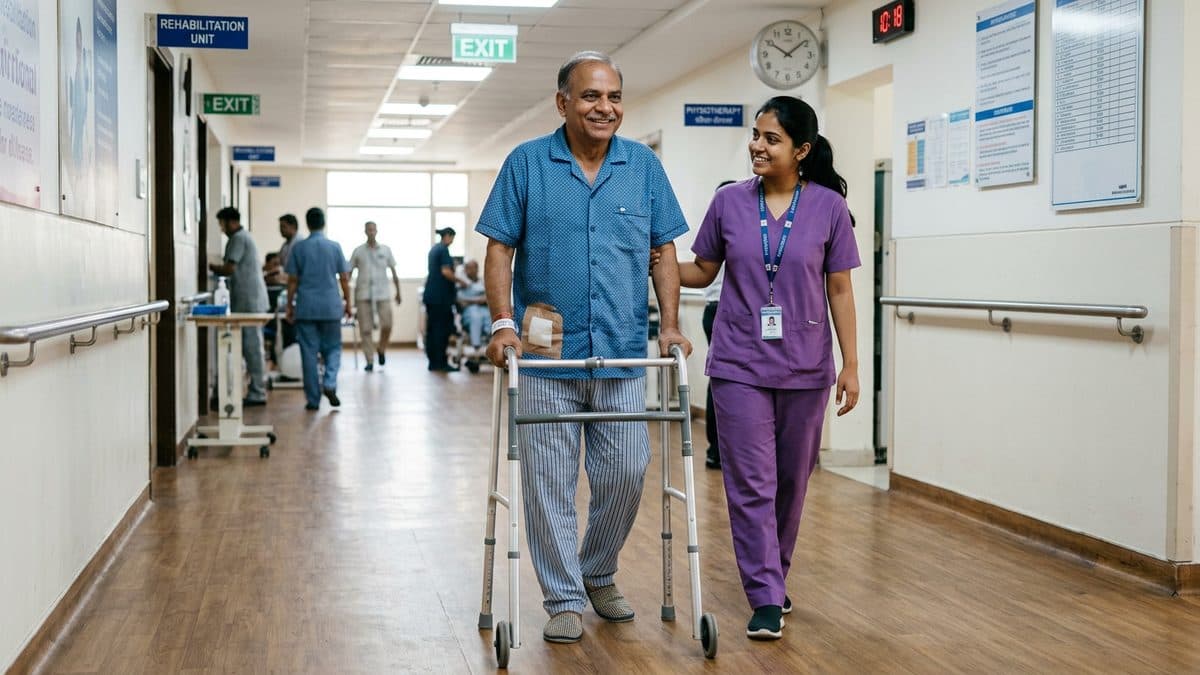
Hip Replacement Rehabilitation: Why Physiotherapy Is Essential
Total hip replacement (THR) is one of the most successful surgical procedures in modern medicine — relieving severe arthritis pain and restoring function in patients who have failed conservative management. But surgery is only half the story: physiotherapy rehabilitation is what transforms a successful operation into a functional, independent patient.
Without structured rehabilitation, hip replacement patients achieve considerably worse outcomes — more stiffness, slower recovery, higher fall risk, and reduced long-term function. At Realign Rehab Clinic in NIT-5, Faridabad, Dr.
Vaishali Suri (P.T.) provides full hip replacement rehabilitation both at clinic and through home visits across Faridabad.
Hip Replacement Rehabilitation: Phase-by-Phase Programme
Phase 1: Hospital Phase (Days 0–5)
Physiotherapy begins Day 1 after surgery — typically in the hospital. Goals: safe bed mobility, standing with a walking frame, first walking steps, stair assessment for discharge safety.
Breathing exercises to prevent pulmonary complications. Hip precautions education (varies by surgical approach): avoiding positions that risk dislocation in the first 6–12 weeks.
Phase 2: Early Home Rehabilitation (Weeks 1–6)
Walking programme progressing from frame to crutches to stick. Hip and quadriceps strengthening: heel slides, ankle pumps, static quads, supine hip abduction, knee extensions.
Scar mobilisation (from Week 3 once wound healed). Swelling management with elevation and compression.
Gait training to normalise walking pattern and reduce limp.
Phase 3: Progressive Strengthening (Weeks 6–12)
Standing exercises: hip abduction, hip extension, mini squats, step-ups. Stationary cycling (excellent low-impact hip rehabilitation).
Pool walking if accessible. Progressive weaning off walking aid.
Return to driving assessment (typically 6–8 weeks for automatic, 8–12 weeks for manual). Clearance for longer walks and gentle activities.
Phase 4: Return to Full Function (Months 3–12)
Single-leg strength and balance exercises. Functional activities: gardening, low-impact exercise, swimming. Return to lower-impact recreational activities. Long-term exercise programme for hip maintenance and osteoporosis prevention.
Hip Precautions After Replacement
Precautions depend on surgical approach. For posterior approach (most common in India): avoid hip flexion beyond 90°, hip adduction past midline, and internal rotation for 6–12 weeks. Practical implications:
- Sit in high chairs — not low sofas. Use a raised toilet seat.
- Do not cross legs when sitting or lying
- Sleep with a pillow between legs for first 6 weeks
- Do not bend forward to put on shoes — use a long-handled shoehorn
home physiotherapy for Hip Replacement in Faridabad
Realign Rehab Clinic provides home physiotherapy visits for hip replacement patients across Faridabad — including NIT, Sector 14, Old Faridabad, Ballabhgarh, and Green Field Colony. Home visits provide rehabilitation in the patient's own environment, where functional goals (stairs, bathroom, kitchen tasks) can be directly addressed.
Call +91 9818185589 .
Frequently Asked Questions — Hip Replacement Rehab
Q: How long does hip replacement rehabilitation take?
Most patients walk independently without aids by 6–12 weeks. Return to most daily activities: 3 months.
Return to gardening, low-impact activities: 3–6 months. Full functional recovery and return to golf, swimming, cycling: 6–12 months.
Pain-free function is typically achieved by 12 months in well-rehabilitated patients.
Q: When can I climb stairs after hip replacement?
Stair climbing with a rail begins in the hospital (Day 2–3) and is an essential safety requirement before discharge. Full stair use (alternating feet) typically returns by 4–8 weeks.
Initially: one step at a time with the good leg leading upstairs and operated leg leading downstairs ("up with the good, down with the bad").
Q: Should I do physiotherapy at home or at a clinic after hip replacement?
Both have strong evidence. Home-based programmes are equally effective when exercise compliance is maintained.
Many patients benefit from a combination: home-based daily exercises supplemented by clinic or home visit physiotherapy 2–3 times per week for hands-on assessment, progression. Gait training in the first 6–8 weeks.
Book Hip Replacement Physiotherapy in Faridabad
Call +91 9818185589. Realign Rehab Clinic, NIT-5, Faridabad. Also see: joint replacement rehabilitation, post-surgical rehabilitation.
References
- Minns Lowe CJ et al. (2009). Effectiveness of physiotherapy exercise after hip arthroplasty. BMJ, 337(7668):a2237.
Content author: Dr. Vaishali Suri (P.T.), MPT (Sports Medicine), BPT, MIAP, MIAP.
Related Articles: Hip Replacement Home Physiotherapy in Faridabad: Recovery at Home | Knee Replacement Rehabilitation in Faridabad: Recovery After TKR | Post-Fracture Stiffness Treatment in Faridabad: Physiotherapy After Any Fracture | Post-COVID Rehabilitation in Faridabad: Long COVID Physiotherapy
Related Conditions: Wrist Pain Treatment | Urinary Incontinence Treatment | Tennis Elbow Treatment
Related Services: Orthopedic Physio | Wrist & Hand Therapy