
 Dr. Vaishali Suri (P.T.)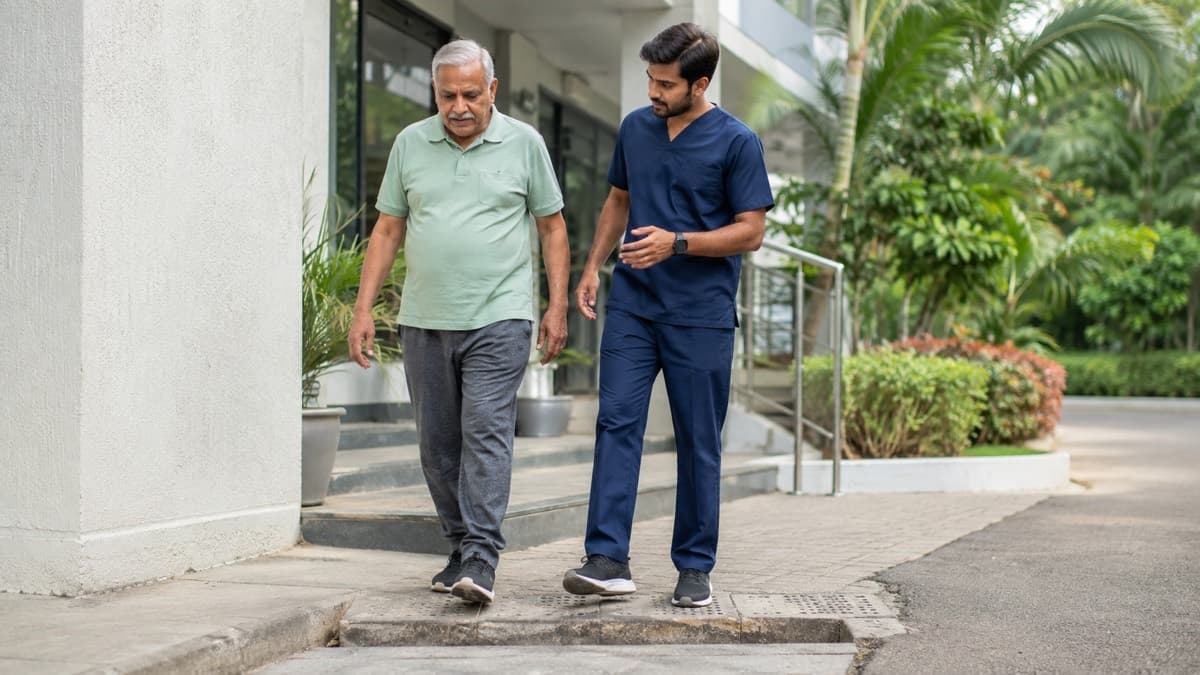
Quick answer: Progressing from indoor walking to uneven surfaces, curbs and community distances. The right plan depends on the surgeon’s instructions, wound status, medical history and an individual physiotherapy assessment; this guide does not prescribe a universal exercise dose.
Outdoor Walking After Knee Replacement
Return to this activity depends on wound healing, strength, balance, reaction time, the operated side, other health conditions and surgeon-specific restrictions.
A graded plan usually separates the task into smaller components, practises them in a safer environment and then increases duration or complexity.
What an assessment should establish
Bring the discharge sheet, operation details, medicine list and usual mobility aid. Review weight-bearing advice, wound concerns and changes since leaving hospital. Test movement, strength and walking only after establishing medical and environmental safety.
The NICE joint-replacement guideline recommends rehabilitation on the day of surgery when possible and no more than 24 hours after primary elective replacement, including daily-activity advice, a home exercise programme and mobilisation. The exact pathway remains subject to medical stability and local surgical instructions.
Break the activity into testable parts
Readiness is easier to judge when the activity is separated into strength, range, balance, endurance and environmental demands. A person may be able to practise one component while still needing clearance or assistance for the complete task. The final progression should be rehearsed under conditions that resemble real life without adding avoidable risk.
- What range and strength does the task require?
- Can it be simulated more safely first?
- What support or modification is available?
- What symptom response follows practice?
Four practical priorities for this topic
Begin on predictable surfaces
For this topic, “Begin on predictable surfaces” should be translated into an observable action rather than a vague instruction. It is practised in the context of progressing from indoor walking to uneven surfaces, curbs and community distances, then reviewed for pain, swelling, confidence and movement quality. The goal is repeatable function, not a one-off best attempt.
Keep the walking aid as needed
Keep the walking aid as needed belongs in the written plan so the patient and caregiver know what to do between visits. The instruction should include the setup, level of assistance and reason to stop. A verbal cue that works in clinic may need modification in the home environment.
Plan rest points
The relevance of “Plan rest points” depends on the recent baseline. A small change can be important when it affects walking, transfers or safety, while a larger numerical change may not matter if movement quality worsens. Reassessment keeps the decision linked to function.
Increase one variable at a time
Increase one variable at a time should be checked alongside the hospital discharge advice and current medical status. It is not a universal milestone. The safest progression is the one the patient can perform with control and recover from without a concerning symptom increase.
These priorities are prompts for discussion, not a substitute for the programme issued by the hospital or treating physiotherapist. Exercise should be scaled to the person’s current ability and recovery response.
How physiotherapy may progress the plan
Link each exercise to a functional goal, practise the goal itself and record whether assistance or control changes. Progress can mean better quality or less help; it does not always mean more repetitions.
The APTA-sponsored clinical practice guideline for physical therapist management after total knee arthroplasty supports structured rehabilitation while emphasising assessment-led decisions. It does not justify identical exercises or guaranteed timelines for every patient.
Home and clinic physiotherapy in Faridabad
Patients may attend Realign Rehab Clinic in NIT-5 or ask whether a selected Faridabad home visit is suitable. Home care is not automatically safer; the decision considers medical status, travel, mobility and the environment.
Use the main knee replacement rehabilitation guide, the home-visit guide and the complete topic library to navigate related questions.
When to contact the surgical team
Red flags override the exercise schedule. Stop and seek appropriate care for wound opening or discharge, fever, rapidly increasing pain or swelling, calf symptoms, a fall with functional loss, or a clear change outside the expected pattern.
See the NHS knee-replacement complications guidance and follow the treating hospital’s local instructions.
Frequently asked questions
Does slower progress mean failure?
No. A plateau or setback should prompt reassessment, not blame.
Who clears restricted activities?
The surgeon provides medical and implant-related clearance; the physiotherapist contributes functional preparation.
Sources and clinical review
- NICE NG157: Joint replacement recommendations
- Physical Therapist Management of Total Knee Arthroplasty clinical practice guideline
- NHS: Recovering from a knee replacement
- NHS: Complications of a knee replacement
Clinical note: This article is general education and requires clinical review before it is treated as an individual plan. The hospital discharge instructions and treating surgeon’s precautions take priority.