
 Dr. Vaishali Suri (P.T.)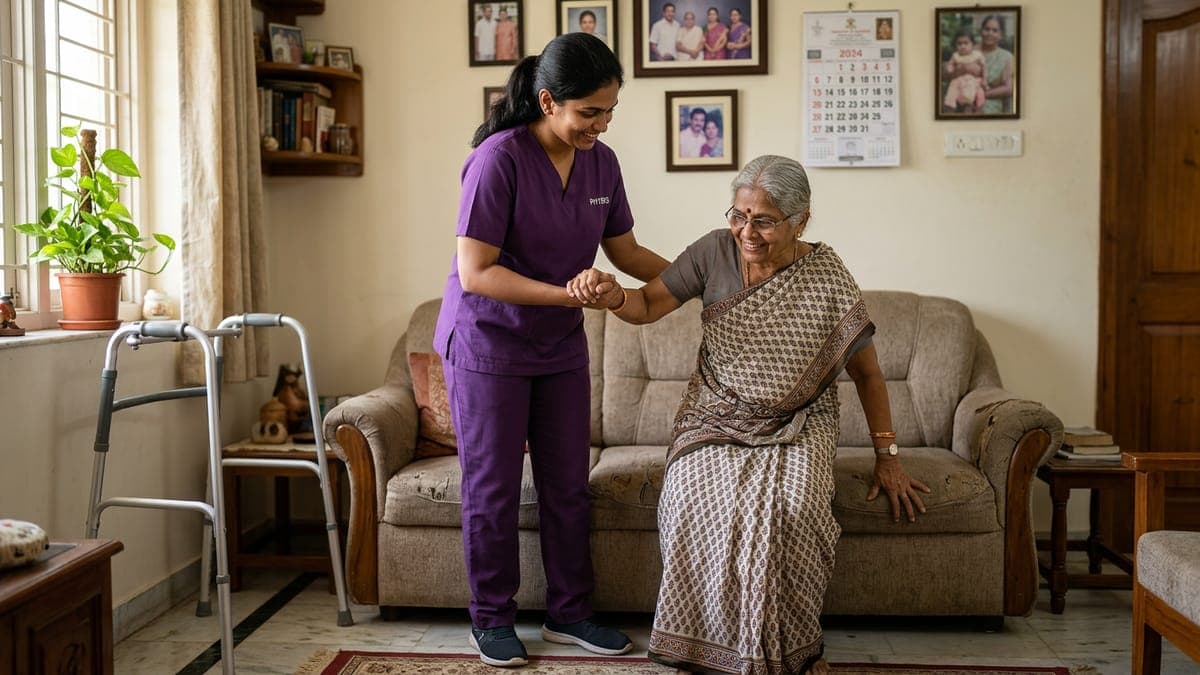
Why a Parkinson’s home routine should be individualized
Exercise is an important part of living with Parkinson’s, but a safe programme is more than a list of movements. Freezing, falls, blood-pressure changes, pain, fatigue, cognition, heart or lung conditions and medication response can all alter the appropriate exercise, dose and supervision.
NICE recommends Parkinson’s-specific physiotherapy for people with balance or motor-function problems and advises considering early physiotherapy for assessment, education and physical-activity guidance. The recommendation supports individualized care; it does not mean the same routine is suitable for everyone.
Four parts of a balanced Parkinson’s exercise plan
The Parkinson’s Foundation exercise recommendations organize activity into aerobic exercise, strengthening, flexibility, and balance, agility and multitasking. An individual plan may combine these domains across the week.
1. Aerobic activity
Walking, a stationary cycle, supported stepping, swimming or another rhythmic activity may build endurance and support general health. The choice depends on balance, freezing, joint symptoms, cardiovascular status and access to supervision. Someone who freezes frequently may be safer on a stationary device than walking alone outdoors.
2. Strength training
Strength work may target the legs, hips, trunk, back and arms for functions such as standing from a chair, climbing stairs, carrying and maintaining upright posture. Resistance and repetitions should allow controlled movement without breath-holding, marked pain or unsafe fatigue.
3. Flexibility and posture
Active movement and selected stretches can address stiffness and reduced movement range. The aim is comfortable, usable motion—not forcing a joint to the end of range. Osteoporosis, joint replacement, spine problems and pain may require modification.
4. Balance, agility and multitasking
Stepping in different directions, weight shifting, turning, reaching and changes of speed or direction may be included. These tasks should be challenging enough to train balance but safe enough to avoid an uncontrolled fall. Dual-task practice is introduced only when single-task movement is stable enough.
Before beginning a home exercise session
- Choose the usual “on” medication period if this is when movement is safest, unless the treating team advises otherwise.
- Clear loose rugs, wires, pets and clutter from the exercise area.
- Use supportive footwear and a stable chair or counter when prescribed.
- Keep the walking aid within reach rather than setting it aside for exercise.
- Check for unusual dizziness, faintness, chest symptoms, fever, injury or a marked change from the person’s normal state.
- Have supervision when the physiotherapist recommends it.
A warm room, dehydration and standing up quickly can worsen light-headedness for some people. Sit down safely if dizziness occurs and discuss recurrent symptoms with the medical team.
A practical home-session framework
This framework helps organize a prescribed programme; it is not a universal prescription.
- Movement preparation: relaxed breathing, upright posture and comfortable large-range movements demonstrated by the physiotherapist.
- Aerobic block: the selected rhythmic activity at the agreed intensity and duration.
- Functional strength: tasks such as controlled sit-to-stand, stepping or resistance exercise chosen for the person’s goals.
- Balance or gait practice: supervised turning, direction changes, cueing or stepping tasks appropriate to risk.
- Cool-down and record: note symptoms, effort, freezing, pain and any loss of balance so the next session can be adjusted.
Quality matters more than completing every repetition. Stop if technique deteriorates, the person becomes unsafe or symptoms are unusual. A modest programme performed consistently is often more practical than an exhausting routine that cannot be sustained.
How families can support exercise
- Use the exact cue and setup agreed with the physiotherapist.
- Give one instruction at a time and allow extra response time.
- Encourage consistency without rushing or turning exercise into a test.
- Track function, such as chair transfers or walking confidence, not only minutes completed.
- Report falls, near-falls, pain, dizziness, freezing or a change in medication response.
- Do not add ankle weights, unstable surfaces or difficult multitasking without review.
The person with Parkinson’s should remain involved in choosing meaningful goals. Caregiver support is most useful when it improves safety and independence rather than replacing every movement.
Common exercise mistakes in Parkinson’s
Using one routine indefinitely
Parkinson’s symptoms and general health can change. The programme should be reviewed and progressed, simplified or replaced according to response and current goals.
Exercising only when symptoms become severe
Early assessment can help establish safe activity habits and baseline measures. This should not be described as proven to prevent or stop Parkinson’s progression; the aim is to support current movement and activity.
Ignoring medication timing and fatigue
Practising during a difficult “off” period may increase freezing or reduce movement quality. Timing is planned around the person’s usual response while medication decisions remain with the neurologist.
Making balance work unsafe
Standing on unstable surfaces without appropriate support is not automatically better balance training. The challenge must match current reactions, cognition and fall risk.
Stopping all activity after a fall
A fall requires review of injury and contributing factors. Complete inactivity can add deconditioning, but restarting without assessment may also be unsafe. The plan should be revised with the relevant clinicians.
When clinic or home physiotherapy may help
Clinic assessment in NIT-5 can measure walking, balance, transfers, strength and exercise tolerance in a controlled setting. A selected home visit can help adapt the routine to the actual chair, bed, bathroom, doorway or walking route and coach the caregiver in that environment.
For a complete assessment pathway, visit Parkinson’s physiotherapy in Faridabad. If walking stops during starts, turns or doorways, read the guide to freezing of gait and cueing. Home-visit availability is described on the home physiotherapy service page.
When to stop and seek medical advice
Stop exercise and seek appropriate medical help for chest pain, fainting, severe breathlessness, a suspected injury, sudden neurological symptoms or a major unexplained change. Contact the treating team for repeated falls, new swallowing difficulty, worsening confusion, hallucinations, marked dizziness or a substantial change in mobility or medication response.
Frequently asked questions
What are the best exercises for Parkinson’s disease?
There is no single best list. A balanced programme commonly includes aerobic activity, strength, flexibility and balance or gait practice, but the exercise and dose should match the person’s symptoms, health, medication response and goals.
How often should someone with Parkinson’s exercise?
Population guidelines provide weekly targets, but an individual starting point depends on current activity, safety and medical status. A physiotherapist can help build frequency and duration progressively rather than applying the maximum target immediately.
Should Parkinson’s exercises be done during an “on” medication period?
Exercise is often safer and more effective during the person’s usual “on” period. Record significant fluctuations and discuss them with the neurologist; do not change medication timing without medical advice.
Can Parkinson’s exercise be done without supervision?
Some people can exercise independently after assessment and instruction. Supervision may be needed with frequent freezing, falls, cognitive change, low blood pressure, significant balance loss or a new exercise programme.
Does exercise stop Parkinson’s disease progression?
Exercise can support fitness, mobility and symptom management, but this page does not claim that it cures Parkinson’s or stops progression. NICE notes that evidence is insufficient to say early physiotherapy prevents or reduces later motor symptoms.