
 Dr. Vaishali Suri (P.T.)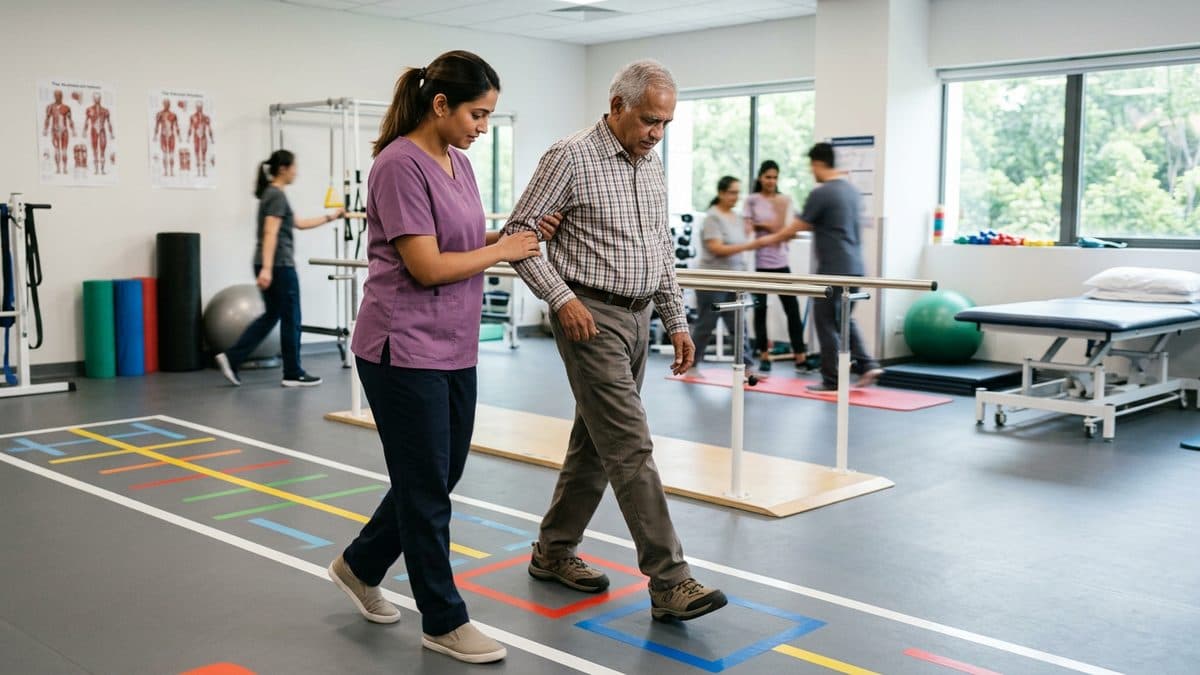
What is freezing of gait in Parkinson’s disease?
Freezing of gait is a brief, involuntary inability to step despite wanting to move. A person may describe the feet as glued to the floor, take several very small steps or show trembling at the knees without moving forward. Freezing commonly appears when starting to walk, turning, approaching a chair, passing through a doorway or moving in a crowded space.
Not everyone with Parkinson’s experiences freezing, and the pattern can vary during the day. Because freezing increases fall risk, new or worsening episodes should be discussed with the treating neurologist and physiotherapist rather than managed only with an online exercise list.
The Parkinson’s Foundation freezing guide notes that some episodes occur when the next dopaminergic medicine dose is due. Medication changes belong with the neurologist, but a record of when and where freezing happens can make that review more useful.
Common freezing triggers to record
- Taking the first step after standing
- Pivoting or turning in a small space
- Walking through a doorway, lift entrance or narrow passage
- Approaching a chair, bed or destination
- Moving while talking, carrying something or doing another mental task
- Feeling rushed, anxious or distracted
- Walking during an “off” medication period
- Changing between floor surfaces or navigating clutter
A useful diary records the time, medication timing, trigger, whether a cue worked and whether balance was lost. It is more informative than counting episodes without context.
What to do during a freezing episode
The first priority is to reduce the immediate fall risk. Do not keep forcing rapid steps and do not let a caregiver pull or push from behind. A commonly used sequence is:
- Stop and reset: pause the stepping attempt and allow the body to become steady.
- Stand tall and breathe: reduce rushing and bring attention back to posture.
- Shift weight: move weight clearly toward one leg so the opposite foot is free to step.
- Choose one cue: count, march, step toward a visual target or follow a familiar rhythm.
- Take a deliberate step: use the cue that has already been practised safely.
These steps are general education, not a guarantee. A cue that works in a quiet clinic may fail in a crowded room or during an “off” period. The purpose of physiotherapy is to test, simplify and practise a strategy in the person’s real problem situations.
Visual, rhythmic and attentional cues
Visual cues
A line on the floor, a tile edge or a clear target can provide an external place to step toward. Permanent tape should not create a trip hazard or confusion, and laser devices or cueing aids should be selected and adjusted with professional guidance.
Rhythmic cues
Counting, clapping, a metronome or familiar music may help establish a stepping rhythm. The pace must suit the person; a rhythm that is too fast can increase rushing or shorten steps.
Attentional cues
Short instructions such as “stand tall,” “shift, then step” or “big step” may help move walking from an automatic task to a deliberate one. Give one instruction at a time. Several simultaneous commands can increase cognitive load and make freezing worse.
Safer turning for Parkinson’s
Turning in place is a frequent freezing trigger. Wider arc or multi-step turns may be safer than planting one foot and pivoting. Practice can include looking toward the new direction, taking a series of clear steps and avoiding rushed 180-degree turns in narrow spaces.
The correct strategy depends on balance, joint mobility, vision, cognition, the walking aid and the direction that causes difficulty. A physiotherapist can assess turning in both directions and decide whether supervision or an assistive device is needed.
How caregivers can help without increasing risk
- Stay calm and allow time; do not repeatedly say “walk” or “hurry.”
- Avoid pulling the arms or pushing the person forward.
- Use the one cue agreed during physiotherapy.
- Stand where support can be given safely without blocking the intended step.
- Keep doorways and turning spaces well lit and free from loose rugs or clutter.
- Report falls, near-falls, faintness or a clear change in freezing frequency.
The Parkinson’s Foundation care-partner guidance also emphasizes individualized cueing and a physiotherapy referral when walking challenges or freezing are present.
What a freezing-of-gait physiotherapy assessment covers
Assessment may review the medication schedule, falls history, start hesitation, straight walking, doorway negotiation, turns, stopping, dual-task movement, transfers and current mobility aid. The physiotherapist also screens strength, balance, blood-pressure symptoms, vision, pain and the home situations where freezing happens.
Treatment can include cue selection, task-specific gait and turning practice, balance and strength work, obstacle negotiation, caregiver training and environmental changes. General exercise supports overall mobility, but frequent freezing usually needs freezing-specific practice as well.
For the broader rehabilitation pathway, see Parkinson’s disease physiotherapy in Faridabad and balance and gait training.
Clinic and home freezing assessment in Faridabad
Clinic assessment in NIT-5 provides space to observe gait, turning and balance under controlled conditions. A selected home visit may be more useful when freezing repeatedly occurs at a particular doorway, bedside, bathroom, staircase or narrow route. Home-visit suitability depends on the address, clinical need, safety, travel time and physiotherapist availability.
When medical review is important
Contact the neurologist for a clear increase in freezing, new “off” periods, repeated falls, fainting, marked dizziness, new confusion, hallucinations or a major medication-response change. Sudden one-sided weakness, facial droop, speech difficulty, severe headache, loss of consciousness or another possible emergency needs urgent medical care.
Frequently asked questions
Can cueing stop every Parkinson’s freezing episode?
No. Cue response varies by person, trigger, medication state, attention and environment. The goal is to identify a simple strategy that improves safety or movement in specific situations, not to promise that freezing will disappear.
Which cue is best for freezing of gait?
There is no universal best cue. Some people respond to a visual target, others to counting, rhythm, marching or deliberate weight shift. The safest useful cue is selected through individual assessment and practice.
Should a caregiver pull someone forward when they freeze?
No. Pulling or pushing can disturb balance and increase fall risk. Pause, keep the person steady, use the agreed cue and allow time for a deliberate restart.
Can freezing be related to Parkinson’s medication timing?
Yes, some freezing clusters during an “off” period before the next dose. Record the timing and discuss it with the neurologist. A physiotherapist can coordinate movement practice with the person’s usual medication response but should not change medication.
Is home physiotherapy available for freezing of gait in Faridabad?
Selected home assessments are available within Faridabad when the environment is central to the problem and the visit is clinically suitable. Call or WhatsApp +91 9818185589 with the area and main mobility difficulty.