
 Dr. Vaishali Suri (P.T.)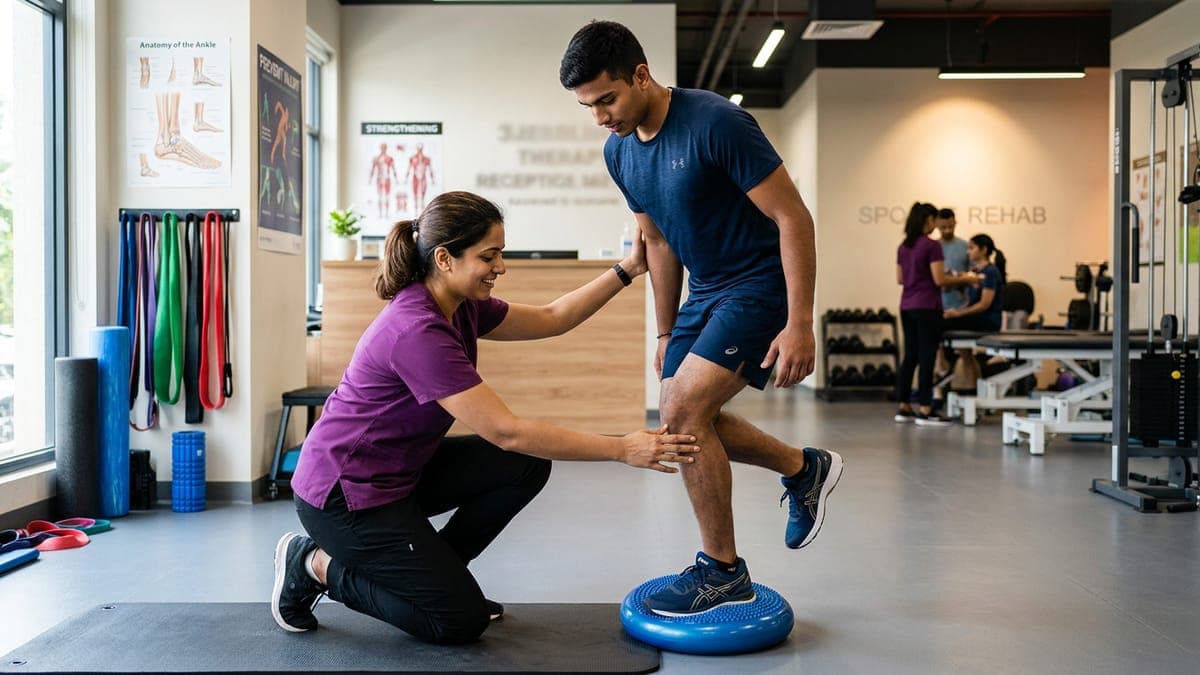
Ankle Sprain Prevention and Foot Physiotherapy in Faridabad
Effective physiotherapy not only treats ankle sprains acutely but provides a structured prevention programme that dramatically reduces re-injury risk.
At Realign Rehab Clinic, NIT-5, Faridabad, our expert physiotherapists provide personalised, evidence-based care. Serving NIT, Green Field Colony, Ballabhgarh, Sector 21–82, and across Faridabad. Contact us: +91 9818185589.
Causes and Risk Factors
- Lateral ankle sprains: inversion (turning in) of the ankle injuring the ATFL and CFL ligaments
- High ankle sprains: syndesmotic injuries from external rotation, common in contact sport
- Medial ankle sprains: less common, from severe eversion forces
- Risk factors: previous ankle sprain (highest risk), playing on uneven surfaces, poor neuromuscular control
- Footwear: high heels, unstable shoes, or inadequate court shoes
- Sport-specific risks: court sports (badminton, basketball, volleyball) requiring rapid direction changes
Signs and Symptoms
- Acute sprain: sudden pain, swelling, and bruising around the ankle after inversion
- Difficulty weight-bearing in grade 2–3 sprains
- Chronic instability: recurrent giving way with minor provocations
- Persistent ankle swelling and stiffness after inadequately treated sprains
- Proprioceptive deficits causing delayed balance responses
- Fear of further sprains limiting sport participation
Physiotherapy Treatment at Realign Rehab, Faridabad
- Acute sprain: POLICE protocol (Protection, Peak Loading, Ice, Compression, Elevation)
- Early mobilisation: protected weight-bearing from day 1–3 prevents stiffness
- Balance and proprioception retraining: the cornerstone of prevention and recovery
- Peroneal muscle strengthening: eversion resistance exercises with progressive loading
- Functional movement retraining: hop, land, and cut patterns
- Sport-specific return-to-play programme with criteria-based progression
- Prevention programme: ankle stability exercises for all court and field sport athletes
- Taping and bracing guidance for early return to sport
Frequently Asked Questions
Should I have physiotherapy for an ankle sprain?
Yes — absolutely. Even grade 1 and 2 sprains benefit from physiotherapy to prevent chronic instability.
How long should I rest after an ankle sprain?
Complete rest is not recommended. Gentle range-of-motion exercises and protected weight-bearing (with crutches if needed) begin from day 1–3. Immobilisation beyond 3 days increases stiffness and delays recovery.
When can I return to sport after an ankle sprain?
Grade 1: 1–2 weeks. Grade 2: 3–6 weeks. Grade 3: 6–10 weeks. Return is based on achieving full strength, proprioception, and sport-specific function — not just pain resolution.
What exercises prevent ankle sprains?
Single-leg balance, peroneal eversion resistance, BOSU balance training, and sport-specific agility drills are the most effective. The FIFA 11+ and similar programmes include ankle-specific components proven to reduce sprain incidence.
What is the difference between a sprain and a fracture?
A sprain tears the ligaments; a fracture breaks the bone. Both cause pain and swelling around the ankle.
The Ottawa Ankle Rules (specific tenderness locations and weight-bearing ability) determine if X-ray is needed. Our physiotherapist can perform this assessment.
Book Your Consultation
Contact Realign Rehab Clinic today:
- 📍 NIT-5, Faridabad (near Green Field Colony, Ballabhgarh Road)
- 📞 +91 9818185589
- 🕑 Mon–Sat: 8 AM–8 PM