 Dr. Vaishali Suri (P.T.)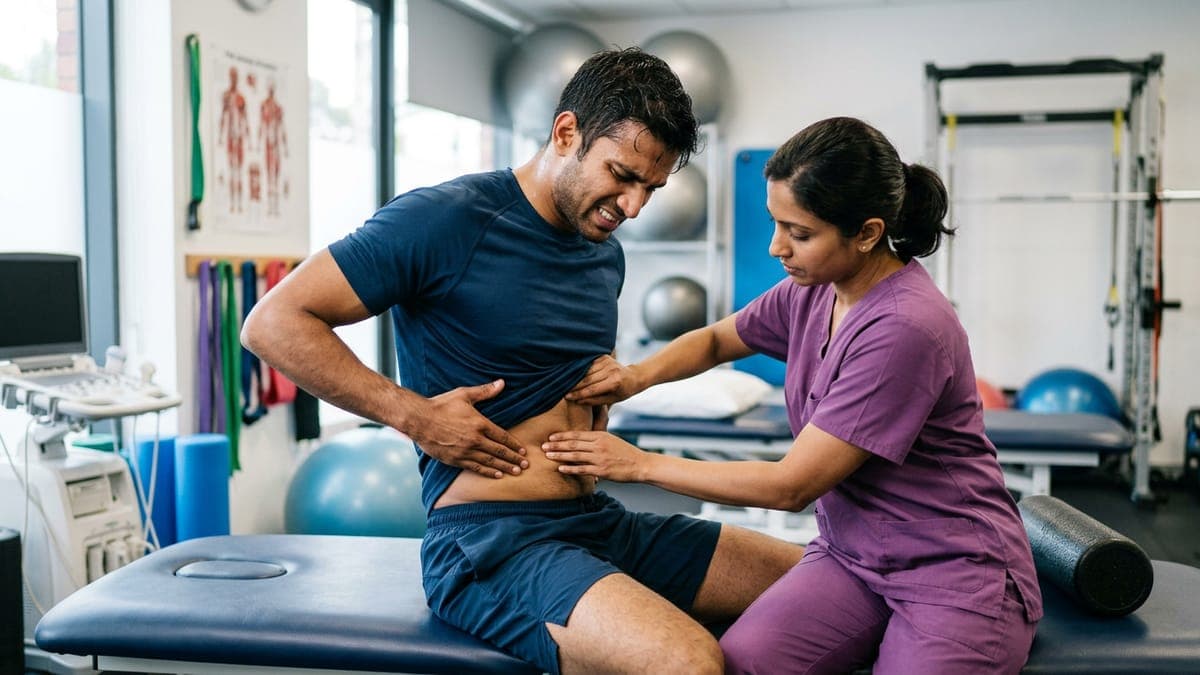
Abdominal Muscle Injury: Physiotherapy Treatment in Faridabad
Abdominal muscle injuries — ranging from mild strains to complete tears — are common in athletes and can also occur from heavy lifting, sudden twisting, or severe coughing. The abdominal wall comprises four layers of muscle: rectus abdominis, external oblique, internal oblique, and transversus abdominis.
Each layer serves distinct functions in trunk stability, breathing, and movement, and injuries to these structures require precise physiotherapy rehabilitation.
At Realign Rehab Clinic, NIT-5, Faridabad, our expert physiotherapists provide personalised, evidence-based care. Serving NIT, Green Field Colony, Ballabhgarh, Sector 21–82, and across Faridabad. Contact us: +91 9818185589.
Causes and Risk Factors
- Sudden forceful contraction: explosive sit-ups, throwing, or overhead sporting actions
- Rapid trunk rotation: cricket batting, golf swings, tennis serves
- Heavy lifting with inadequate core bracing
- Prolonged severe coughing or sneezing causing repetitive strain
- Direct trauma to the abdominal wall from sports contact
- Post-surgical weakness following abdominal or Caesarean section surgery
- Chronic low-load overuse in endurance athletes (rowing, swimming)
Signs and Symptoms
- Sharp pain in the abdomen during or after the precipitating activity
- Localised tenderness over the affected abdominal quadrant
- Pain on trunk flexion, rotation, or raising the legs while lying
- Swelling or bruising over the abdominal wall in acute strains
- Difficulty coughing, laughing, or sneezing due to pain
- Weakness of core function and reduced athletic performance
Physiotherapy Treatment at Realign Rehab, Faridabad
- Acute phase: protected rest, ice, and compression to reduce bleeding and inflammation
- Graded abdominal activation: isometric holds, progressing to isotonic exercises
- Core stability programme: deep stabilisers before global movers
- Thoracolumbar fascia mobilisation where relevant
- Breathing pattern retraining to restore diaphragmatic function
- Return-to-sport progression: functional testing before full return
- Surgical liaison for complete ruptures requiring operative repair
- Prevention programme: core stability training and progressive load management
Frequently Asked Questions
How long does an abdominal muscle strain take to heal?
Grade 1 strains: 1–2 weeks. Grade 2: 3–6 weeks. Grade 3 (complete tear): 3–6 months or longer, potentially requiring surgical repair. Early physiotherapy clearly reduces recovery time.
Can I exercise with a strained abdominal muscle?
Light lower limb and upper limb exercise is possible. Direct abdominal loading should be avoided until pain-free at rest, then progressively reintroduced under physiotherapy guidance.
Is ice or heat better for abdominal muscle injury?
Ice is better in the first 48–72 hours to reduce bleeding and inflammation. Heat can be useful from day 3–5 onwards to reduce muscle spasm.
Your physiotherapist will advise on the appropriate choice.
How do I know if my abdominal injury is serious?
If pain is severe and unremitting, there is visible bulging (possible hernia or haematoma), or you have associated abdominal symptoms (nausea, fever), seek medical review urgently. Most sports-related strains are manageable with physiotherapy.
Can poor core stability cause abdominal muscle injuries?
Yes — inadequate core strength and coordination under dynamic loads is a primary risk factor. A core stability programme is both treatment and prevention for abdominal injuries.
Book Your Consultation
Contact Realign Rehab Clinic today:
- 📍 NIT-5, Faridabad (near Green Field Colony, Ballabhgarh Road)
- 📞 +91 9818185589
- 🕑 Mon–Sat: 8 AM–8 PM