 Dr. Vaishali Suri (P.T.)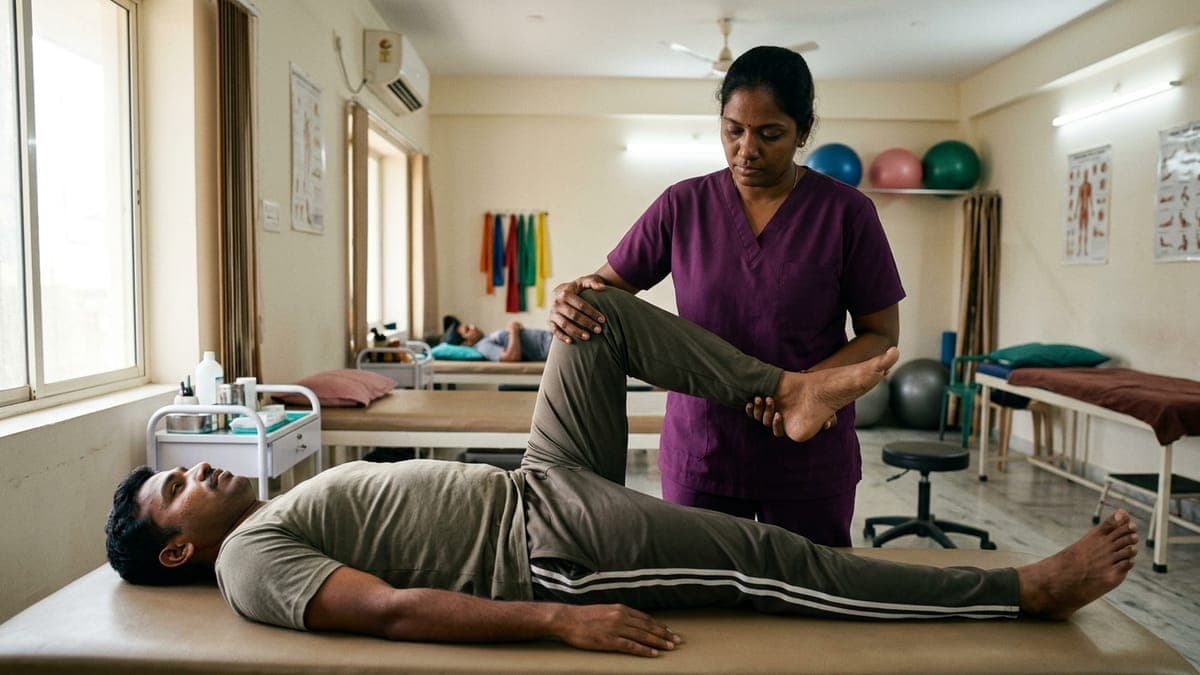
Hip Impingement (FAI): Physiotherapy Treatment in Faridabad
Femoroacetabular impingement (FAI) is a mechanical hip condition where abnormal contact between the femoral head and the acetabulum causes pain, labral tears, and progressive cartilage damage during end-range hip movements. Once thought to require surgery, growing evidence shows that structured physiotherapy produces equivalent outcomes to arthroscopy for most patients with mild-to-moderate FAI.
At Realign Rehab Clinic, NIT-5, Faridabad, our expert physiotherapists provide personalised, evidence-based care. Serving NIT, Green Field Colony, Ballabhgarh, Sector 21–82, and across Faridabad. Contact us: +91 9818185589.
Causes and Risk Factors
- Cam FAI: abnormal bony prominence on the femoral head (pistol grip deformity)
- Pincer FAI: acetabular over-coverage creating rim-to-femoral contact
- Mixed FAI: combination of cam and pincer morphology (most common)
- Activities requiring repetitive end-range hip flexion: football, basketball, martial arts
- Hip labral tear associated with FAI morphology
- Genetic predisposition to FAI bone morphology
- Youth sport participation during skeletal development
Signs and Symptoms
- Groin pain or deep anterior hip pain, reproduced by hip flexion and internal rotation
- C-sign: patient cups the hip with the hand (indicative of intra-articular pain)
- Positive impingement test: pain at end-range hip flexion with internal rotation
- Pain during sitting for prolonged periods, getting in and out of a car, or squatting
- Clicking or catching sensation in the hip
- Reduced hip internal rotation compared to the opposite side
Physiotherapy Treatment at Realign Rehab, Faridabad
- Activity modification: identifying and modifying the provocative movements
- Hip mobility programme: improving available hip internal rotation within comfortable range
- Hip external rotator and abductor strengthening: primary targets of FAI rehabilitation
- Core and lumbopelvic stabilisation reducing hip compensatory patterns
- Movement retraining: modifying landing, squatting, and sport-specific movement patterns
- Manual therapy: hip joint mobilisation in non-provocative directions
- Education on FAI: understanding the condition, prognosis, and activity choices
- Surgical referral assessment for labral tears with mechanical symptoms failing conservative care
Frequently Asked Questions
Do I need surgery for hip impingement?
The FAIT trial showed that physiotherapy produces equivalent outcomes to surgery for FAI at 2 years. Surgery (hip arthroscopy) is considered for patients with significant labral tears and mechanical symptoms that fail 3–6 months of physiotherapy.
Can physiotherapy cure FAI?
Physiotherapy cannot change the underlying bone morphology of FAI, but it can sharply reduces symptoms in most cases — equivalent to surgical outcomes. The goal is improving hip muscle control and modifying provocative activities.
What exercises help hip impingement?
Hip external rotator strengthening, hip abductor strengthening (clamshells, side-lying abduction), core stability, and hip mobility exercises in non-provocative ranges are the foundation. Avoid deep squatting and hip flexion exercises that reproduce the impingement.
Is running OK with FAI?
Running on flat surfaces is usually tolerable. Uphill running increases hip flexion and may aggravate FAI.
Running technique modification (shorter stride, reduced hip extension) can help. Our physiotherapist will advise based on your specific presentation.
How long does FAI physiotherapy take?
A structured programme runs 8–16 weeks. Most patients see measurable improvement in 8–12 weeks, with ongoing maintenance exercises to prevent recurrence.
Surgery is only considered after an adequate trial of physiotherapy.
Book Your Consultation
Contact Realign Rehab Clinic today:
- 📍 NIT-5, Faridabad (near Green Field Colony, Ballabhgarh Road)
- 📞 +91 9818185589
- 🕑 Mon–Sat: 8 AM–8 PM