
 Dr. Vaishali Suri (P.T.)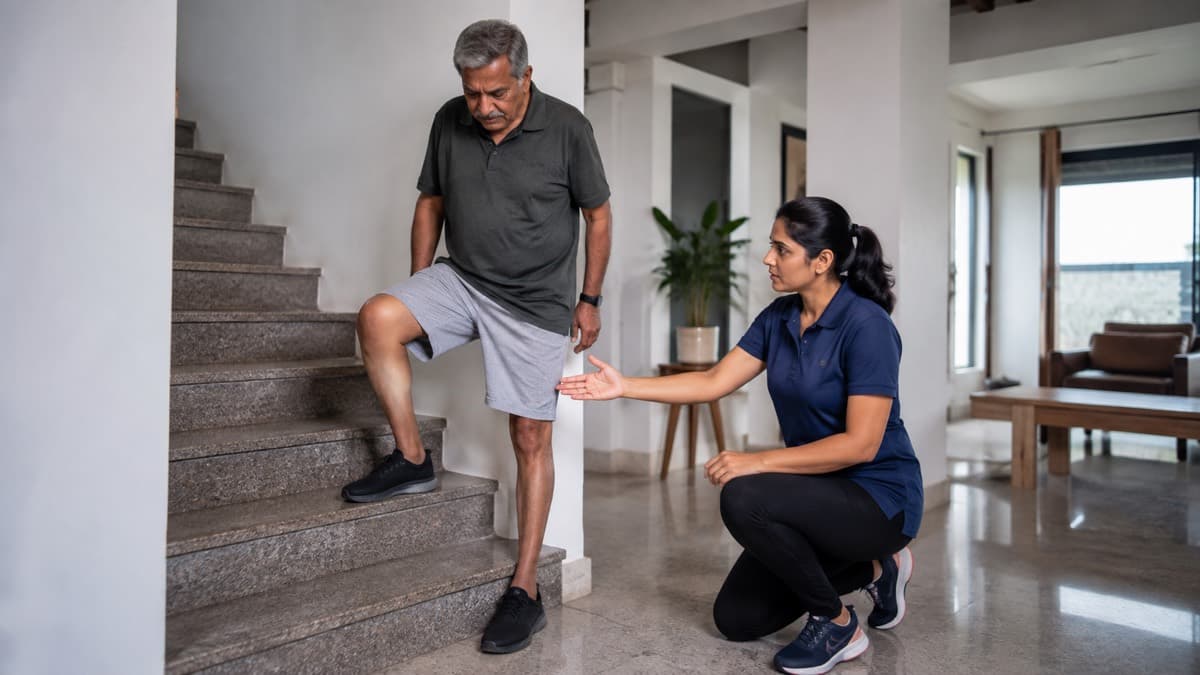
Quick answer: Why an unrailed staircase needs an individual home-safety plan rather than generic stair advice. The right plan depends on the surgeon’s instructions, wound status, medical history and an individual physiotherapy assessment; this guide does not prescribe a universal exercise dose.
Managing Stairs Without a Railing After Knee Replacement
Routine rehabilitation should pause when symptoms suggest a complication or when the person cannot complete the task safely. Exercise is not a test that should override medical warning signs.
The surgical team’s discharge instructions take priority because weight-bearing status, wound care and precautions can differ.
What an assessment should establish
Start with the operation date and type, discharge instructions, medicines, wound status, symptoms and current walking aid. Observe transfers, gait, knee movement, quadriceps control, balance and the response to recent activity. Connect measurements to a daily task rather than treating one range number as the outcome.
The NICE joint-replacement guideline recommends rehabilitation on the day of surgery when possible and no more than 24 hours after primary elective replacement, including daily-activity advice, a home exercise programme and mobilisation. The exact pathway remains subject to medical stability and local surgical instructions.
Decide whether rehabilitation should continue today
Safety screening is an active part of physiotherapy. When a possible complication, sudden functional loss or unsafe environment is identified, the correct decision may be to stop the session and contact the medical team. Reassurance should be based on assessment, not on the assumption that every postoperative symptom is normal.
- Is urgent medical assessment needed?
- Do the hospital instructions address this situation?
- Can the task be made safe today?
- Who should be contacted and how quickly?
Four practical priorities for this topic
Do not practise alone
Do not practise alone is a practical checkpoint within why an unrailed staircase needs an individual home-safety plan rather than generic stair advice. The physiotherapist observes whether it improves safety or function, records the response and changes only one part of the task at a time. If performance deteriorates, the previous level of support may remain appropriate.
Consider a temporary rail or alternate route
For this topic, “Consider a temporary rail or alternate route” should be translated into an observable action rather than a vague instruction. It is practised in the context of why an unrailed staircase needs an individual home-safety plan rather than generic stair advice, then reviewed for pain, swelling, confidence and movement quality. The goal is repeatable function, not a one-off best attempt.
Use the prescribed aid only as trained
Use the prescribed aid only as trained belongs in the written plan so the patient and caregiver know what to do between visits. The instruction should include the setup, level of assistance and reason to stop. A verbal cue that works in clinic may need modification in the home environment.
Home assessment may be appropriate
The relevance of “Home assessment may be appropriate” depends on the recent baseline. A small change can be important when it affects walking, transfers or safety, while a larger numerical change may not matter if movement quality worsens. Reassessment keeps the decision linked to function.
These priorities are prompts for discussion, not a substitute for the programme issued by the hospital or treating physiotherapist. Exercise should be scaled to the person’s current ability and recovery response.
How physiotherapy may progress the plan
Move from a predictable setup toward greater distance, less support or a more complex environment. Add speed only when control is adequate. A walking aid or higher chair can remain useful while capacity develops.
The APTA-sponsored clinical practice guideline for physical therapist management after total knee arthroplasty supports structured rehabilitation while emphasising assessment-led decisions. It does not justify identical exercises or guaranteed timelines for every patient.
Home and clinic physiotherapy in Faridabad
Clinic rehabilitation in NIT-5 provides controlled space and equipment for gait, balance and strength work. A selected home visit may be useful for the actual bed, chair, toilet, doorway or staircase. Faridabad home visits depend on address, suitability and availability.
Use the main knee replacement rehabilitation guide, the home-visit guide and the complete topic library to navigate related questions.
When to contact the surgical team
Seek prompt medical advice for worsening wound redness, discharge, fever, marked calf pain or swelling, sudden inability to bear weight or rapidly increasing pain. Leg symptoms with chest pain or breathing difficulty require emergency care.
See the NHS knee-replacement complications guidance and follow the treating hospital’s local instructions.
Frequently asked questions
Is stairs without railing after knee replacement the same for every patient?
No. Operation details, precautions, health and starting function change the plan.
Is pain proof that an exercise is working?
No. Sharp, escalating or unusual pain is not a target; agree the acceptable response with the treating clinician.
Sources and clinical review
- NICE NG157: Joint replacement recommendations
- Physical Therapist Management of Total Knee Arthroplasty clinical practice guideline
- NHS: Recovering from a knee replacement
- NHS: Complications of a knee replacement
Clinical note: This article is general education and requires clinical review before it is treated as an individual plan. The hospital discharge instructions and treating surgeon’s precautions take priority.