 Dr. Vaishali Suri (P.T.)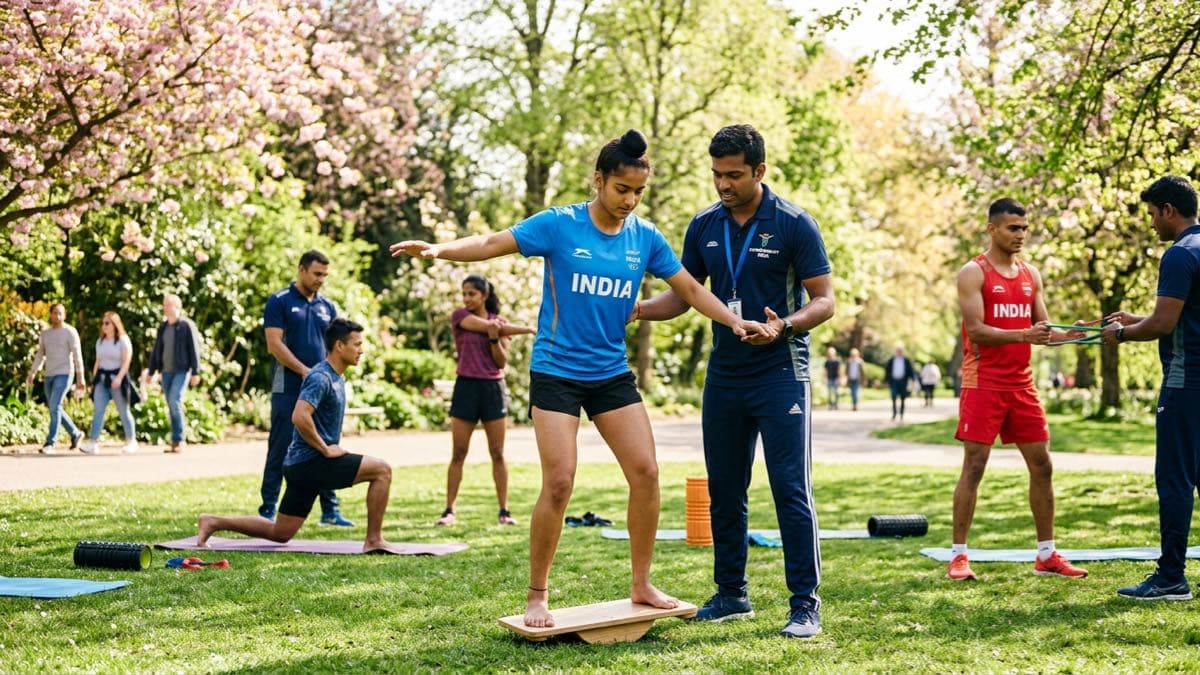
Basketball combines vertical jumping, lateral cutting, sudden stops, and physical contact in a way that few other sports can match. At Realign Rehab Clinic in NIT-5, Faridabad, we treat basketball players from school and college teams as well as recreational players from across Faridabad, Ballabhgarh, Surajkund, and the surrounding areas. The injury patterns we see in basketball are distinct from those in football or cricket — they demand specific assessment and rehabilitation approaches.
Ankle sprains: the most common basketball injury by far
The typical mechanism is an inversion sprain — landing on another player's foot, stepping on the boundary line at an angle, or making an abrupt lateral cut with the foot planted. The lateral ligament complex, primarily the anterior talofibular ligament, takes the force.
The grading system we apply is the same as in other sports: Grade I (ligament stretch, return to play in 5–10 days), Grade II (partial tear, 3–6 weeks), and Grade III (complete rupture, 6–12 weeks). What is specific to basketball is the critical importance of proprioception retraining — the sport demands precise foot positioning during landing at high speed, and ankle proprioception degrades after any sprain. We use wobble boards, single-leg stance progressions, and basketball-specific landing drills to restore this.
High-top basketball shoes provide some ankle support but do not prevent sprains. They are not a substitute for rehabilitation and strengthening. Players who rely solely on ankle tape without addressing the underlying weakness and proprioception deficit are likely to re-sprain.
Jumper's knee (patellar tendinopathy)
Patellar tendinopathy — known in sport as jumper's knee — is an overuse injury of the patellar tendon, which connects the kneecap to the shinbone and transmits the enormous forces generated by the quadriceps during jumping and landing. In basketball, where players may perform 50–70 jumps per training session, the cumulative load on the tendon is substantial.
Players describe a dull to sharp ache at the lower pole of the kneecap, typically worse after activity and in the early stages often settling once warmed up. Over time, the tendon degenerates and pain becomes constant. This is a condition that worsens with complete rest followed by a sudden return to jumping — the approach many players take when trying to "run it off".
At Realign Rehab Clinic, Dr. Vaishali Suri uses a load management and progressive tendon loading protocol:
- Phase 1 — isometric loading: Wall sits and leg press holds at 60–70° knee flexion, performed daily. These reduce tendon pain rapidly and can be done even during mild symptoms.
- Phase 2 — isotonic loading: Slow, heavy leg press and split squat progressions, building tendon capacity over 4–8 weeks.
- Phase 3 — energy storage: Plyometric progressions — drop jumps, box jumps, bounding — which prepare the tendon for the explosive demands of basketball.
- Phase 4 — sport-specific: Basketball-specific cutting, jumping, and landing drills at increasing speed and volume.
Players with mild to moderate patellar tendinopathy do not need to stop playing entirely — but they do need to modify training load and begin the loading programme. Complete rest allows the tendon to decondition further, which makes the problem worse once training resumes.
ACL injuries in basketball versus football
ACL tears occur in basketball at a rate roughly comparable to football, though the mechanism differs. Football ACL injuries often involve contact from an opponent; basketball ACL injuries more commonly happen during non-contact situations — a player landing from a rebound with the knee in a valgus (knock-knee) position, or pivoting to change direction at speed.
The clinical presentation and rehabilitation approach are broadly similar to what we apply for football ACL injuries — a six to nine month timeline, with return-to-sport testing (hop tests, limb symmetry index, psychological readiness) before full clearance. What we adapt for basketball specifically is the final phase of rehab: players must be competent at landing from maximal vertical jumps, pivoting at speed, and performing defensive slide movements before returning to match play.
Finger and hand injuries
Finger injuries are among the most frequently ignored injuries in basketball. A "jammed finger" — typically a proximal interphalangeal (PIP) joint sprain from the ball striking the fingertip — is routinely taped and played through. When the underlying ligament or volar plate injury is not properly assessed and managed, the result can be chronic joint instability, persistent swelling, and reduced grip strength that affects shooting and ball-handling mechanics.
We assess all finger injuries for the specific structures involved. A mallet finger (extensor tendon avulsion) requires 6–8 weeks of continuous splinting in extension. A collateral ligament tear at the PIP joint may need 3–4 weeks of buddy taping alongside range-of-motion exercises. Fractures must be ruled out with X-ray when there is point tenderness over bone.
Players who come in early — within 48–72 hours of injury — consistently have better outcomes than those who wait weeks until the pain becomes unmanageable.
Shoulder impingement from shooting mechanics
Shoulder problems in basketball are less common than ankle and knee injuries but are frequently missed or attributed vaguely to "overuse". Shoulder impingement syndrome — pain in the anterior shoulder during arm elevation, particularly in the 60–120° arc — often develops in players who have poor scapular control or rotator cuff strength relative to their shooting volume.
A shooting guard performing 200 jump shots per session is placing repetitive stress on the subacromial space. When the rotator cuff muscles — particularly supraspinatus and infraspinatus — fatigue or are weak relative to the dominant deltoid and pectoral muscles, the humeral head migrates superiorly during arm elevation and compresses the subacromial bursa and rotator cuff tendons.
Treatment involves load reduction in the early phase, targeted rotator cuff and lower trapezius strengthening, and a mechanics review of the shooting action where relevant. Most players recover fully in 4–8 weeks with an appropriate programme.
Landing mechanics training and injury prevention
The most effective way to reduce ACL, ankle, and patellar tendon injuries in basketball is to train how players land. Poor landing mechanics — heel striking with a stiff knee, knees collapsing inward, landing asymmetrically on one foot — are directly associated with increased injury risk.
Our prevention screening at Realign Rehab Clinic includes a drop jump landing assessment where we observe knee alignment, trunk control, and foot positioning. Players who show valgus collapse (knee caving inward) on landing are placed on a neuromuscular training programme before that pattern translates into an ACL tear.
The programme includes glute strengthening, hip abductor work, single-leg landing drills, and jump-landing technique coaching. It takes 6–8 weeks and has a strong evidence base for reducing lower limb injury rates.
"In basketball, most serious knee and ankle injuries are not random accidents — they are the result of movement patterns that can be identified and corrected before injury happens. That's why we screen players who come in for any injury, not just the one they presented with."
— Dr. Vaishali Suri (P.T.), Realign Rehab Clinic, Faridabad
Return-to-sport testing for basketball players
We use a court-based functional test battery before clearing basketball players for match play. This includes:
- Lateral shuffle speed test
- Reactive agility test involving a visual cue and change of direction
- 5-metre sprint and stop test with landing assessment
- Pain-free completion of full practice session for at least five consecutive days
Players who are cleared purely on the basis of "pain is gone" are at the highest risk of re-injury in the first two weeks back on court. Time and symptom resolution are not sufficient return-to-sport criteria.
If you play basketball and are dealing with an ankle sprain, knee pain, finger injury, or shoulder problem, the team at Realign Rehab Clinic can assess and treat you. Dr. Vaishali Suri (BPT, MIAP) works with players from across Faridabad including NIT, Sector 14, 15, 16, Old Faridabad, Ballabhgarh, Surajkund, and Greater Faridabad. Rated 4.9/5 on Google. Book an appointment at realign.clinic or call +91 9818185589.