
 Dr. Vaishali Suri (P.T.)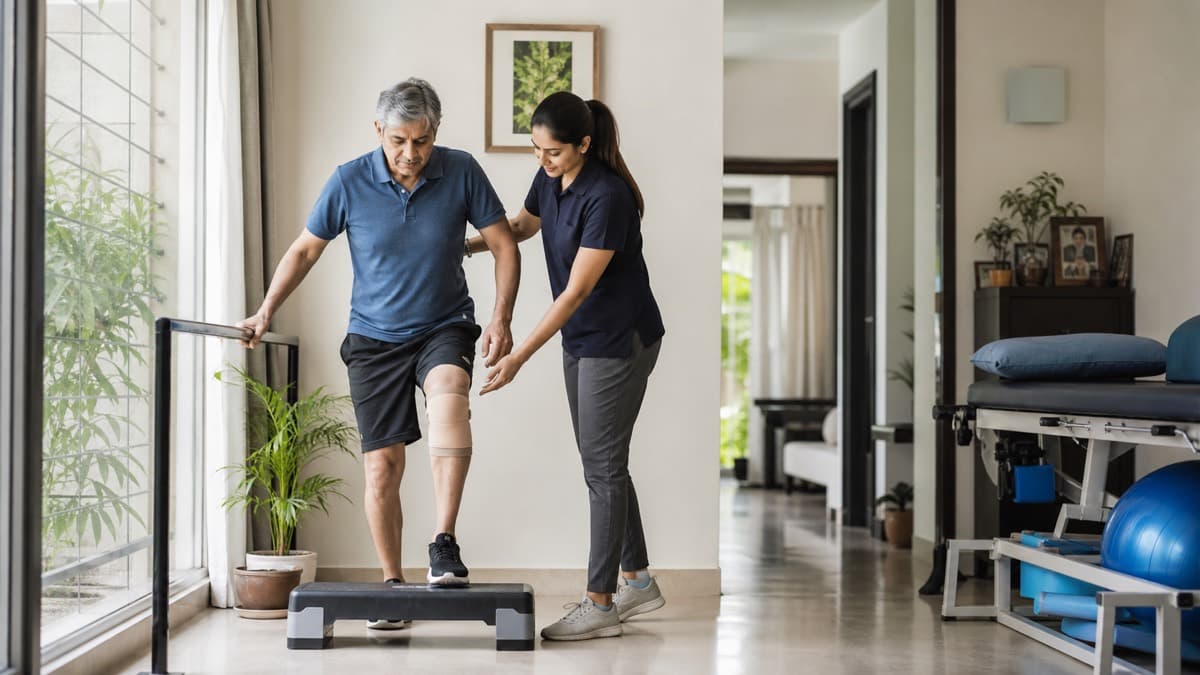
Quick answer: Helping with safety and adherence without pulling, rushing or replacing the patient’s independence. The right plan depends on the surgeon’s instructions, wound status, medical history and an individual physiotherapy assessment; this guide does not prescribe a universal exercise dose.
Caregiver Guide for Knee Replacement Rehabilitation
Good rehabilitation is organised around meaningful tasks, measurable findings and the person’s environment. A generic session count or fixed timeline cannot replace reassessment.
Written instructions, clear escalation rules and communication with the surgical team reduce avoidable confusion.
What an assessment should establish
Bring the discharge sheet, operation details, medicine list and usual mobility aid. Review weight-bearing advice, wound concerns and changes since leaving hospital. Test movement, strength and walking only after establishing medical and environmental safety.
The NICE joint-replacement guideline recommends rehabilitation on the day of surgery when possible and no more than 24 hours after primary elective replacement, including daily-activity advice, a home exercise programme and mobilisation. The exact pathway remains subject to medical stability and local surgical instructions.
Turn advice into a usable rehabilitation plan
A workable plan identifies the next functional goal, the exercise or task that supports it, the expected response and the threshold for seeking help. It also states who is responsible for decisions about wounds, medicines, weight bearing and return to restricted activities. This prevents generic internet advice from being treated as personal clearance.
- What is the next measurable functional goal?
- Which action supports that goal?
- What response is acceptable?
- When should the plan be reviewed?
Four practical priorities for this topic
Use the therapist-taught assistance
Use the therapist-taught assistance belongs in the written plan so the patient and caregiver know what to do between visits. The instruction should include the setup, level of assistance and reason to stop. A verbal cue that works in clinic may need modification in the home environment.
Keep instructions simple
The relevance of “Keep instructions simple” depends on the recent baseline. A small change can be important when it affects walking, transfers or safety, while a larger numerical change may not matter if movement quality worsens. Reassessment keeps the decision linked to function.
Prepare meals and walking routes
Prepare meals and walking routes should be checked alongside the hospital discharge advice and current medical status. It is not a universal milestone. The safest progression is the one the patient can perform with control and recover from without a concerning symptom increase.
Know the medical red flags
In helping with safety and adherence without pulling, rushing or replacing the patient’s independence, know the medical red flags can influence both confidence and independence. Practice should begin in a predictable setup, add challenge gradually and retain enough support for good technique. New instability, sharp pain or marked swelling changes the plan.
These priorities are prompts for discussion, not a substitute for the programme issued by the hospital or treating physiotherapist. Exercise should be scaled to the person’s current ability and recovery response.
How physiotherapy may progress the plan
Change one variable at a time: range, repetitions, resistance, duration, support or environment. Observe the immediate quality and the later symptom response before deciding whether to retain, reduce or progress the task.
The APTA-sponsored clinical practice guideline for physical therapist management after total knee arthroplasty supports structured rehabilitation while emphasising assessment-led decisions. It does not justify identical exercises or guaranteed timelines for every patient.
Home and clinic physiotherapy in Faridabad
Clinic rehabilitation in NIT-5 provides controlled space and equipment for gait, balance and strength work. A selected home visit may be useful for the actual bed, chair, toilet, doorway or staircase. Faridabad home visits depend on address, suitability and availability.
Use the main knee replacement rehabilitation guide, the home-visit guide and the complete topic library to navigate related questions.
When to contact the surgical team
Do not assume every postoperative symptom is routine. The direction of change matters. Worsening wound appearance, fever, calf pain, uncontrolled pain or sudden weakness warrants medical contact, while breathlessness or chest pain requires emergency help.
See the NHS knee-replacement complications guidance and follow the treating hospital’s local instructions.
Frequently asked questions
Is knee replacement caregiver guide the same for every patient?
No. Operation details, precautions, health and starting function change the plan.
Is pain proof that an exercise is working?
No. Sharp, escalating or unusual pain is not a target; agree the acceptable response with the treating clinician.
Sources and clinical review
- NICE NG157: Joint replacement recommendations
- Physical Therapist Management of Total Knee Arthroplasty clinical practice guideline
- NHS: Recovering from a knee replacement
- NHS: Complications of a knee replacement
Clinical note: This article is general education and requires clinical review before it is treated as an individual plan. The hospital discharge instructions and treating surgeon’s precautions take priority.