
 Dr. Vaishali Suri (P.T.)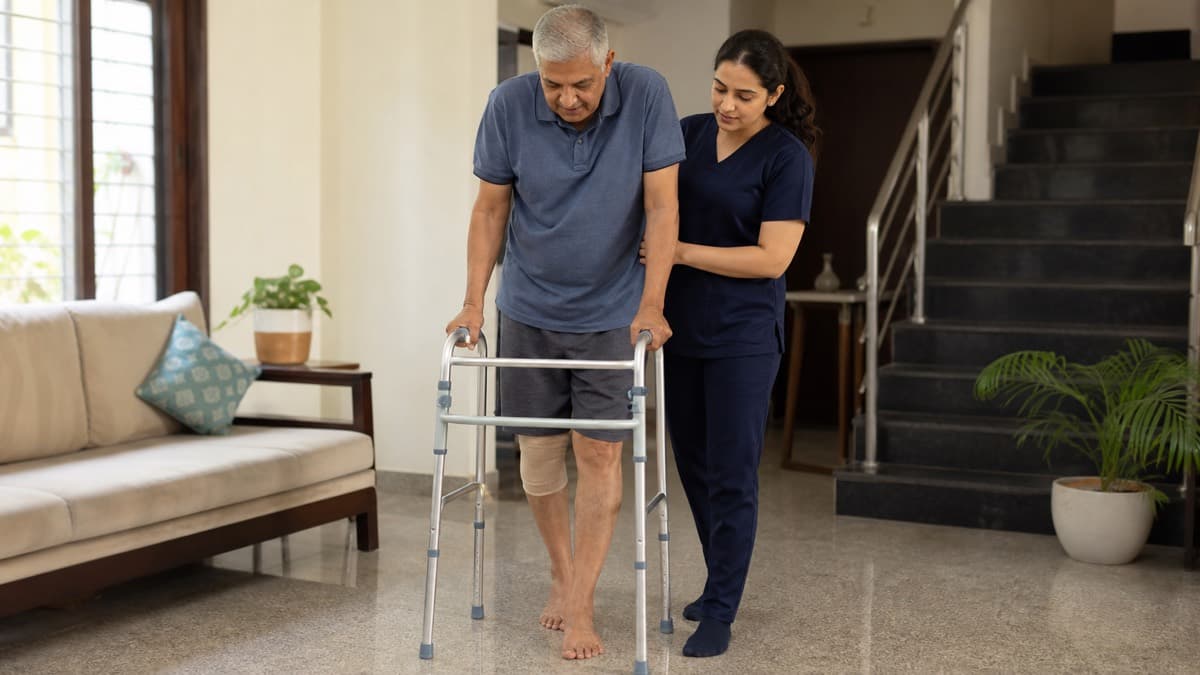
Quick answer: Walker height, sequence, turning and household safety after surgery. The right plan depends on the surgeon’s instructions, wound status, medical history and an individual physiotherapy assessment; this guide does not prescribe a universal exercise dose.
Using a Walker After Knee Replacement: Physio Guide
The goal is usable movement with control, not forcing a single measurement. Swelling, pain, muscle inhibition and confidence can all affect performance from one day to the next.
Progression is based on movement quality and function. Sharp pain, sudden loss of control or a clear deterioration is a reason to stop and seek review.
What an assessment should establish
The useful question is not only how far the knee bends. Assessment checks whether the patient can control the limb, transfer safely, walk with an appropriate aid and recover from the current exercise dose.
The NICE joint-replacement guideline recommends rehabilitation on the day of surgery when possible and no more than 24 hours after primary elective replacement, including daily-activity advice, a home exercise programme and mobilisation. The exact pathway remains subject to medical stability and local surgical instructions.
Movement quality comes before a target number
Range and strength measurements help track change, but they are interpreted with swelling, pain, muscle control and function. Forcing a measurement can produce guarding without improving the task that matters. The programme should connect the impairment to a real goal such as standing, clearing the foot during walking or controlling a step.
- Can the movement be completed without compensation?
- Is the change maintained after the session?
- Does it improve a daily task?
- Is swelling or pain limiting control?
Four practical priorities for this topic
Use the device prescribed at discharge
In walker height, sequence, turning and household safety after surgery, use the device prescribed at discharge can influence both confidence and independence. Practice should begin in a predictable setup, add challenge gradually and retain enough support for good technique. New instability, sharp pain or marked swelling changes the plan.
Keep the frame close enough for support
Keep the frame close enough for support is a practical checkpoint within walker height, sequence, turning and household safety after surgery. The physiotherapist observes whether it improves safety or function, records the response and changes only one part of the task at a time. If performance deteriorates, the previous level of support may remain appropriate.
Turn with small controlled steps
For this topic, “Turn with small controlled steps” should be translated into an observable action rather than a vague instruction. It is practised in the context of walker height, sequence, turning and household safety after surgery, then reviewed for pain, swelling, confidence and movement quality. The goal is repeatable function, not a one-off best attempt.
Do not lift or race the walker
Do not lift or race the walker belongs in the written plan so the patient and caregiver know what to do between visits. The instruction should include the setup, level of assistance and reason to stop. A verbal cue that works in clinic may need modification in the home environment.
These priorities are prompts for discussion, not a substitute for the programme issued by the hospital or treating physiotherapist. Exercise should be scaled to the person’s current ability and recovery response.
How physiotherapy may progress the plan
Identify whether movement, strength, balance, confidence or endurance is limiting the task. Select the smallest useful challenge, keep enough support for control and review how the knee settles afterward.
The APTA-sponsored clinical practice guideline for physical therapist management after total knee arthroplasty supports structured rehabilitation while emphasising assessment-led decisions. It does not justify identical exercises or guaranteed timelines for every patient.
Home and clinic physiotherapy in Faridabad
Patients may attend Realign Rehab Clinic in NIT-5 or ask whether a selected Faridabad home visit is suitable. Home care is not automatically safer; the decision considers medical status, travel, mobility and the environment.
Use the main knee replacement rehabilitation guide, the home-visit guide and the complete topic library to navigate related questions.
When to contact the surgical team
Routine rehabilitation should pause for a leaking or opening wound, spreading redness, fever, a substantial calf change, new instability or sudden loss of function. Chest pain, collapse or difficulty breathing needs emergency assessment.
See the NHS knee-replacement complications guidance and follow the treating hospital’s local instructions.
Frequently asked questions
Does slower progress mean failure?
No. A plateau or setback should prompt reassessment, not blame.
Who clears restricted activities?
The surgeon provides medical and implant-related clearance; the physiotherapist contributes functional preparation.
Sources and clinical review
- NICE NG157: Joint replacement recommendations
- Physical Therapist Management of Total Knee Arthroplasty clinical practice guideline
- NHS: Recovering from a knee replacement
- NHS: Complications of a knee replacement
Clinical note: This article is general education and requires clinical review before it is treated as an individual plan. The hospital discharge instructions and treating surgeon’s precautions take priority.