 Dr. Vaishali Suri (P.T.)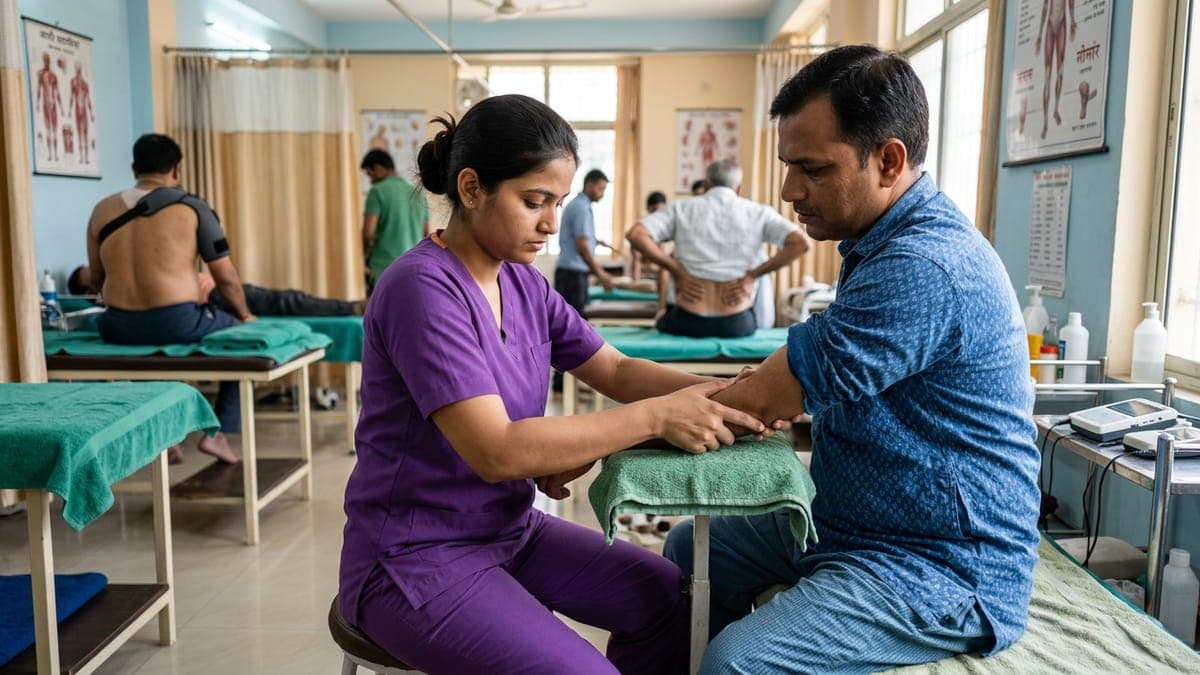
Golfer's Elbow (Medial Epicondylalgia): Physiotherapy in Faridabad
Golfer's elbow — medial epicondylalgia — is pain and tenderness at the medial (inner) epicondyle of the elbow, arising from degenerative changes in the common flexor tendon origin. Despite its name, it affects far more people who have never played golf: manual workers, tennis players (with topspin serve), assembly workers.
Anyone with repetitive forearm flexion and pronation activities.
At Realign Rehab Clinic, NIT-5, Faridabad, our expert physiotherapists provide personalised, evidence-based care. Serving NIT, Green Field Colony, Ballabhgarh, Sector 21–82, and across Faridabad. Contact us: +91 9818185589.
Causes and Risk Factors
- Repetitive forearm flexion and pronation: gripping tools, racquet sports, throwing
- Sudden single overload: catching a heavy object, forceful wrist flexion
- Age-related tendon degeneration (most common in adults 45–55)
- Poor throwing or stroke mechanics in overhead athletes
- Occupational overuse: plumbers, carpenters, assembly workers
- Prolonged typing with wrist in flexed position
Signs and Symptoms
- Pain and tenderness over the medial epicondyle (inner bump of the elbow)
- Pain worsened by resisted wrist flexion and forearm pronation
- Pain on gripping activities: shaking hands, carrying bags, opening jars
- Morning stiffness of the elbow and forearm
- Referred pain into the inner forearm and wrist
- Associated ulnar nerve symptoms: tingling in the ring and little finger in some cases
Physiotherapy Treatment at Realign Rehab, Faridabad
- Eccentric wrist flexion loading programme: the most evidence-based treatment for medial epicondylalgia
- Isometric wrist flexion exercises as early pain-free loading
- Deep transverse friction therapy to the flexor-pronator origin
- Dry needling for trigger points in flexor carpi radialis and pronator teres
- Ultrasound therapy and TENS for pain modulation
- Medial elbow counterforce brace to offload the tendon origin during activity
- Activity modification: reducing provocative gripping and flexion activities
- Ulnar nerve assessment and mobilisation where nerve symptoms coexist
Frequently Asked Questions
What is the difference between tennis elbow and golfer's elbow?
Tennis elbow (lateral epicondylalgia) affects the outer elbow — wrist extensor tendon origin. Golfer's elbow (medial epicondylalgia) affects the inner elbow — wrist flexor tendon origin.
Both respond well to eccentric loading physiotherapy.
How long does golfer's elbow take to heal?
Mild to moderate cases respond in 6–10 weeks of eccentric loading physiotherapy. Chronic cases (>6 months) may take 3–6 months. Adherence to the loading programme is the critical factor.
Should I use a brace for golfer's elbow?
A medial counterforce brace reduces tendon loading during activity and can sharply reduces pain. Use alongside physiotherapy — not as a substitute. Remove the brace during rehabilitation exercises.
Can I continue sport with golfer's elbow?
Often yes, with modification. Avoiding the most provocative movements while continuing other sport activities is usually possible. Our physiotherapist will advise on specific technique modifications for your sport.
What exercises treat golfer's elbow?
The Tyler Twist (reverse Tyler Twist for medial) using a Theraband, and progressive wrist flexion eccentric exercises, are the most effective. Exercises should be performed daily for best results.
Book Your Consultation
Contact Realign Rehab Clinic today:
- 📍 NIT-5, Faridabad (near Green Field Colony, Ballabhgarh Road)
- 📞 +91 9818185589
- 🕑 Mon–Sat: 8 AM–8 PM