 Dr. Vaishali Suri (P.T.)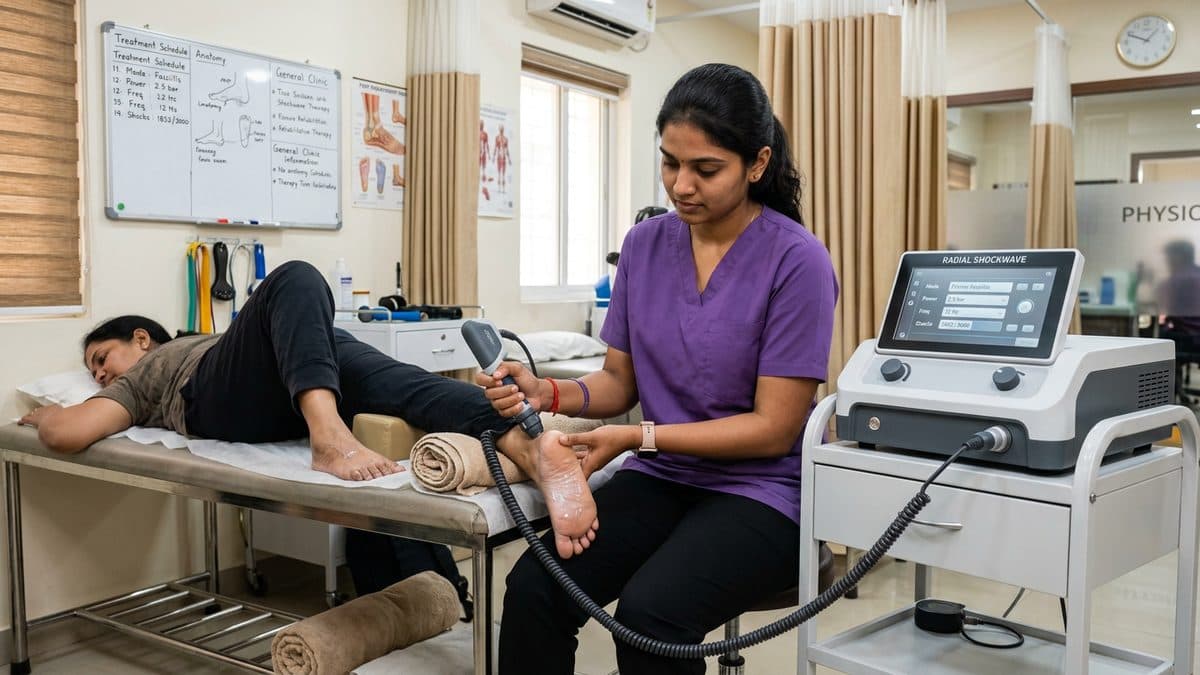
Shockwave Therapy for Calcific Shoulder Tendinitis in Faridabad
Calcific tendinitis of the shoulder, where calcium deposits form within the rotator cuff tendons, is one of the most painful shoulder conditions and one of the hardest to treat with conventional physiotherapy alone. The calcification creates a mechanical impingement and triggers an intense inflammatory response that can leave patients unable to sleep, lift their arm, or function normally.
Book: +91 9818185589 .
What Causes Calcific Shoulder Tendinitis?
Calcium hydroxyapatite crystals deposit within the rotator cuff tendons, most commonly the supraspinatus tendon. The exact cause is not fully understood, but it is associated with:
- Repetitive overhead activities (construction, painting, swimming, cricket)
- Tendon degeneration and poor microcirculation
- Impingement of the rotator cuff under the acromion
- Genetic predisposition to abnormal calcium metabolism
The deposits go through resorptive and chronic phases. In the resorptive (acute) phase, intense inflammatory pain can be debilitating.
In the chronic phase, the calcification causes persistent impingement, weakness, and restricted movement.
How Shockwave Therapy Dissolves Shoulder Calcifications
- Mechanical disruption — high-energy acoustic waves physically fragment the calcium crystal deposits
- Cell death induction — triggers apoptosis of cells maintaining the calcification
- Phagocytic activation — stimulates macrophages to clear the calcium debris from the tissue
- Neovascularisation — restores blood supply to allow debris removal and tendon healing
- Pain modulation — reduces substance P and nociceptor sensitivity at the treatment site
Shockwave for Calcific Shoulder at Realign Rehab Clinic, Faridabad
Our protocol for calcific shoulder tendinitis:
- Diagnostic assessment — shoulder impingement testing, rotator cuff strength assessment, review of X-ray or ultrasound imaging to confirm calcification location and size
- Focused ESWT — high-energy focused shockwave targeted precisely at the calcification using palpation and/or imaging guidance
- 6-session course — weekly sessions; most patients begin feeling improvement between sessions 3 and 4
- Concurrent rehabilitation — rotator cuff strengthening and scapular control exercises to restore full shoulder function as the calcification resolves
Frequently Asked Questions
Is shockwave therapy painful for calcific shoulder?
Treatment over an active calcification can be intense. The more inflamed the deposit, the more sensitised the tissue.
We start at lower intensity and increase progressively. Post-treatment soreness lasting 24 to 48 hours is expected and usually reduces measurably after the second session.
How long before I see results?
Pain reduction typically begins by sessions 3 to 4. Calcium resorption continues for 6 to 12 weeks after completing the course.
Follow-up imaging at 12 weeks usually confirms partial or complete resorption.
Do I still need surgery after shockwave therapy?
Most achieve sufficient resorption and function recovery to avoid surgery entirely.
Can I combine shockwave with physiotherapy exercises?
Absolutely, and we recommend it. Rotator cuff strengthening, scapular stabilisation, and posture work are started concurrently to restore full shoulder function as the calcification resolves.
Book Your Shockwave Therapy Session in Faridabad
Contact Realign Rehab Clinic today to book your shockwave therapy assessment:
- 📍 Ground Floor, 5E/9, B.P. Railway Rd, NIT-5, Faridabad, Haryana 121001
- 📞 +91 9818185589 (Call / WhatsApp)
- 🕑 Monday to Saturday: 8:00 AM to 8:00 PM
- 🏠 Home visits available for mobility-limited patients