 Dr. Vaishali Suri (P.T.)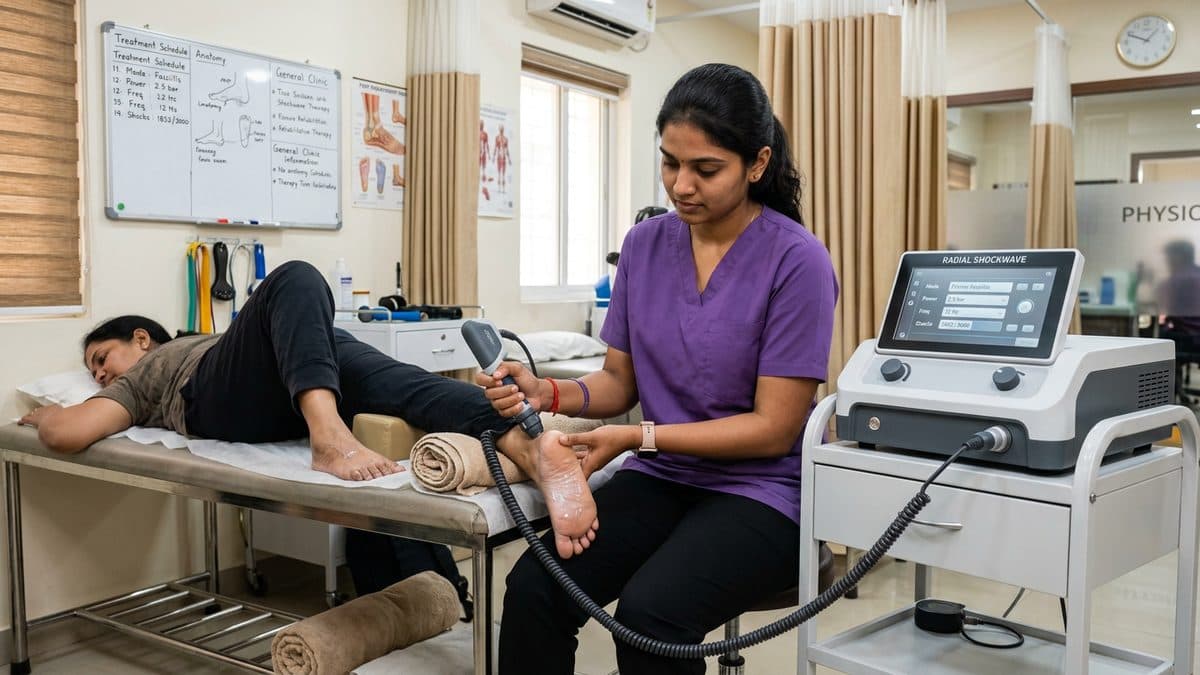
Shockwave Therapy for Tennis Elbow in Faridabad: Evidence-Based Tendon Healing
Standard treatments — rest, braces, NSAIDs — often provide only temporary relief because they do not address the underlying tendon degeneration.
Shockwave therapy targets the degenerative collagen pathology directly , stimulating the biological processes that conventional treatment cannot. At Realign Rehab Clinic , NIT-5, Faridabad, our physiotherapists combine ESWT with eccentric loading for the most evidence-backed treatment available for chronic tennis elbow.
Book: +91 9818185589 .
Why Tennis Elbow Is Not Simply Inflammation
Modern understanding of lateral epicondylitis reveals a degenerative tendinosis process, not active inflammation. The common extensor tendon origin (primarily extensor carpi radialis brevis) shows:
- Disorganised collagen fibres with angiofibroblastic infiltration
- Reduced type I collagen (structural) replaced by weaker type III collagen
- Increased substance P and glutamate causing pain sensitisation
- Absence of inflammatory cells in biopsy samples
This explains why anti-inflammatories and steroid injections provide only short-term relief. Shockwave therapy addresses the degenerative pathology by stimulating genuine tissue remodelling.
Shockwave Therapy Mechanisms for Tennis Elbow
- Mechanotransduction — acoustic waves stimulate tendon cells (tenocytes) to produce new collagen
- Neovascularisation — new blood vessel growth restores nutrient delivery to the degenerated tendon
- Pain modulation — reduces substance P concentrations at the lateral epicondyle
- Scar tissue disruption — breaks down disorganised collagen and adhesions
- Growth factor release — stimulates TGF-beta and VEGF for tissue repair
Treatment Protocol at Realign Rehab Clinic, Faridabad
Phase 1 (Sessions 1 to 3): Radial or focused shockwave applied to the common extensor origin at the lateral epicondyle. 2,000 to 3,000 pulses per session. Combined with isometric wrist extension exercises to maintain tendon load tolerance during treatment.
Phase 2 (Sessions 4 to 5 plus exercise progression): Progressive increase in shockwave energy as tissue tolerance improves. Eccentric wrist extension loading programme (Tyler Twist) introduced alongside ESWT.
Maintenance: Home exercise programme and activity modification advice. Counterforce brace guidance for return to work or sport activities.
Frequently Asked Questions
How many sessions of shockwave therapy for tennis elbow?
Typically 3 to 5 sessions spaced one week apart. Chronic cases lasting more than 12 months may require up to 6 sessions.
The combination of ESWT with eccentric loading exercises produces faster and more durable results than ESWT alone.
Should I stop using my arm during shockwave treatment?
No. Complete rest is counterproductive for tendon healing. Guided activity modification combined with progressive tendon loading exercises is the recommended approach during your ESWT course.
I have already had a steroid injection that did not work. Can shockwave still help?
Yes. Shockwave therapy is often used specifically for patients who have not responded to steroid injection. ESWT addresses a different mechanism (stimulating repair rather than suppressing inflammation) and is not affected by prior injection history.
How does shockwave therapy compare to PRP for tennis elbow?
Current evidence suggests ESWT produces outcomes comparable or superior to PRP for lateral epicondylitis at 12 months. ESWT is non-invasive, has a larger evidence base, and is considerably more cost-effective.
We recommend ESWT as the first-line procedure before considering PRP.
Book Your Shockwave Therapy Session in Faridabad
Contact Realign Rehab Clinic today to book your shockwave therapy assessment:
- 📍 Ground Floor, 5E/9, B.P. Railway Rd, NIT-5, Faridabad, Haryana 121001
- 📞 +91 9818185589 (Call / WhatsApp)
- 🕑 Monday to Saturday: 8:00 AM to 8:00 PM
- 🏠 Home visits available for mobility-limited patients