
 Dr. Vaishali Suri (P.T.)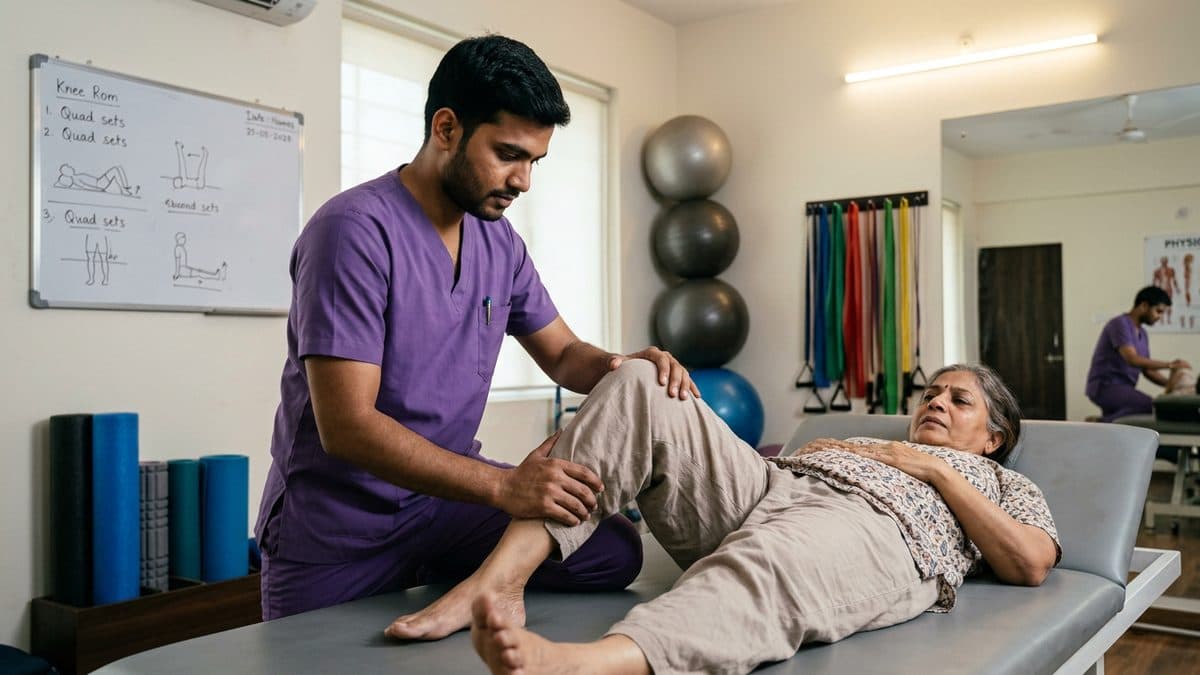
Osteoarthritis: India's Most Common Joint Disease
In Faridabad, with its large ageing and working population, OA is one of the most frequent conditions we treat at Realign Rehab Clinic.
OA is characterised by progressive degradation of articular cartilage — the smooth covering on joint surfaces — along with bony changes (osteophytes, subchondral sclerosis), synovial inflammation, and soft tissue changes. It is not simply "wear and tear" from normal use; it is a complex disease process influenced by genetics, obesity, previous injury, and muscle weakness.
The OA-Muscle Weakness Cycle
One of the most important and actionable insights from OA research is the muscle weakness cycle: OA causes pain → pain inhibits muscle activation → muscle weakness increases joint loading → cartilage damage accelerates → more pain. This cycle can be broken by physiotherapy-directed strengthening — the most powerful OA treatment available.
Key Physiotherapy Treatments for OA
Strengthening Exercise
Multiple randomised controlled trials demonstrate that progressive strengthening reduces OA pain as effectively as NSAIDs — with zero side effects and lasting benefits. For knee OA: quadriceps strengthening (the most important intervention), hip strengthening (reduces knee valgus loading), and calf strengthening.
For hip OA: gluteal and hip external rotator strengthening.
Aerobic Exercise
Low-impact aerobic exercise (walking, cycling, swimming) reduces OA pain, improves function, and reduces systemic inflammation. The key is finding activities that can be performed without real pain exacerbation.
We help patients find and progress appropriate aerobic exercise.
Manual Therapy
Joint mobilisation maintains and improves the range of motion that OA progressively reduces. Soft tissue techniques reduce the muscle guarding and spasm that amplify OA pain.
Regular mobilisation slows the progression of joint stiffness.
Weight Management
Every kilogram of body weight reduction removes approximately 4 kilograms of force from the knee joint. Physiotherapy supports weight management through exercise prescription and activity modification.
Electrotherapy
TENS, IFT, and laser therapy provide effective short-term pain relief that enables more effective participation in exercise therapy. Heat therapy before exercise, cold therapy for flare-ups.
Assistive Devices
Walking sticks (used on the opposite side to the affected joint), unloader knee braces, and appropriate footwear modifications reduce joint loading and improve safety.
Physiotherapy vs. Surgery for OA
For mild to moderate OA, physiotherapy is consistently recommended as the first-line treatment by all major clinical guidelines (NICE, OARSI, ACR). Surgery (knee replacement, hip replacement) is reserved for severe OA where conservative management has failed.
Even for patients who will eventually need joint replacement, physiotherapy before surgery (prehabilitation) noticeably improves outcomes.
OA Physiotherapy in Faridabad
At Realign Rehab Clinic , NIT-5, Faridabad, we help OA patients at all stages — from early OA through to post-surgical rehabilitation. Our OA programmes combine evidence-based strengthening, pain management, and lifestyle advice for lasting functional improvement.
Book your consultation today.
OARSI Treatment Guidelines for Osteoarthritis: What the Evidence Recommends
The Osteoarthritis Research Society International (OARSI) 2019 guidelines provide the most thorough evidence-based recommendations for OA management:
- Strongly recommended for ALL patients: Land-based exercise therapy, aquatic exercise, weight management (if overweight), self-management education
- Recommended for knee OA: Walking programme, strengthening exercises, balance training
- Recommended for hip OA: Manual therapy (short-term) plus exercise
- Not recommended: Glucosamine and chondroitin supplementation (insufficient evidence), acupuncture for knee OA (insufficient evidence)
The Exercise Prescription for Osteoarthritis: Specifics Matter
Not all exercise is equal for OA. Research shows specific exercise types produce the best outcomes:
- Aerobic exercise: 150 minutes/week of moderate-intensity activity. Walking, cycling, swimming. Reduces systemic inflammation and maintains cartilage health.
- Balance training: Essential for fall prevention in OA — Otago programme, single-leg standing.
Frequently Asked Questions — Osteoarthritis
Q: Will walking damage my arthritic joint?
No — in fact, walking is beneficial for OA joints. Walking at a comfortable pace (not through severe pain) promotes cartilage nutrition, maintains muscle support, improves circulation, and reduces inflammation.
The key is appropriate footwear, flat surfaces, and avoiding prolonged walking that causes severe pain lasting more than 30 minutes afterwards (the "after 30-minute test"). Your physiotherapist will advise on appropriate walking programmes.
Q: Can I take supplements for osteoarthritis?
Glucosamine and chondroitin supplements are not recommended by OARSI or NICE guidelines due to insufficient evidence of clinical benefit over placebo. Turmeric (curcumin) has some anti-inflammatory evidence but modest effect size.
Omega-3 fatty acids may have mild benefits. Vitamin D and calcium are important for bone health.
The most evidence-based "supplement" for OA remains exercise.
Q: When is joint replacement surgery necessary for OA?
Joint replacement is appropriate when: pain is severe and unresponsive to complete conservative management (3–6 months of physiotherapy, weight management, medication), daily function is severely compromised, and quality of life is unacceptable. Surgery is not appropriate based on X-ray severity alone — many patients with severe X-ray changes have minimal symptoms.
At Realign Clinic, we optimise conservative management before supporting surgical referral.
Book Osteoarthritis Physiotherapy in Faridabad
Call +91 9818185589. Realign Rehab Clinic, NIT-5, Faridabad. Also see: knee pain treatment, osteoarthritis conditions page, arthritis management.
References
- Bannuru RR et al. (2019). OARSI guidelines for the non-surgical management of knee, hip and polyarticular osteoarthritis. Osteoarthritis Cartilage.
- Fransen M et al. (2015). Exercise for osteoarthritis of the knee. Cochrane Database Syst Rev.
Content author: Dr. Vaishali Suri (P.T.), MPT (Sports Medicine), BPT, MIAP, MIAP.
Related Articles: Elbow Osteoarthritis: Physiotherapy Treatment in Faridabad | Hip Osteoarthritis: Non-Surgical Relief Through Physiotherapy in Faridabad | Yoga Injury Treatment in Faridabad: Physiotherapy for Yoga-Related Pain | Wrist Tendinopathy: Physiotherapy Treatment in Faridabad
Related Conditions: Osteoarthritis Management | Wrist Pain Treatment | Urinary Incontinence Treatment
Related Services: Wrist & Hand Therapy | Taping & Bracing