 Dr. Vaishali Suri (P.T.)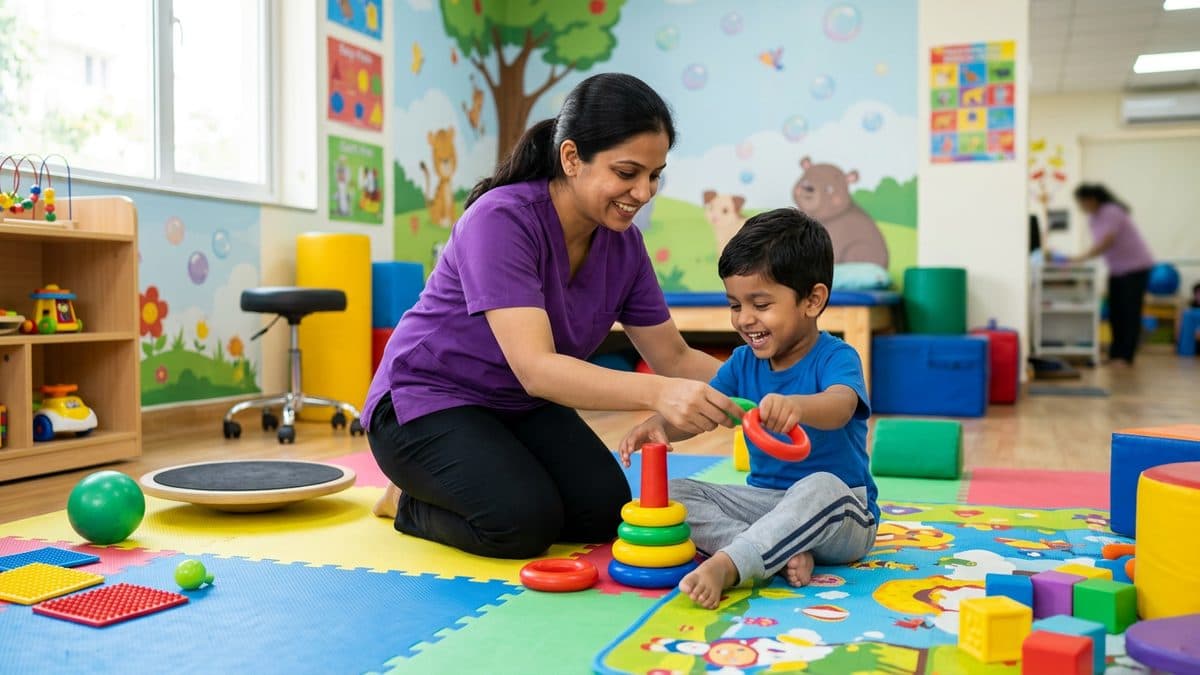
Why Paediatric Physiotherapy Is Different
Children have different musculoskeletal, neurological, and psychological needs from adults. Their bones, tendons, and muscles are at different stages of development; their nervous systems have much greater plasticity; and their engagement with therapy depends on making it fun and meaningful.
Our paediatric physiotherapy approach is child-centred, play-based where appropriate, and always involves parents/caregivers as active participants in the rehabilitation process.
Conditions We Treat in Children
Developmental Delays: Delayed motor milestones — late rolling, sitting, standing, walking. We assess whether delays are within normal variation or require intervention.
Cerebral Palsy: In-depth neurological rehabilitation (see our dedicated CP page). Torticollis: Tight neck muscles causing the head to tilt to one side.
Responds excellently to early physiotherapy. Developmental Coordination Disorder (DCD): Children who are 'clumsy' — difficulty with ball skills, writing, balance.
Flat Feet (Pes Planus): Assessment of whether flat feet are symptomatic and require treatment. Growing Pains / Osgood-Schlatter: knee pain treatment at the growth plate during adolescent growth spurts.
Scoliosis: Spinal curve monitoring and physiotherapy-specific scoliosis exercise (PSSE). Sports Injuries in Children: Growth plate injuries, overuse injuries in young athletes.
Our Paediatric Approach
Play-based therapy for young children. Goal-directed, age-appropriate activities. Regular goal-setting and progress review with families. School liaison where appropriate. Parent education and home exercise programmes that fit into family routines.
Paediatric Physiotherapy in Faridabad
At Realign Rehab Clinic, NIT-5, Faridabad, we create a welcoming, child-friendly environment. Book your child's assessment today.
Why Children Need Physiotherapy: Developmental Context
Children are not small adults — their musculoskeletal system is still developing, their movement patterns are being established, and their responses to physiotherapy differ clearly from adult approaches. Paediatric physiotherapy addresses conditions affecting movement, development, and physical function from birth through adolescence.
At Realign Rehab Clinic in Faridabad, Dr. Vaishali Suri provides child-friendly, family-centred physiotherapy for a wide range of paediatric conditions.
Common Paediatric Conditions Treated at Realign Clinic Faridabad
- Cerebral palsy: See our thorough CP physiotherapy guide
- Developmental delay: Children who are late reaching motor milestones (rolling, sitting, standing, walking) benefit from early physiotherapy to address underlying movement limitations
- Flat feet (pes planus): Painful flat feet in children — intrinsic foot strengthening, appropriate footwear, and orthotic support
- Scoliosis in adolescents: Physiotherapy-specific scoliosis exercises (PSSE — Schroth method) shown to reduce curve progression in mild-moderate adolescent idiopathic scoliosis
- Juvenile idiopathic arthritis (JIA): Hydrotherapy, range of motion, and appropriate strengthening during remission
- Coordination difficulties (DCD): Children with developmental coordination disorder benefit from task-specific motor practice and sensorimotor training
- Sports injuries in young athletes: Cricket, kabaddi, football, and swimming injuries in children require age-appropriate rehabilitation
- Erb's palsy / brachial plexus birth injury: Early passive and active range of motion training to maximise arm function
Frequently Asked Questions — Paediatric Physiotherapy
Q: My 2-year-old is not walking yet — do they need physiotherapy?
Typically, children walk independently by 18 months. A 2-year-old not walking warrants physiotherapy assessment to identify any developmental, neurological, or musculoskeletal reason for the delay.
Early intervention is noticeably more effective than a wait-and-see approach when motor delay is identified.
Q: Can scoliosis be treated without surgery in teenagers?
For mild to moderate adolescent idiopathic scoliosis (Cobb angle less than 40°), physiotherapy-specific scoliosis exercises (particularly the Schroth method) have strong evidence for reducing curve progression during the growth spurt. Surgery is considered for curves above 40–50° that continue to progress.
Starting physiotherapy early in adolescence provides the greatest benefit.
Q: Does Realign Clinic provide paediatric physiotherapy home visits in Faridabad?
Home visits for paediatric physiotherapy patients are available across Faridabad. Home visits are especially effective for young children who are most comfortable in familiar environments and for CP and neurological patients requiring daily carryover programmes.
Call +91 9818185589.
Book Paediatric Physiotherapy in Faridabad
Call +91 9818185589. Realign Rehab Clinic, NIT-5, Faridabad. Family-centred paediatric physiotherapy. Also see: paediatric physiotherapy services, paediatric conditions, cerebral palsy guide.
References
- Novak I et al. (2020). State of the evidence traffic lights 2019 for interventions in cerebral palsy. Current Neurology and Neuroscience Reports.
- Schreiber S et al. (2016). Effectiveness of Schroth exercises for AIS. Pediatrics, 135(5):e1329–e1336.
Content author: Dr. Vaishali Suri (P.T.), MPT (Sports Medicine), BPT, MIAP, MIAP.