
 Dr. Vaishali Suri (P.T.)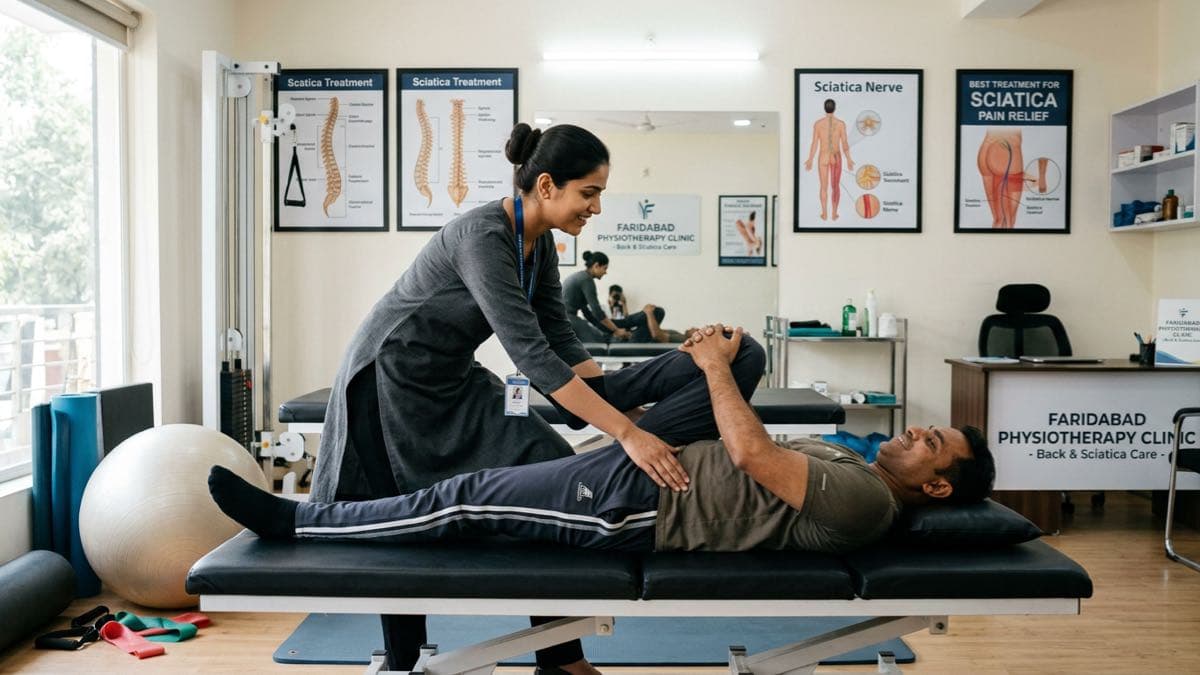
Understanding Sciatica
Sciatica refers to pain that travels along the sciatic nerve — from the lower back through the buttock, down the back of the thigh, and into the leg and foot. It is caused by irritation or compression of the sciatic nerve, most commonly by a herniated lumbar disc, lumbar spinal stenosis, or piriformis syndrome.
In Faridabad, sciatica is one of the most common presentations we see at Realign Rehab Clinic.
Symptoms
Classic sciatica presents as: sharp, shooting, burning, or electric-shock pain radiating from the lower back into the buttock and leg; numbness or tingling in the leg or foot; weakness in the leg or foot (in more severe cases); and pain that worsens with sitting, bending forward, or coughing/sneezing.
Physiotherapy Treatment for Sciatica
Neural Mobilisation (Nerve Flossing)
Neural mobilisation techniques gently move the sciatic nerve through its surrounding tissues, reducing neural tension and adhesions. These techniques are highly effective for sciatica caused by nerve irritation rather than severe compression.
McKenzie Method
Directional preference exercises (usually lumbar extension for disc-related sciatica) can rapidly centralise pain — moving pain from the leg back to the lower back — and accelerate recovery. We assess each patient's directional preference and prescribe appropriate exercises.
Lumbar Traction
Mechanical traction gently distracts the lumbar vertebrae, reducing disc pressure and widening the intervertebral foramen to relieve nerve compression. Effective for disc-related sciatica.
Core Stabilisation
Strengthening the deep spinal stabilisers (multifidus, transversus abdominis) reduces recurrent disc stress that perpetuates sciatica. This is essential for long-term recovery and prevention of recurrence.
Electrotherapy
IFT, TENS, and ultrasound therapy provide pain relief that enables active rehabilitation. Laser therapy can also reduce sciatic nerve inflammation.
When to Seek Urgent Care
Seek immediate medical attention for sciatica with: bowel or bladder dysfunction, saddle anaesthesia (numbness in the groin/inner thighs), or rapidly progressive leg weakness — these may indicate cauda equina syndrome requiring emergency surgery.
Sciatica Treatment in Faridabad
Understanding Sciatica Leg Pain: Dermatome Maps and What They Mean
Sciatica leg pain follows specific nerve distribution patterns called dermatomes. Understanding which nerve root is affected helps target physiotherapy treatment precisely:
- L4 nerve root: Pain down the inner leg to the inner foot. Weakness in knee extension. Reduced knee reflex.
- L5 nerve root (most common): Pain down the outer thigh, outer calf, and top of the foot. Weakness in big toe extension (extensor hallucis longus). No reflex change.
- S1 nerve root: Pain down the back of the thigh and calf to the sole and little toe. Weakness in foot plantar flexion (standing on tiptoe). Reduced ankle reflex.
Neural Tension Tests: How Sciatica Is Diagnosed Clinically
At Realign Rehab Clinic Faridabad, Dr. Vaishali Suri uses validated neural tension tests to confirm sciatic nerve involvement and assess its severity:
- Straight Leg Raise (SLR) test: Positive when lifting the straight leg reproduces leg pain below the knee before 70°. High sensitivity for disc-related sciatica.
- Slump test: More sensitive than SLR for detecting neural tension throughout the sciatic pathway. Positive when spinal flexion with neck flexion reproduces leg pain, relieved by neck extension.
- FAIR test: For piriformis syndrome — hip flexion, adduction, internal rotation compresses the piriformis against the sciatic nerve.
Neural Mobilisation: How It Relieves Sciatica Leg Pain
Neural mobilisation (nerve flossing or nerve gliding) techniques restore the sciatic nerve's ability to slide freely through its neural canal. When the nerve is adhered or under tension, it transmits pain more sensitively.
Neural mobilisation reduces this neurodynamic tension through gentle oscillatory movements that create a "flossing" motion of the nerve through its surrounding tissues.
Sciatica at Home vs Sciatica Requiring Urgent Medical Attention
Seek immediate medical attention (possible cauda equina syndrome) if you have:
- Bowel or bladder dysfunction (incontinence or retention)
- Saddle anaesthesia (numbness in the inner thighs, groin, and perineum)
- Bilateral leg weakness or paralysis
- Rapidly progressive neurological deficit
These symptoms represent a medical emergency. Contact emergency services or go directly to the nearest hospital.
All other sciatica presentations — even severe leg pain — can begin physiotherapy management without delay.
Sciatica Leg Pain: Frequently Asked Questions
Q: How do I know if my leg pain is sciatica or something else?
True sciatica follows the sciatic nerve pathway: buttock → back of thigh → outer or back of calf → foot. It typically affects one leg, worsens with sitting or coughing (increased disc pressure), and may be accompanied by numbness, tingling, or weakness.
Leg pain that is localised, bilateral, or follows a different pattern may have a different cause. A physiotherapy assessment at Realign Clinic Faridabad will differentiate sciatica from other causes of leg pain.
Q: How long does sciatica leg pain last with physiotherapy?
The key is early intervention — sciatica treated promptly with physiotherapy resolves significantly faster than cases managed with rest or pain medications alone.
Q: Does sciatica leg pain mean I need surgery?
Surgery (microdiscectomy) is reserved for cauda equina syndrome (emergency), severe or progressive neurological deficit, or failure to improve after 6–12 weeks of in-depth physiotherapy. At Realign Clinic, we treat sciatica with excellent outcomes using McKenzie therapy, neural mobilisation, and core stabilisation — without surgery in most patients.
Book Sciatica Treatment in Faridabad
Call +91 9818185589 or visit realign.clinic/contact . Realign Rehab Clinic, NIT-5, Faridabad.
Expert back pain treatment and sciatica rehabilitation. Home visits available across Faridabad for patients who find sitting painful.
Also see our full sciatica pain relief guide .
References
- Neto T et al. (2019). Effects of neural mobilisation on pain and disability in patients with low back-related leg pain. JOSPT, 49(8):588–597.
- Koes BW et al. (2007). Diagnosis and treatment of sciatica. BMJ, 334(7607):1313–1317.
- Deyo RA et al. (2012). Overtreating chronic back pain: time to back off? J Am Board Fam Med, 22(1):62–68.
Content author: Dr. Vaishali Suri (P.T.), MPT (Sports Medicine), BPT, MIAP, MIAP.
Related Articles: Sciatica Pain Relief: Best Physiotherapy Exercises & Treatment in Faridabad | Thoracic (Mid-Back) Pain Treatment in Faridabad: Physiotherapy Solutions | Sacroiliac Joint Pain Treatment in Faridabad: Physiotherapy for SI Joint | Wrist Pain from Keyboard and Mouse Use in Faridabad: Physiotherapy Solutions
Related Conditions: Wrist Pain Treatment | Postpartum Back Pain Relief | Urinary Incontinence Treatment
Related Services: Neck Pain Therapy | Wrist & Hand Therapy