 Dr. Vaishali Suri (P.T.)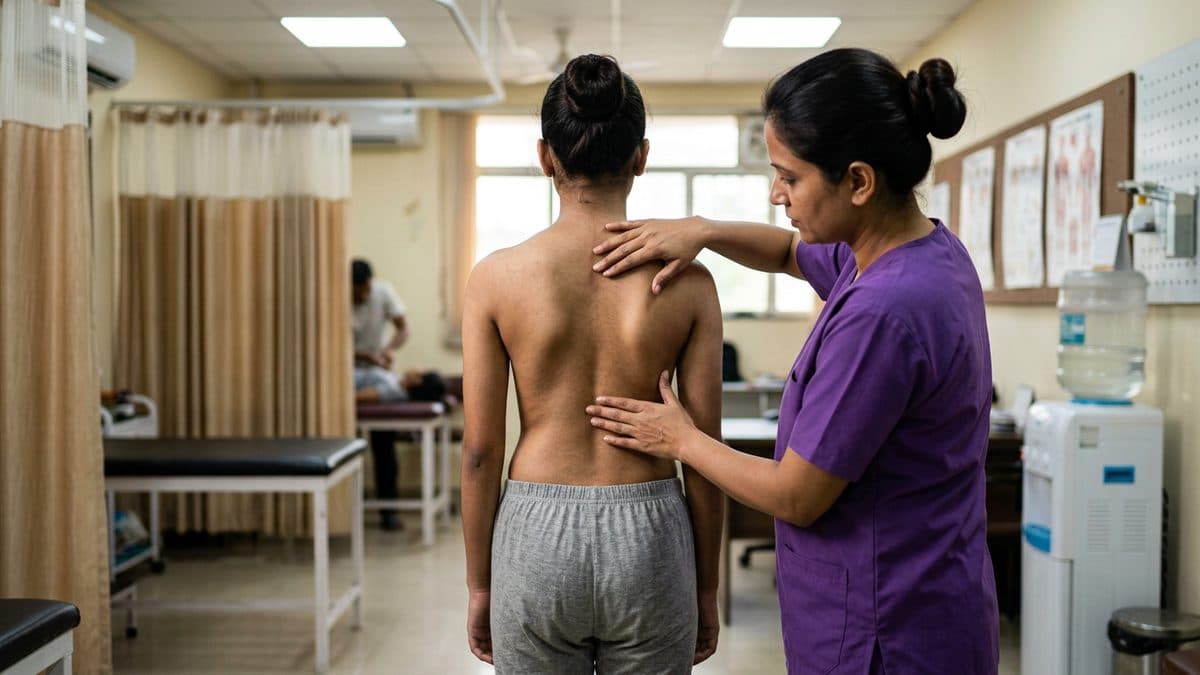
Scoliosis: Physiotherapy Treatment in Faridabad
While significant curves (Cobb angle >50°) may require surgical intervention, the majority of scoliosis cases are manageable with physiotherapy, bracing, and monitoring. The SEAS (Scientific Exercise Approach to Scoliosis) and Schroth Method are the most evidence-based physiotherapy approaches.
At Realign Rehab Clinic , NIT-5, Faridabad, our expert physiotherapists provide personalised, evidence-based care. We serve patients from NIT, Green Field Colony, Ballabhgarh, Sector 21–82, and across Faridabad.
Book: +91 9818185589 .
Causes and Risk Factors
- Adolescent idiopathic scoliosis (AIS): most common form, onset during puberty growth spurt
- Degenerative scoliosis: disc degeneration and asymmetric vertebral collapse in adults over 50
- Congenital scoliosis: vertebral malformation present from birth
- Neuromuscular scoliosis: secondary to cerebral palsy, muscular dystrophy, or spinal cord injury
- Functional scoliosis: non-structural, caused by leg length discrepancy or hip pathology
Signs and Symptoms
- Visible lateral curve in the spine — noticed during school screening or routine check
- One shoulder, hip, or scapula higher than the other
- Rib hump on forward bending (Adam's forward bend test)
- Back pain in adults with degenerative scoliosis
- Reduced trunk height and waistline asymmetry
- In severe cases: reduced lung capacity and heart function
Physiotherapy Treatment at Realign Rehab, Faridabad
- Schroth Method: three-dimensional breathing and posture correction specific to curve pattern
- SEAS (Scientific Exercise Approach to Scoliosis): active self-correction and stabilisation
- Core and trunk stabilisation programme for scoliosis-specific muscle imbalances
- Flexibility exercises for the concave side; strengthening for the convex side
- Bracing guidance and physiotherapy during brace use for adolescents
- Proprioceptive training: body awareness and self-correction exercises
- Pain management for degenerative adult scoliosis: manual therapy and electrotherapy
- Breathing exercises to maximise thoracic expansion and lung function
Frequently Asked Questions
Does physiotherapy fix scoliosis?
Physiotherapy cannot reverse established structural scoliosis. However, it can prevent curve progression, reduce pain, improve posture and function, and in some cases reduce Cobb angle modestly in adolescents during the growth phase.
What is the Schroth Method for scoliosis?
The Schroth Method is a physiotherapy approach that uses three-dimensional breathing and active self-correction exercises specific to the individual's curve pattern. It is the most evidence-based physiotherapy technique for scoliosis.
At what Cobb angle is surgery recommended?
Surgery (spinal fusion) is typically considered for curves over 45–50° that are progressing, particularly in adolescents who are still growing. Curves under 45° are managed with physiotherapy and bracing.
Can scoliosis cause back pain?
Yes, particularly in adults with degenerative scoliosis. Adolescent idiopathic scoliosis is less consistently painful, but as the curve progresses or with ageing changes, back pain becomes more common.
Does scoliosis physiotherapy work for adults?
Yes — adult scoliosis physiotherapy focuses on pain management, functional improvement, and preventing further curve progression. The Schroth-based approach is effective at all ages.
Book Your Consultation
Start your recovery today — contact Realign Rehab Clinic:
- 📍 NIT-5, Faridabad (near Green Field Colony, Ballabhgarh Road)
- 📞 +91 9818185589
- 🕑 Mon–Sat: 8 AM–8 PM