 Dr. Vaishali Suri (P.T.)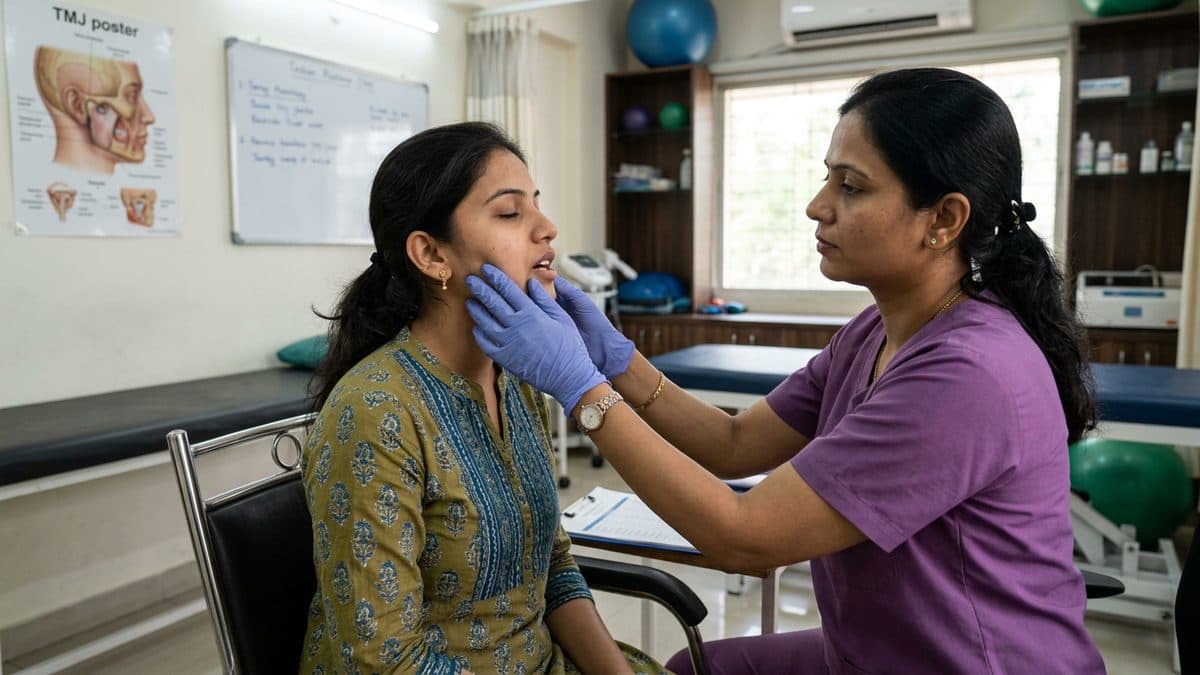
TMJ Disorders: Physiotherapy Treatment in Faridabad
Temporomandibular joint (TMJ) disorders affect the jaw joint and associated muscles, causing pain, clicking, and restricted mouth opening. In Faridabad, where desk work, stress, and smartphone use are endemic, TMJ disorders are increasingly common — driven by teeth grinding (bruxism), jaw clenching, and forward head posture.
Physiotherapy is highly effective for TMJ disorders and often avoids the need for dental splints or surgical intervention.
At Realign Rehab Clinic, NIT-5, Faridabad, our expert physiotherapists provide personalised, evidence-based care. Serving NIT, Green Field Colony, Ballabhgarh, Sector 21–82, and across Faridabad. Contact us: +91 9818185589.
Causes and Risk Factors
- Bruxism: nocturnal teeth grinding from stress or sleep disorders
- Jaw clenching: habitual daytime clenching from occupational stress
- Forward head posture: alters mandibular position, increasing TMJ loading
- Disc displacement: anterior displacement of the articular disc (clicking)
- Trauma: direct blow to the jaw or whiplash affecting TMJ mechanics
- Dental malocclusion: bite problems creating unequal jaw loading
- Hypermobility: generalised joint laxity causing TMJ over-range
Signs and Symptoms
- Jaw pain: pre-auricular (in front of the ear) or diffuse facial pain
- Clicking or popping during mouth opening or closing
- Limited mouth opening (<40 mm inter-incisal distance)
- Morning jaw pain and stiffness (from nocturnal bruxism)
- Headache: temporal and frontal from masseter and temporalis muscle tension
- Ear fullness, tinnitus, or dizziness from TMJ-related inner ear effects
- Neck pain and upper cervical stiffness (TMJ and cervical spine are closely linked)
Physiotherapy Treatment at Realign Rehab, Faridabad
- Manual therapy: TMJ mobilisation, distraction, and intra-oral techniques
- Masseter and temporalis soft tissue release and trigger point treatment
- Jaw exercises: controlled opening, lateral excursion, and resistance training
- Postural correction: addressing forward head posture that alters jaw mechanics
- Bruxism management: relaxation techniques and awareness training
- Night guard coordination with dentist for significant nocturnal bruxism
- Upper cervical physiotherapy: C0–C2 mobilisation for cervical contributions
- Patient education: jaw rest position, dietary modification, and habit reversal
Frequently Asked Questions
Can physiotherapy treat TMJ pain?
Yes — physiotherapy is highly effective for most TMJ disorders. Manual therapy, jaw exercises, and postural correction resolve symptoms in the majority of patients without the need for dental splints or surgery.
What causes clicking in the jaw?
Clicking is usually caused by anterior displacement of the TMJ articular disc. When the disc slips forward and then reduces on mouth opening, it produces a click.
Early treatment prevents disc displacement from becoming permanent (closed lock).
Is my neck pain related to my jaw pain?
Often yes — the upper cervical spine and TMJ are closely related anatomically and neurologically. Neck pain and TMJ disorders frequently coexist and influence each other.
Treating both simultaneously produces better outcomes than treating either in isolation.
Should I see a dentist or physiotherapist for TMJ?
Both have roles — dentists manage bite issues and fabricate night guards; physiotherapists treat the joint and muscle dysfunction. For most TMJ disorders, physiotherapy should be the first-line treatment, with dental review for significant malocclusion or bruxism.
How long does TMJ physiotherapy take?
Most patients see measurable improvement in 6–10 sessions over 6–8 weeks. Chronic or severe cases may take 3–4 months. Home exercises and habit correction are essential for preventing recurrence.
Book Your Consultation
Contact Realign Rehab Clinic today:
- 📍 NIT-5, Faridabad (near Green Field Colony, Ballabhgarh Road)
- 📞 +91 9818185589
- 🕑 Mon–Sat: 8 AM–8 PM