 Dr. Vaishali Suri (P.T.)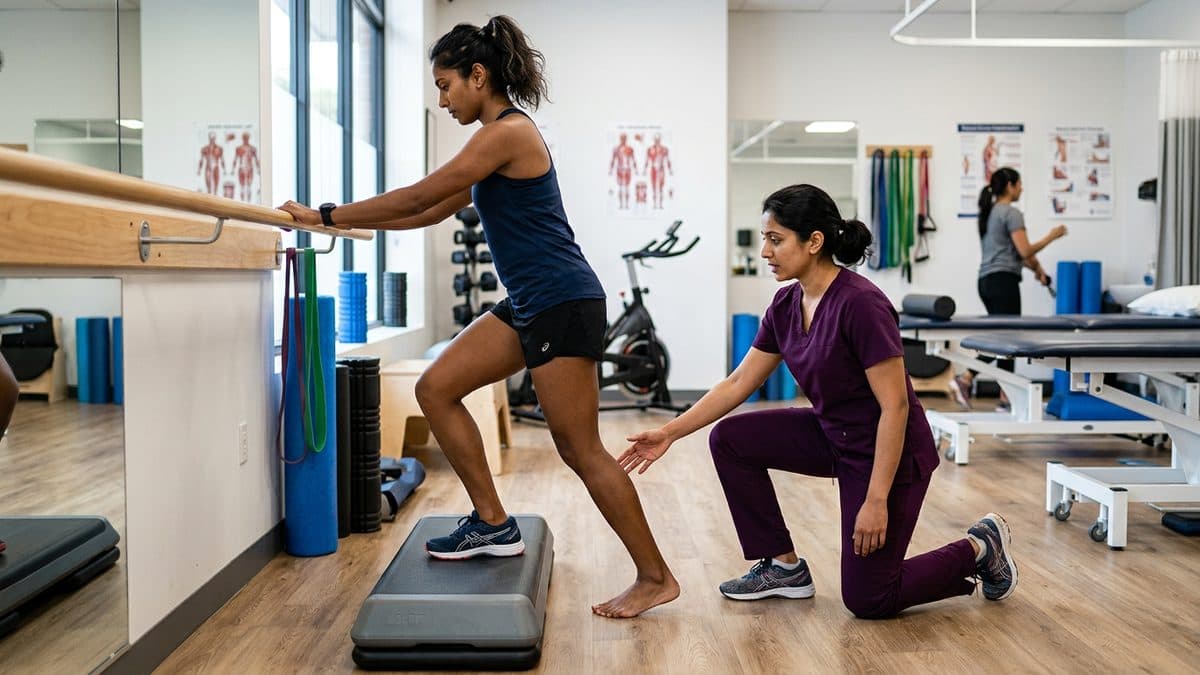
What Is Achilles Tendinopathy?
Achilles tendinopathy is a painful, degenerative condition affecting the Achilles tendon — the strongest tendon in the body connecting the calf muscles (gastrocnemius and soleus) to the heel bone (calcaneus). It is an extremely common overuse injury in runners, badminton players, and physically active adults, characterised by pain, stiffness, and reduced function.
The Achilles is not "inflamed" in the traditional sense — it is a failed healing response in the tendon collagen. This distinction matters because anti-inflammatory treatments (NSAIDs, cortisone) do not resolve the underlying problem.
Types of Achilles Tendinopathy
- Mid-portion Achilles tendinopathy (most common): Pain and swelling 2–6 cm above the heel. The avascular (poor blood supply) zone most vulnerable to overload. Responds well to eccentric loading.
- Insertional Achilles tendinopathy: Pain directly at the heel bone insertion. Associated with a Haglund deformity (bony prominence). Requires modified eccentric exercise technique (not over the edge of a step). Slower to respond to treatment.
Causes and Risk Factors
- Sudden increase in running volume or intensity
- Hard training surfaces
- Inadequate rest between sessions
- Tight calf muscles (reduced Achilles tendon compliance)
- Overpronation (excessive inward foot roll increases Achilles loading)
- Older age (tendons become stiffer and less elastic after 40)
- Previous Achilles tendinopathy or injury
- Fluoroquinolone antibiotics (ciprofloxacin) — increases tendon rupture risk
Symptoms
- Pain and stiffness at the back of the heel or just above it
- Morning stiffness that warms up with activity — classic "warm-up phenomenon"
- Pain and stiffness after prolonged inactivity (sitting, waking)
- Swelling and thickening of the tendon visible or palpable
- Pain on direct palpation of the tendon
- Positive Royal London Hospital test (tenderness reduces with passive dorsiflexion)
Achilles Tendinopathy Treatment at Realign Clinic Faridabad
The Alfredson Eccentric Calf Raise Protocol
Stand on a step on the toes of the injured foot. Rise up with both feet, then lower slowly (3 seconds) on the injured foot only.
Perform with both knee straight (gastrocnemius) and knee bent (soleus). 3 sets of 15, twice daily, 7 days a week for 12 weeks. Continue through mild discomfort — mild pain during the exercise is acceptable and does not indicate tissue damage.
This is the most evidence-based treatment for mid-portion Achilles tendinopathy.
Load Management
Low-impact alternatives: cycling, swimming, aquatic jogging. Gradual return to running using a run-walk progression once pain level is ≤3/10 during and after exercise.
Shockwave Therapy for Refractory Cases
Extracorporeal shockwave therapy (ESWT) provides additional benefit for chronic Achilles tendinopathy that has not responded to 3+ months of eccentric loading. We offer shockwave therapy at Realign Clinic Faridabad.
See our shockwave therapy guide .
Achilles Tendinopathy Home Exercises
Eccentric Heel Drop (Alfredson)
As described above. 3 × 15 reps, twice daily. The cornerstone exercise.
Begin Week 1 and maintain for 12 weeks minimum. Use a weighted backpack to progress load as symptoms improve.
Calf Stretch
Standing lunge stretch — hold 30 seconds, 3 times. Repeat with a bent back knee for soleus.
Avoid aggressive stretching in the acute phase — once the Alfredson protocol is underway (Week 3+), gentle calf stretching is appropriate.
Frequently Asked Questions — Achilles Tendinopathy
Q: How long does Achilles tendinopathy take to heal?
With the Alfredson Protocol: measurable improvement in 8–12 weeks, full resolution in 3–6 months. Insertional tendinopathy takes longer — 6–12 months is common.
Chronic tendinopathy (more than 3 months) responds more slowly. Key: consistency with the eccentric loading programme 7 days per week is essential — missing sessions noticeably slows progress.
Q: Should I stop running with Achilles tendinopathy?
Not necessarily completely. Continue running if pain is ≤3/10 during running and the tendon is not significantly swollen or painful the following morning.
Reduce volume, eliminate speed work and hills, and keep you are completing the Alfredson protocol daily. Complete rest from running is counterproductive — it further weakens the tendon and delays recovery.
Q: Will my Achilles tendon rupture if I continue running?
Tendinopathy and tendon rupture are related but not the same condition. Tendinopathy itself does not directly cause rupture.
However, playing through severe tendinopathy pain with inadequate rehabilitation increases the risk. Fluoroquinolone antibiotics (ciprofloxacin) measurably increase rupture risk and should be disclosed to your physiotherapist.
Most tendinopathy patients can continue modified activity safely.
Book Achilles Tendinopathy Treatment in Faridabad
Call +91 9818185589. Realign Rehab Clinic, NIT-5, Faridabad. Expert sports injury physiotherapy — also see our plantar fasciitis guide for heel pain treatment in Faridabad.
References
- Alfredson H et al. (1998). Heavy-load eccentric calf muscle training for the treatment of chronic Achilles tendinosis. AJSM, 26(3):360–366.
- Beyer R et al. (2015). Heavy slow resistance versus Alfredson's protocol as treatment for Achilles tendinopathy. AJSM, 43(7):1704–1711.
- Furia JP. (2008). High-energy ESWT for Achilles tendinopathy. JOSPT, 38(2):68–73.
Content author: Dr. Vaishali Suri (P.T.), MPT (Sports Medicine), BPT, MIAP, MIAP.
Related Articles: Shockwave Therapy for Achilles Tendinopathy in Faridabad | Wrist Tendinopathy: Physiotherapy Treatment in Faridabad | Tennis Elbow Treatment Guide: Physiotherapy in Faridabad | Slip Disc Treatment in Faridabad: Can Physiotherapy Avoid Surgery?
Related Conditions: Rotator Cuff Tendinopathy | Wrist Pain Treatment | Urinary Incontinence Treatment