
 Dr. Vaishali Suri (P.T.)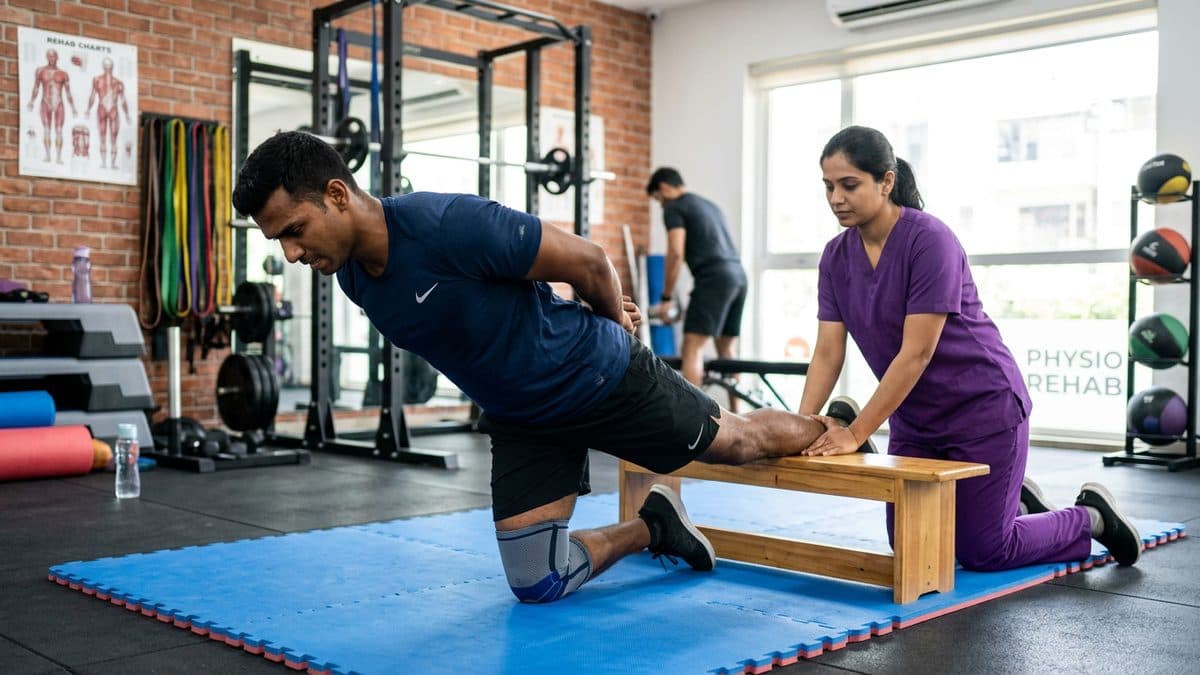
What Is a Hamstring Strain?
A hamstring strain is a tear in one or more of the three hamstring muscles — biceps femoris, semimembranosus, and semitendinosus — at the back of the thigh. It is the most common injury in running sports and one of the highest-recurrence injuries in cricket, football, and athletics.
Grades of Hamstring Strain
- Grade 1 (Mild): Micro-tears, minimal functional loss. Mild pain and tightness. Return to sport: 1–2 weeks with physiotherapy.
- Grade 2 (Moderate): Partial muscle tear, often felt as a sudden "pull" during sprinting. Bruising, tenderness, limp. Return: 4–8 weeks.
- Grade 3 (Severe): Complete muscle tear or proximal avulsion (hamstring pulled off the ischial tuberosity). Significant bruising down the thigh, inability to run. Return: 3–6 months; proximal avulsions may require surgery.
How Hamstring Strains Happen
Hamstring strains typically occur at the moment of peak speed during sprinting — specifically during the late swing phase when the hamstring decelerates the rapidly extending knee. Common causes include:
- Inadequate warm-up before sprinting or explosive activity
- Hamstring-to-quadriceps strength imbalance (hamstrings weaker than quads)
- Fatigue in late-game situations
- Previous hamstring injury (the single strongest predictor of re-injury)
- Poor hip mobility forcing extra hamstring load
- Sudden acceleration changes in cricket, kabaddi, or football
Symptoms
- Sudden sharp pain at the back of the thigh during running or kicking
- Bruising appearing 24–48 hours after injury (Grade 2/3)
- Tenderness on palpation of the hamstring muscle or ischial tuberosity
- Weakness and pain with resisted knee flexion
- Positive straight-leg raise restriction due to hamstring tightness
Hamstring Rehabilitation at Realign Clinic Faridabad
Phase 1: Acute Care (Days 0–3)
POLICE protocol: protected weight-bearing, ice 15–20 minutes every 2 hours, compression bandage, elevation. Avoid heat and alcohol.
Gentle pain-free isometric hamstring contractions to maintain neural drive without stressing healing tissue. MRI is recommended for Grade 2/3 strains or proximal injuries to rule out tendon avulsion.
Phase 2: Early Loading — L-Protocol (Days 3–14)
The Askling L-Protocol uses three specific exercises — Supine Stretch, Extender, and Diver — performed with slow, controlled lengthening of the hamstring under progressive load. This approach targets the musculotendinous junction where most strains occur, promoting most effective collagen fibre alignment.
Pain should be 0–3/10 during exercises.
Phase 3: Progressive Strengthening (Weeks 2–6)
Nordic Hamstring Exercise (NHE), Romanian deadlifts, single-leg bridges, and Swiss ball hamstring curls form the core of this phase. Eccentric loading under progressive resistance is the most evidence-based intervention for hamstring rehabilitation and prevention.
Hip flexor and glute strengthening addresses the kinetic chain drivers of hamstring overload.
Phase 4: Running Progression and Return to Sport (Weeks 4–8)
Home Exercises for Hamstring Strains
Prone Knee Flexion (Isometric)
Lying face down, press the heel gently into the floor or bed as if trying to bend the knee — without actually moving. Hold 10 seconds, 3 sets of 10.
Safe from Day 2–3 post-injury. Maintains muscle activation without stressing the tear.
Romanian Deadlift (Bodyweight)
Stand on both feet, hinge forward at the hips with a neutral spine, lowering hands toward the floor until you feel hamstring stretch. Hold 2 seconds, return. 3 sets of 12.
Progress to single-leg version and then with a weight. Start Week 2.
Nordic Hamstring Curl (Late Phase)
Kneel with feet anchored under a sofa leg or partner's hands. Lower your body toward the floor as slowly as possible using hamstring eccentric control.
Catch yourself with hands. Return to start. 3 sets of 8.
The single most evidence-based hamstring exercise for injury prevention and rehabilitation. Start Week 4–6.
Frequently Asked Questions — Hamstring Strains
Q: How long does a hamstring strain take to heal in Faridabad?
Grade 1: 1–2 weeks. Grade 2: 4–8 weeks.
Grade 3 or proximal avulsion: 3–6 months. These timelines are shortened noticeably with evidence-based physiotherapy including early loading protocols.
At Realign Clinic Faridabad, we use the Askling L-Protocol for the best recovery timelines.
Q: Should I stretch my hamstring after a strain?
Not aggressively in the first 2–3 days. Aggressive static stretching immediately after a hamstring tear risks further fibre damage.
We use gentle, controlled lengthening through specific therapeutic exercises (not static stretching) from Day 3. Static stretching is reintroduced after 2 weeks once the acute tear has stabilised.
Q: Can cricketers and footballers prevent hamstring strains?
For cricketers, addressing poor hip mobility, quadriceps dominance, and inadequate warm-up protocols reduces hamstring strain risk. We offer sports injury prevention programmes at Realign Clinic for Faridabad sports teams.
Q: I had a hamstring strain last year and it keeps re-tearing — why?
At Realign Clinic, we use objective testing to confirm rehabilitation completion before clearing athletes for return to sport.
Book Hamstring Strain Physiotherapy in Faridabad
Call +91 9818185589 or visit realign.clinic/contact. Realign Rehab Clinic, NIT-5, Faridabad. Expert sports injury rehabilitation for cricketers, footballers, and athletes across Faridabad, Ballabhgarh, and Delhi NCR.
References
- Askling CM et al. (2013). Proximal hamstring strains of stretching type in different sports: injury situations, clinical and magnetic resonance imaging characteristics. AJSM, 41(6):1253–1259.
- van der Horst N et al. (2015). The preventive effect of the Nordic hamstring exercise on hamstring injuries in amateur soccer players. AJSM, 43(6):1316–1323.
- Orchard JW & Best TM. (2002). The management of muscle strain injuries: an early return versus the risk of recurrence. CJSM, 12(1):3–5.
Content author: Dr. Vaishali Suri (P.T.), MPT (Sports Medicine), BPT, MIAP, MIAP.
Related Articles: Repetitive Strain Injury (RSI) Treatment in Faridabad: Physiotherapy | Repetitive Strain Injuries for Office Workers in Faridabad: Prevention and Treatment | Hip Flexor Strain Treatment in Faridabad: Physiotherapy for Iliopsoas | Calf Strain Treatment in Faridabad: Physiotherapy for Gastrocnemius and Soleus
Related Conditions: Wrist Pain Treatment | Urinary Incontinence Treatment | Tennis Elbow Treatment
Related Services: Wrist & Hand Therapy | Taping & Bracing