 Dr. Vaishali Suri (P.T.)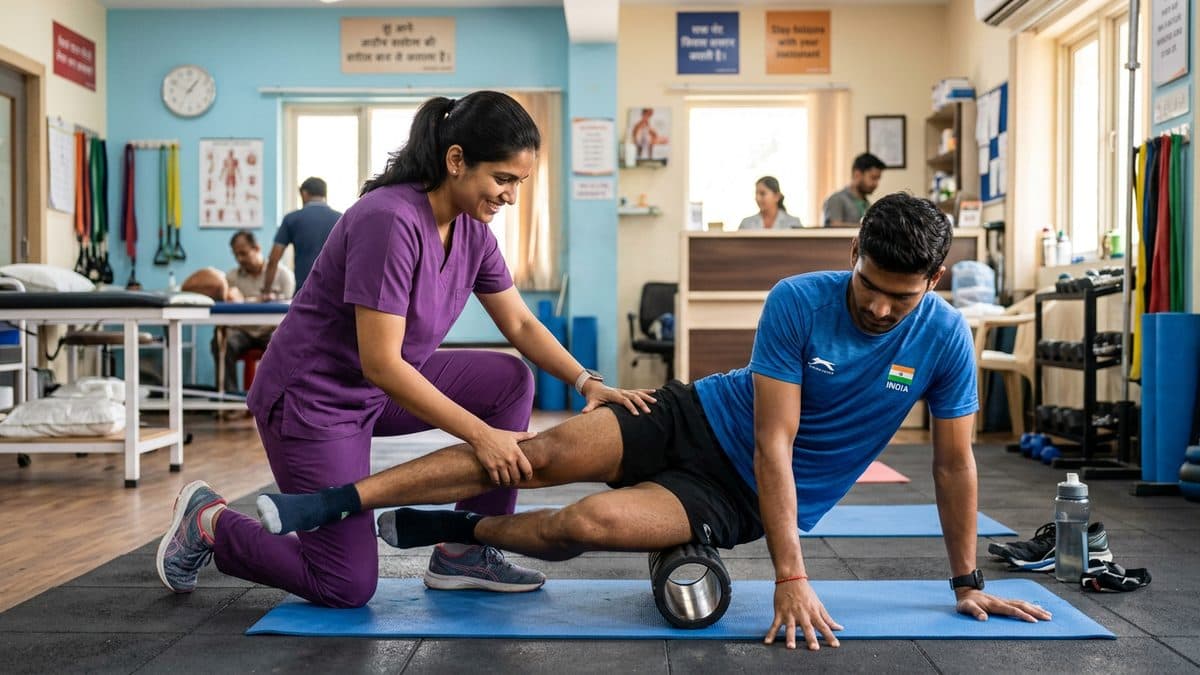
What Is IT Band Syndrome?
Iliotibial band syndrome (ITBS) is the most common cause of lateral knee pain in runners, cyclists, and endurance athletes. The iliotibial band is a thick strip of fascia running from the hip (iliac crest and tensor fasciae latae) down the outside of the thigh to the lateral knee.
ITBS occurs when the IT band repeatedly rubs against the lateral femoral epicondyle during repetitive knee flexion-extension — causing inflammation and sharp lateral knee pain. It affects runners across Faridabad and Delhi NCR, particularly those training on banked or uneven roads.
Why Does IT Band Syndrome Happen?
Despite its name, the IT band is not actually "tight" in the traditional sense — it cannot be significantly lengthened by stretching. Instead, ITBS is driven by poor hip biomechanics:
- Weak hip abductors (gluteus medius): The hip drops on the swing side (Trendelenburg gait), causing increased IT band tension
- Weak hip external rotators: The femur internally rotates during loading, increasing lateral knee compression
- Training load errors: Too much too soon — rapid mileage increases without adequate recovery
- Running gait issues: Overstriding, excessive crossover gait pattern
- Road camber: Running on banked roads in Faridabad and NH-48 consistently with the downhill leg creates asymmetric IT band loading
Symptoms of IT Band Syndrome
- Sharp or burning pain on the outside of the knee
- Pain typically begins 10–20 minutes into a run and worsens progressively
- Pain that disappears quickly after stopping running but returns on the next run
- Tenderness over the lateral femoral epicondyle (2 cm above the lateral joint line)
- Positive Ober test on physiotherapy assessment (tight TFL/IT band)
- No locking, clicking, or giving way (distinguishes from meniscal or ligament injury)
IT Band Syndrome Treatment at Realign Clinic Faridabad
Hip Strengthening Programme
The cornerstone of ITBS treatment. Gluteus medius exercises (clamshells, side-lying hip abduction, lateral band walks, single-leg squat with hip alignment feedback) reduce the hip drop that drives IT band tension. 3–4 sessions per week for 6–8 weeks produces clear improvement.
Running Gait Retraining
Video analysis provides objective feedback that helps runners understand and correct their mechanics.
Manual Therapy
Trigger point release for the TFL (tensor fasciae latae) and gluteus medius, hip joint mobilisation, and lateral knee soft tissue therapy provide pain relief and improve movement quality. We avoid aggressive IT band "stripping" — this is unnecessarily painful and poorly supported by evidence.
Load Management
IT Band Exercises to Do at Home
Clamshells
Lie on your side with knees bent at 45°. Keep feet together.
Lift the top knee upward like a clamshell, rotating the hip without rolling the pelvis. 3 sets of 20. Targets gluteus medius specifically.
Start Week 1.
Lateral Band Walk
Place a resistance band around your ankles. Walk sideways 20 steps each direction in a slight squat position, keeping feet hip-width. 3 sets each direction.
One of the most effective hip abductor exercises for ITBS prevention and rehabilitation.
Single-Leg Squat with Knee Alignment
Stand on the affected leg. Slowly squat down to 60° knee flexion, keeping the knee aligned over the second toe (no inward collapse). 3 sets of 12.
This functional exercise integrates hip, knee, and ankle alignment — essential for running rehabilitation.
Frequently Asked Questions — IT Band Syndrome
Q: Will foam rolling my IT band fix IT band syndrome?
Foam rolling the IT band is a common recommendation but has limited evidence for treating ITBS. The IT band is a thick fascial structure that cannot be significantly lengthened.
Short-term pain relief from rolling is useful, but it does not address the underlying hip weakness that drives ITBS. Foam rolling is fine for managing symptoms during rehabilitation, but hip strengthening is the treatment that resolves the condition.
Q: How long before I can run again after IT band syndrome?
Most runners return to full training in 6–10 weeks with proper physiotherapy.
Q: Is IT band syndrome serious? Do I need surgery?
Surgery (IT band bursectomy or lengthening) is only considered after 6+ months of failed in-depth physiotherapy, which is rare. Most patients improve noticeably within 4–6 weeks of proper rehabilitation.
Q: Can I cycle or swim while treating IT band syndrome?
Yes — both are generally well-tolerated by IT band syndrome patients. Swimming is often pain-free and maintains cardiovascular fitness during running reduction.
Cycling with seat height adjusted to avoid knee flexion below 30° can also be continued. We recommend these as cross-training options during ITBS rehabilitation at Realign Clinic Faridabad.
Book IT Band Syndrome Treatment in Faridabad
Call +91 9818185589. Realign Rehab Clinic, NIT-5, Faridabad. Expert physiotherapy for runners, cyclists, and endurance athletes. See also: knee pain treatment and sports physiotherapy in Faridabad.
References
- Fredericson M & Wolf C. (2005). Iliotibial band syndrome in runners: innovations in treatment. Sports Medicine, 35(5):451–459.
- Noehren B et al. (2011). ITBS: A case report of conservative management. Phys Ther, 91(3):429–436.
- Ellis R et al. (2007). Iliotibial band friction syndrome: a systematic review. Manual Therapy, 12(3):200–208.
Content author: Dr. Vaishali Suri (P.T.), MPT (Sports Medicine), BPT, MIAP, MIAP.
Related Articles: Piriformis Syndrome Treatment in Faridabad: Deep Buttock Pain Relief | Upper Crossed Syndrome Treatment in Faridabad: Fix Rounded Shoulders and Neck | Thoracic Outlet Syndrome Treatment in Faridabad: Arm Pain and Numbness | Lower Crossed Syndrome Treatment in Faridabad: Correct Pelvic Imbalance
Related Conditions: Carpal Tunnel Syndrome | Wrist Pain Treatment | Urinary Incontinence Treatment
Related Services: Resistance Band Training | Wrist & Hand Therapy