 Dr. Vaishali Suri (P.T.)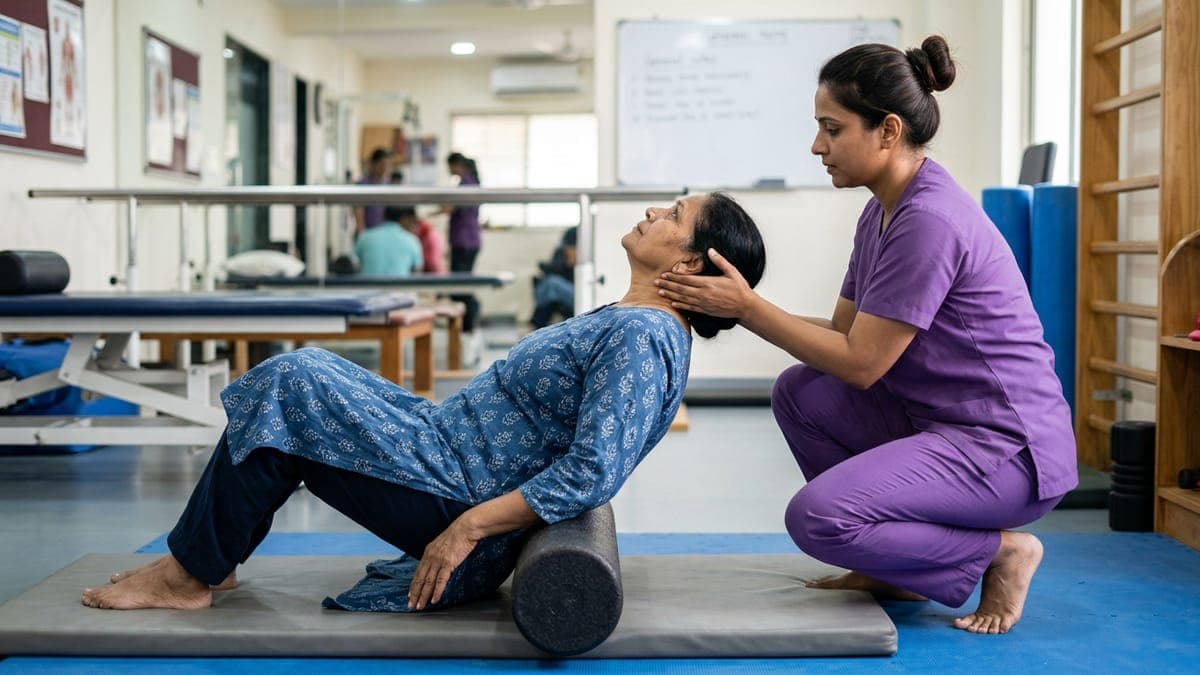
Postural Kyphosis: Physiotherapy to Correct Rounded Upper Back in Faridabad
Postural kyphosis — the excessive forward rounding of the upper back — is one of the most prevalent posture-related conditions in modern life. Long hours at desks, smartphones, and laptops have created an epidemic of thoracic hyperkyphosis, particularly among young adults and office workers in cities like Faridabad.
Left untreated, postural kyphosis leads to chronic neck and upper back pain, reduced lung capacity, shoulder impingement, and in the long term, structural vertebral changes.
At Realign Rehab Clinic , NIT-5, Faridabad, our expert physiotherapists provide personalised, evidence-based care. We serve patients from NIT, Green Field Colony, Ballabhgarh, Sector 21–82, and across Faridabad.
Book: +91 9818185589 .
Causes and Risk Factors
- Prolonged sitting in a slumped posture at desks, in cars, or on sofas
- Smartphone use with sustained downward neck flexion ('text neck')
- Weak thoracic extensors and deep cervical flexors failing to maintain upright posture
- Tight pectoralis minor and anterior chest muscles pulling shoulders forward
- Scheuermann's disease: structural kyphosis from vertebral wedging in adolescents
- Osteoporotic vertebral compression fractures in elderly women
- Body image issues causing deliberate slumping (particularly tall adolescents)
Signs and Symptoms
- Rounded upper back visible at rest and during daily activities
- Upper back, neck, and shoulder pain after prolonged sitting
- Forward head posture with chin protruding
- Chest tightness and restricted shoulder flexion
- Headaches from upper cervical compression
- Fatigue of the upper back muscles by mid-afternoon
- Reduced deep breathing capacity from thoracic restriction
Physiotherapy Treatment at Realign Rehab, Faridabad
- Thoracic spine joint mobilisation and manipulation to restore extension range
- Deep cervical flexor (longus colli) strengthening: chin tuck exercises
- Thoracic extensor and scapular retractor strengthening: rows, Y-W-T exercises
- Pectoral and anterior chest stretching to open the chest
- Postural taping and kinesiology taping for proprioceptive feedback
- Ergonomic workstation assessment: monitor height, chair support, and keyboard position
- Breathing retraining to maximise thoracic expansion
- Home exercise programme with regular postural breaks and movement reminders
Frequently Asked Questions
Can physiotherapy fix a rounded back?
Yes — postural kyphosis responds very well to physiotherapy, with most patients seeing clear improvement within 6–12 weeks. The combination of thoracic mobilisation, chest stretching, and back strengthening is highly effective.
How long does it take to correct posture?
Measurable improvement in posture is typically seen within 6–8 weeks of consistent physiotherapy. Maintaining the improvement requires ongoing exercise and postural habits — the correction is sustainable but requires practice.
Is kyphosis the same as scoliosis?
No — kyphosis is a forward curvature of the spine (roundback), while scoliosis is a side-to-side curvature. Both can be treated with physiotherapy, though the exercises are different.
What exercises help rounded back posture?
Thoracic extension over a foam roller, chin tucks, prone Y-W-T raises, rows, and pectoral stretching are the most effective. Avoid exercises that reinforce the forward posture (e.g., too much bench pressing without corresponding rows).
Can bad posture cause back and neck pain?
Yes — sustained thoracic kyphosis compresses the posterior thoracic facets, strains the paraspinal muscles, and increases the load on the cervical spine. Correcting posture almost always reduces associated neck and upper back pain.
Book Your Consultation
Start your recovery today — contact Realign Rehab Clinic:
- 📍 NIT-5, Faridabad (near Green Field Colony, Ballabhgarh Road)
- 📞 +91 9818185589
- 🕑 Mon–Sat: 8 AM–8 PM